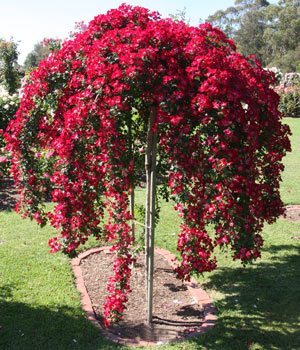
For a wonderful display of flowers and a rather dramatic look, weeping roses are forms that have a natural weeping habit.

In Australia some wonderful examples of weeping roses can be found in some of the rose gardens. In Melbourne the Victorian State Rose Garden at Werribee Park has some of the best.
Two of the better varieties are ‘Bloomfield Courage’ with attractive red flowers on long canes, and ‘Dortmund’ brilliant crimson flowers that last long through the season.
If you really want the true weeping look them ‘Bloomfield Courage’ pictured right is the one.
Grafted onto tall stems of robust rootstock usually at around 1.5 to 1.8m high they will require a permanent support as the weight of the growing top can put pressure on the graft. Shorter ‘patio weeping roses’ at around half that height are also available.
Weeping Rose Varieties
Some will be longer flowering than others, some have a better weeping habit, others better fragrance. It is a little difficult to get all of these qualities in one, so choose the variety that suits you best.
Best Weeping Rose Varieties
Here are some reliable and popular weeping roses suited to Australian gardens:
Pink and Light Colours
- Sea Foam — profuse double blooms with soft white-pink tones and excellent repeat flowering.
- New Dawn — an enduring favourite with pale pink petals and a strong fragrance.
- Apple Blossom — pastel pink clusters on an elegant, arching form.
- Crepescule is another that works well.
White and Cream
- Heideschnee — a vigorous repeat-flowering variety with crisp white blooms.
- Heidesommer – Is more of a creamy white with a light fragrance.
- Lamarque – with its white flowers with pale yellow centres, double flowers and fragrant.
- Alister Stella Grey — charming pale yellow buds opening to creamy-white flowers.
Red and Bold Tones
- Bloomfield Courage — rich scarlet-red blooms with strong growth habit.
- Dortmund — vibrant crimson flowers set against glossy green foliage.
- Red Cascade lives up to its name, clusters of red flowers and a repeat flowering type as well.
- Mainaufeuer is a bright red type.
- Scarlet Meidland with its double clusters of vivid red is another.
- Island Fire is a carpet rose available as a weeping standard.
- Red Pierre is another, excellent fragrance as well.
Tip: Choose varieties suited to your local climate and blooming season for the most consistent performance.
Growing and Caring for Weeping Roses
Light and Position
Plant in full sun — at least six hours daily — for maximum flowering and healthy foliage.
Soil and Water
- Use well-drained, humus-rich soil. If your soil is heavy clay, improve it with compost and coarse sand.
- Water deeply once or twice weekly during dry spells, aiming to keep the root zone consistently moist but not waterlogged.
Support and Structure
Weeping roses need strong support due to their grafted height and heavy flowering canopy.
- Use a sturdy stake or metal rose frame with a ring to prevent movement and graft strain.
- Tie canes loosely with soft ties to avoid damage as they grow.

Why Pruning Matters
Regular pruning isn’t just about looks. It also helps with overall plant health :
- Stimulates strong growth and repeat flowering.
- Improves air circulation to reduce fungal disease.
- Maintains a balanced crown that resists wind and heavy rain.
With proper pruning and support, weeping roses provide years of graceful colour and form, becoming a true focal point in any garden landscape.
How and When to Prune Weeping Roses
Pruning maintains shape, encourages new flowering wood, and prevents the canopy from becoming too dense or wind-damaged.
When to Prune
- Late winter to early spring: prune before new growth starts once frost danger has passed.
- After flowering: for single-flowering varieties, prune lightly as blooms fade.
- Avoid heavy pruning late in autumn, as new shoots may be damaged by early cold.
How to Prune Weeping Roses
- Remove dead, diseased or weak wood first to improve airflow and reduce fungal risk.
- Thin out crowded canes — remove about 25–30 % of the oldest branches at the base each year.
- Retain strong, arching canes to preserve the classic weeping shape.
- Trim ends that drag on the ground to keep canes free-hanging and prevent breakage.
For young weeping roses (first 2–3 years) — only prune lightly for shaping and health. Once established, switch to annual thinning and shaping for long-term balance.
The Difference Between Standard and Weeping Roses
The main difference is that you really do need a weeping rose support or ‘rose ring’. Pruning is also a little more ‘harsh’. Otherwise, weeping roses are treated the same as other Roses.
More Rose Varieties