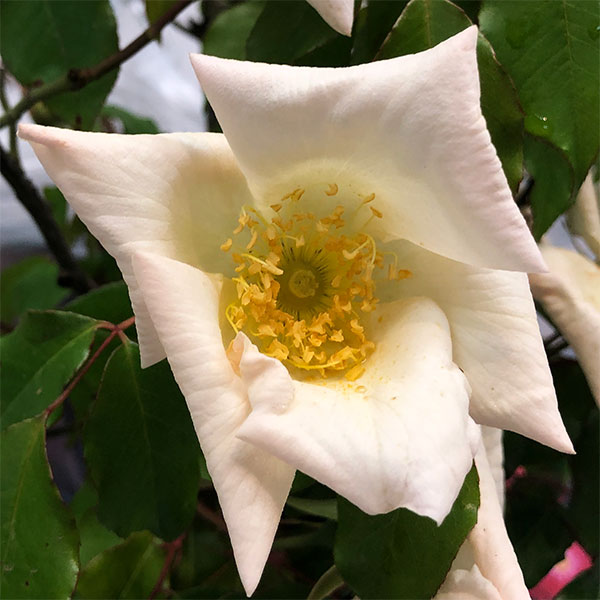
Rosa gigantea is a striking species of wild rose that naturally grows in the lower elevations of the Himalayan foothills.
Best described as a vigorous climber or rambler, this rose lives up to its name with massive blooms and impressive height.
The large, creamy white to pure white flowers are a standout feature, and under the right conditions, Rosa gigantea can soar to heights of over 15 metres (50 feet).
While not commonly cultivated, it holds a special place in rose history.
Alongside Rosa chinensis, it was instrumental in the development of the hybrid tea rose—one of the most popular rose types today. Much of this foundational hybridization work took place in Portugal during the late 19th century.
Another defining trait of this species is its fierce armor of curved, robust thorns, which help protect it in its native environment. It’s occasionally listed under the botanical name Rosa odorata var. gigantea.
Though not suited to every garden, Rosa gigantea is an excellent choice if you have the space—and perhaps a shed, pergola, or large wall you’d like to cover with something truly impressive. This wild rose brings both history and grandeur wherever it grows.
This wild rose is also a very thorny rose, with large curved thorns. Sometimes listed as R. odorata var. gigantea.
Growing Notes for Rosa gigantea
If you’re considering growing Rosa gigantea, be prepared to give it space—this is not your average garden rose. With the right conditions, it can become a dramatic feature in the landscape.
- Climate & Hardiness: Native to the subtropical foothills of the Himalayas, Rosa gigantea prefers warm, temperate climates and is best suited to USDA zones 8–10. It does not tolerate prolonged frost well, so protection may be needed in colder areas.
- Sunlight: Full sun is essential for strong flowering and healthy growth. Aim for at least 6–8 hours of direct sunlight daily.
- Soil: This rose thrives in rich, well-drained soil with a slightly acidic to neutral pH. Adding organic matter such as compost will help retain moisture while improving soil structure.
- Watering: Deep, regular watering is important, especially during dry periods. However, avoid waterlogging the roots—good drainage is key.
- Support & Space: Being a natural climber, Rosa gigantea needs sturdy support. Train it over large trellises, arbors, pergolas, or allow it to sprawl over a shed or tree. Make sure you allow plenty of room—it’s not unusual for this rose to reach 15 metres (50 feet) in ideal conditions.
- Pruning: Prune lightly to maintain shape and remove dead or weak growth. Because it blooms on old wood, avoid heavy pruning in winter or early spring. The best time to prune is after flowering.
- Thorns: Be mindful—this rose has large, hooked thorns, so wear gloves and long sleeves when handling.
- Propagation: Can be propagated from semi-hardwood cuttings or layering, although success rates can vary.
Rosa gigantea is not a rose for the faint-hearted gardener, but in the right spot, it rewards patience with spectacular growth and historical significance. It’s a true collector’s rose with a legacy that shaped modern hybrid teas.
More Species Roses