

Quick Facts About Dublin Bay Rose
- Botanical Name: Rosa ‘Dublin Bay’
- Common Names: Dublin Bay Rose, Dublin Bay Climbing Rose
- Plant Type: Climbing rose (Floribunda type)
- Climate Zones:
- Australia: Cool temperate to warm temperate
- USA: USDA Zones 6–10
- UK & Europe: Hardy throughout most rose-growing regions
- Sun/Shade: Full sun
- Growth Habit: Vigorous climbing rose, repeat flowering
- Height/Width: 2–3 m high (6–9 ft), spread depends on training and pruning
- Flowering Time: Spring through summer (repeat flowering)
- Foliage: Deep green, healthy, disease resistant
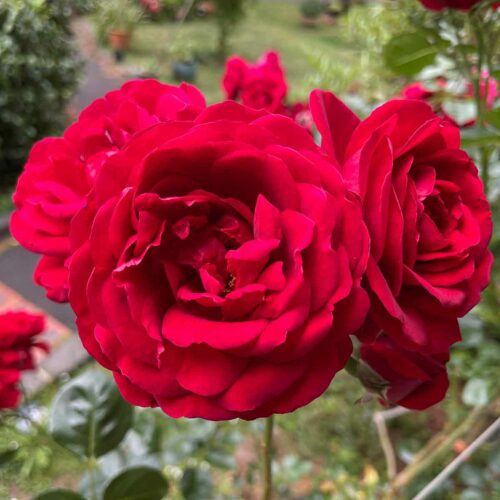
- Flowers: Dense clusters of rich red blooms
- Fragrance: Pleasant but light
- Special Attributes: Reliable repeat flowering, disease resistance, excellent track record
🌱 Growth Rate & Longevity
Dublin Bay is a strong, reliable climbing rose that establishes well and produces steady growth once planted into well-prepared soil. As with most climbing roses, its ultimate height is largely determined by how it is pruned and trained.
Left unpruned, Dublin Bay can reach around 2–3 metres in height, however it is most commonly trained along trellises, fences, or arches where its size can be easily controlled. Having been in cultivation since the late 1960s, it has a proven track record as a long-lived and dependable garden rose.
- Moderate to strong growth once established
- Height and spread easily controlled through pruning
- Repeat flowering from spring through summer
- Long-lived with consistent performance over many years
- Well proven variety with excellent garden reliability
Description
Rosa ‘Dublin Bay is a hybrid (‘Bantry Bay’ × ‘Altissimo’), this is a Floribunda type (Dense Clusters of Flowers) climbing rose raised by Samuel Darragh McGredy who was born in Ireland and lived in New Zealand and introduced ‘Dublin Bay in 1975.

Regarded as one of the very best red flowering climbing roses , this is a repeat flowering so it flowers from spring right through summer.
Being a climbing rose its height will determined by how you prune it, left unpruned it can easily reach 2 – 3 metres (6ft – 9ft), however it is usually trained across a trellis so height can be controlled easily.
This is a disease resistant rose, a strong grower, good deep green foliage and has been around since the late 1960s so it has a good track record.
Foliage is a good deep green and the fragrance or perfume is pleasant but light.
Important Warnings
- Poisonous/Toxic: Not considered toxic, though thorns can cause injury
- Invasive/Weed Potential: Not invasive
How to Grow the Dublin Bay Rose
Position: Give them an open sunny position and any deep well-drained soil including clay.
Cultivation:
- Roses do like a humus rich and nutrient rich soil.
Dig in some bonemeal, aged cow manure and some leaf mold if you have it. - Plant at the same depth it was in the container.
- Dig a hole twice the width of the pot or twice the with of the roots if bare rooted.
- Fill the hole with water and wait for it to soak in.
- Mix the bonemeal, cow manure and leaf mold through the soil removed when digging the planting hole.
- Remove the rose from the pot or packaging.
- Plant at the same depth it was in the hole making sure any graft is above soil level.
- Backfill with the soil/fertiliser mix.
- Water in.
- Much around the plant.
Fertilise in spring and again early summer with a rose fertiliser or an organic pelletised or liquid fertiliser.
Ongoing Care
Watering:
Water regularly during establishment. Once established, water deeply during dry periods.
Fertiliser:
Feed in spring and again in early summer using a rose fertiliser or organic pelletised or liquid fertiliser.
Pruning:
As a climbing rose, pruning determines height and spread. Train new canes horizontally to encourage more flowering. Remove dead or weak growth annually.
Overwintering:
Hardy in cool climates. In very cold regions, mulch around the base to protect roots.
Pests and Diseases
Dublin Bay is regarded as disease resistant and has an excellent track record. No significant pest or disease issues are noted when grown in suitable conditions.
Design Ideas
- Train over trellises, arches, and pergolas for vertical colour
- Use against fences or walls for summer-long flowering impact
- Ideal feature rose for courtyards or entry gardens
- Combine with pale or white climbers for colour contrast
- Excellent choice for classic cottage or formal rose gardens




Author Bio
“Written by JohnnyA, drawing from horticultural sources, a certificate in propagation, membership of horticultural societies and over 40 years of practical gardening experience and producing YouTube gardening tutorials.”