
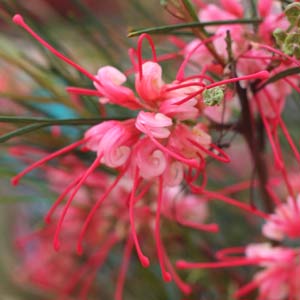
Grevillea species, are native to Australia, New Guinea and also New Caledonia. Most Grevilleas found for sale in your local nursery are from Australia and are bred in Australia.
Grevillea are a useful garden plant providing a show of flowers in late winter. The spider like flowers of Grevillea longistyla is the plant pictured right
Grevillea ‘Robyn Gordon’ in well known for its long flowering period. Grafted Grevillea are now appearing on the market. The latest addition are weeping standards, a really attractive alternative.
Grevillea are a varied group and are one of Australia’s’ favourite plants, easy to grow, sun loving and drought tolerant
Grevillea Plant Profile
Long flowering, easy care, low water requirements and bird attracting, Gevilleas are are also great bird attracting plants as well as making good informal hedges. Grevillea Robyn Gordon is one of the better know cultivars along with Grevillea ‘Honey Gem’, ‘Bronze rambler’ and ‘Moonlight’.

Grevillea varieties
Specialist Grevillea Nurseries and Australian Native plant nurseries can also supply grafted and weeping grevillea plants. Some species are longer flowering than others and length of flowering will depend on the climate. The warmer the winter the longer the flowering period.
Best Long Flowering Grevillea Varieties.
- Loopy Lou
- Billy Bonkers
- Ivory Whip
- Soopa Doopa
- Jester
- Honey Gem
- Bush Lemons
- Droopys Drawers
Best Grevilleas for Tropical and Sub Tropical areas
Many species do not grow well in humid condition, however some do. These include :
- Grevillea aurea is a species suited to tropical also known as the Deaf Adder Gorge grevillea (Kakadu National Park}
- Grevillea baileyana.
- Grevillea banksii.
- Grevillea heliosperma.
- Grevillea hookeriana.
- Grevillea iaspicula.
- Grevillea insignis
- Grevillea juniperina.
Grevillea Species – Different Forms
Grevillea come in many forms, from low growing ground cover types to large trees.
- Prostrate forms such as Grevillea lanigera ‘Prostrate Form’, Grevillea thelemanniana ‘Prostrate form’ and Grevillea obtusifolia ‘Prostrate form’.
- Bushy Shrubs – The most common garden form that will reach from 2 – 5 metres
- Trees of 8m and more such as Grevillea barklyana and Grevillea robusta or Silky-oak which will grow to almost 30m.
Hedging
A number of varieties are well suited for use as hedges, these include:
- Grevillea rosmarinifolia.
- Grevillea ‘Robyn Gordon’
- Grevillea olivaceae
- Grevillea pinaster
- Grevillea `Flora Mason’ (Grevillea olivacea x preissii)
Grafted varieties
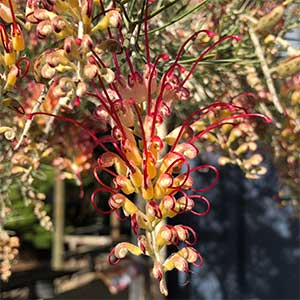
Grafted Grevillea such as the Grevillea treueriana that is pictured top right, are increasingly popular due to improved disease resistance and improved forms, Richard Tomkin of Changers Green Nursery is a leader in this field.
Groundcover varieties
Some species such as Grevillea lanigera Mt Tamboritha, Grevillea laurifolia, Grevillea plurijuga, and Grevillea tenuiloba are excellent ground cover plants.
Weeping Grevilleas are also now available, these are created by grafting prostrate forms onto upright rootstock. Grevillea ‘Honey Gem, Grevillea ‘Ivanhoe’ and Grevillea hookeriana are all excellent screening plants. Grevilleas need a well drained soil and resent being moved.
Growing conditions and care
Grevillea are a evergreen hardy native plant, many are bird attracting due to the nectar in the flowers. All species are are reasonably drought tolerant once established.
They grow well in a sunny position, a well drained soil. Some deep watering 3-4 times a year will help promote flower growth.
The spider like flowers appear from late winter through spring, the prickly foliage of provides protection and a safe nesting place for native birds.
Problems
Many Grevillea are sensitive to fungal infections caused by poorly draining soil and high humidity. These include : Sooty Mold, Cinnamon fungus, Honey Fungus as well as Cercospora and Phyllosticta (Leaf Spot),
Leaf spot is usually identified by yellow leaves with brown or black spots.
Grevillea species and varieties
G. alpina ‘Kinglake Form’
G. baileyana
G. baueri
G. baueri Asperula
G. bauerlenni
G. bipinnatifida
G. bronwenae
G. ‘Bush Lemons’
G. caleyi
G. chrysophaea
G. dimorpha
G. drummondii
G. fililoba “Ellendale”
G. flexuosa
G. x Honey Gem
G. hookeriana ‘RedHooks’
G. insignis
G. ‘Ivory Whip’
G. lanigera
G. lanigera ‘Kangarutha Form’
G. lanigera lutea
G. lanigera Mt Tamboritha’
G. laurifolia
G. lavandulacea
G. longistyla
G. x ‘Loopy Lou’
You may also be interested in
Grevilleas are available for sale online from the following growers and nurseries
PO 8243 Bargara QLD 4670
Richard Tomkin is the producer of spectacular grafted hybrid grevilleas (Large Super Tube - Square) Over 400 species, grevillea cultivars and hybrids.
www.nurseriesonline.com.au/changers_green

470 Monbulk-Silvan Road Monbulk VIC 3793
"Guaranteed mail order flowering bulbs, perennials, roses, trees, landscaping plants, garden accessories and community fundraising Austra lia-wide."
www.gardenexpress.com.au

Phone: 0411 435 314
Online Retailer of Landscaping Plants, large quantities of small pot sizes up to advanced sizes & plant Sourcing.
SYDNEY | NORTHERN NSW | GOLD COAST | BRISBANE | MELBOURNE | ADELAIDE
www.egardens.com.au
6 Cobrawonga Rd Cobram East VIC 3644
Plants propagated on site. Selling natives, popular non natives, roses & fruit trees. Seedlings, pots and advanced. Wholesale, retail & online. Monthly wholesale runs.