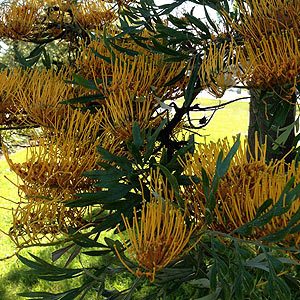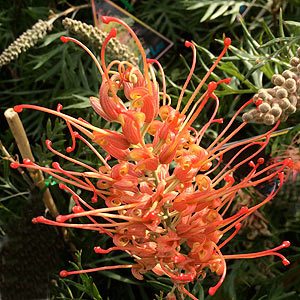
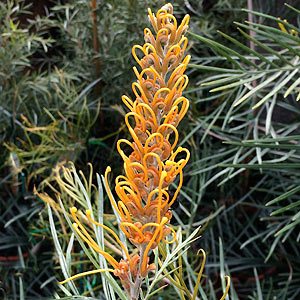
With wonderful golden flowers Grevillea x Honey Gem is one of the best yellow flowering grevilleas. If you like to have honeyeaters and loreketts in the garden, then Honey Gem is the Grevillea for you.
Long flowering and with ferny foliage this is a taller growing cultivar that can reach 5m although often less. The golden honey colored flowers appear almost year round.
The flowers are very attractive, combined with the way that they attract birds to the garden and the good mid green foliage it is no wonder that Grevillea Honey Gem appears on so many lists of ‘Best Grevilleas’.
Although this is a naturally tall growing plant, many gardeners prune it from a young age to keep it more compact. This lowers the flowers to where they can be easily seen as well as making the plant more bushy.
- Basic Care
- Soil and Drainage Requirements
- Climate Suitability and Frost Tolerance
- Watering Requirements
- Care and Maintenance
- Pruning Grevillea ‘Honey Gem’
- Landscaping Uses
- Companion Plants for Grevillea ‘Honey Gem’
- Common Problems and Pests
- How Fast Does Grevillea ‘Honey Gem’ Grow?
- Summary Information
- Related Searches
Why Grow Grevillea x Honey Gem ?
This popular cultivar is valued for its combination of ornamental appeal and practicality:
- Long flowering period, often close to year-round
- Bright golden flowers that stand out in the garden
- Attractive, fern-like foliage
- Excellent for attracting birds and pollinators
- Suitable for screening, feature planting, or larger garden spaces
Its reliability and visual impact make it a favourite in many Australian gardens.
Basic Care
Best planted in a sunny position in a well drained soil. In areas of poor drainage, try hilling up the garden bed a little before planting.
Water in well after planting and water occasionally through the first summer. Mulch around the plant to maintain a cool root run.
Like all Grevilleas, Honey Gem does not like to have its roots disturbed, so avoid digging around the base of the plant.
Soil and Drainage Requirements
Free-draining soil is key to success with Grevillea ‘Honey Gem’. Sandy or loamy soils are ideal, allowing water to move through easily.
If planting in heavier soils, improving drainage before planting is recommended. This may include adding coarse material or building up the planting area.
Avoid wet or waterlogged conditions, as grevilleas are sensitive to excess moisture around the roots.
Climate Suitability and Frost Tolerance
Grevillea ‘Honey Gem’ grows well across a wide range of Australian climates, particularly in warm temperate and subtropical regions.
It thrives in full sun and benefits from a position protected from strong winds. While established plants can tolerate light frost, younger plants may be affected by colder conditions.
In cooler regions, a sheltered, sunny location will help support healthy growth and flowering.
Watering Requirements
Water well after planting and continue regular watering through the first summer while the plant establishes.
Once established, Grevillea ‘Honey Gem’ is reasonably drought tolerant and generally requires only occasional deep watering during extended dry periods.
Container-grown plants will need more frequent watering, especially during warmer weather.
Care and Maintenance
This is a relatively low-maintenance plant once established. Avoid disturbing the soil around the base, as grevilleas have sensitive root systems.
Mulching will help retain soil moisture and regulate temperature around the roots. Fertiliser is rarely needed, but if applied, use a low-phosphorus product suitable for native plants.
Pruning Grevillea ‘Honey Gem’
Pruning will help maintain a dense shape and encourage more prolific flowering.
- Begin light pruning from a young age to control size
- Remove spent flowers to promote new growth
- Carry out more substantial pruning after flowering if required
Regular pruning will keep the plant bushy and bring the flowers down to a more visible level.
Landscaping Uses
Grevillea ‘Honey Gem’ is a versatile plant suited to a range of landscape applications.
It works well as a tall screening or hedging plant, as a background feature in garden beds, or as a standalone specimen in larger spaces.
The long-lasting flowers also make it useful as a cut flower, while its nectar-rich blooms attract a wide range of birds to the garden.
Companion Plants for Grevillea ‘Honey Gem’
This plant pairs well with other Australian natives that prefer similar sunny, well-drained conditions.
Suitable companion plants include:
- Smaller grevilleas such as Grevillea lanigera and Grevillea ‘Robyn Gordon’
- Westringia varieties for contrasting foliage and form
- Callistemon (Bottlebrush) for additional colour and bird attraction
- Banksia species in larger gardens to create a strong native planting scheme
These combinations help create a cohesive, low-maintenance garden with year-round interest.
Common Problems and Pests
Grevillea ‘Honey Gem’ is generally reliable, although a few issues may occur if conditions are not ideal.
Problems
- Poor drainage – Can lead to root issues in heavy soils
- Frost damage – Young plants may be affected in colder areas
- Open growth habit – Can develop if not pruned regularly
Pests
- Scale insects – Sap-feeding pests that may appear on stems and foliage
- Sooty mould – A black residue on leaves caused by insect activity
Most problems can be avoided by planting in well-drained soil and maintaining good growing conditions.
How Fast Does Grevillea ‘Honey Gem’ Grow?
Grevillea ‘Honey Gem’ is a vigorous and fast-growing plant when grown in suitable conditions.
With plenty of sun and good drainage, it can establish quickly and put on strong annual growth. Regular pruning will help manage its size and encourage a more compact, bushy habit.
Summary Information
- Botanical Name: Grevillea x ‘Honey Gem’
- Height: Up to 5 metres
- Width: Around 3 metres
- Soil: Well-drained
- Position: Full sun
- Flowers: Golden yellow, for much of the year
- Foliage: Deep green, finely divided
Related Searches