
The Perfect Flowering Tree for Small Australian Gardens
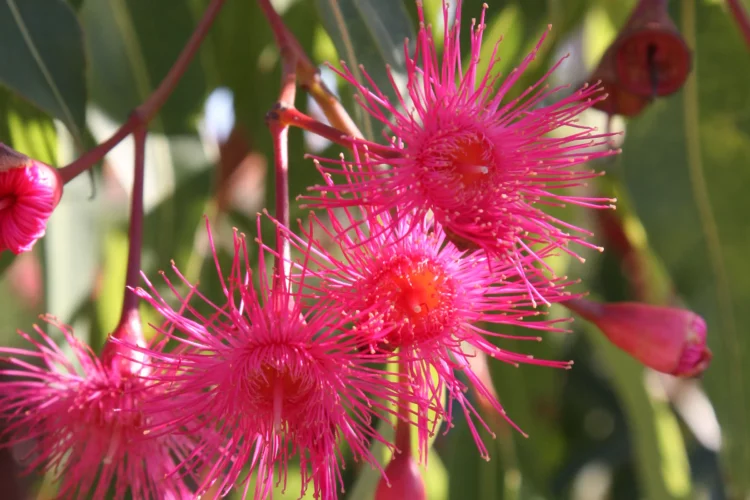
Many gardeners love the spectacular flowers of flowering gums but simply do not have the space for a large tree. This is where Dwarf Flowering Gums excel. These compact growing Corymbia varieties provide the same brilliant display of red, orange, pink or white flowers as their larger relatives while remaining suitable for smaller gardens, courtyards and even large containers.
Not only do they provide months of colour, they are also excellent for attracting birds, bees and butterflies into the garden. Once established they are relatively drought tolerant and well suited to many Australian climates.
With their colourful flowers, attractive evergreen foliage and manageable size, dwarf flowering gums have become some of the most popular native flowering trees available
Quick Facts
Botanical Name: Corymbia ficifolia cultivars and hybrids
Common Name: Dwarf Flowering Gum
Plant Type: Small evergreen native tree
Height: 2.5m – 6m depending on variety
Spread: 2m – 5m
Position: Full sun
Soil: Well-drained, humus-rich soil
Flower Colour: Red, orange, pink, cream and white
Flowering Time: Summer through autumn depending on cultivar
Foliage: Evergreen
Growth Rate: Medium to fast
Frost Tolerance: Moderate
Drought Tolerance: Good once established

How tall will Dwarf Gum Trees Grow?
One point that often causes confusion is the use of the term “dwarf”.
Some varieties marketed as dwarf flowering gums can still reach around 6 metres in height. Others are genuinely compact and remain closer to 3 metres.
If size is important, always check the expected mature height before planting.
Corymbia ficifolia ‘Dwarf Orange’
One of the most popular cultivars, Dwarf Orange eventually reaches around 3 metres in height. Although relatively slow growing, it flowers from an early age and makes an excellent specimen tree for smaller gardens and large containers.
Little Sweetie
Little Sweetie grows to around 4 metres tall and is particularly attractive to butterflies, bees and nectar-feeding birds.
Although compact in size, most Corymbia ficifolia cultivars are considered medium to fast growing once established. Growth rates will vary depending on climate, soil conditions and available moisture.
Popular Dwarf Flowering Gum Varieties
Corymbia ficifolia ‘Mini Orange’
A compact form reaching around 2.5 metres with masses of deep orange flowers and a dense canopy.
Corymbia ficifolia ‘Dwarf Orange’
Bright orange flowers on a compact tree growing to around 3 metres.
Corymbia ficifolia ‘Lollypops’
A rounded tree reaching around 5 metres with attractive dusky pink flowers.
Corymbia ficifolia ‘Little Sweetie’
Growing to around 4 metres, this variety is noted for its wildlife appeal and colourful blooms.
Corymbia ficifolia ‘Summer Beauty’
A larger dwarf form growing to approximately 6 metres with brilliant red flowers.
Corymbia ficifolia ‘Snowflake’
Creamy white flowers provide a striking contrast to the dark green foliage. Reaches around 6 metres.
Corymbia ficifolia ‘Wild Sunset’
Forms a naturally rounded canopy covered in orange-red flowers. Grows to around 6 metres over time.
What defines a good dwarf tree is the spacing between the leaves along each stem, known as internode length. Shorter internodes result in a more compact and bushy growth pattern.

Care of Dwarf Flowering Gums
Many of these plants are grafted, so it’s essential to watch for shoots emerging below the graft and remove them using sharp secateurs.
These trees thrive in full sun or with a bit of shade for short periods during the day. However, deeper shade can limit their flowering. Good drainage is crucial, but this doesn’t mean they should be planted in poor, dry soils.
For best performance, the following conditions should be aimed for:
- Full sun.
- Well-drained soil; avoid heavy clay and waterlogged soils.
- Humus-rich soil that will retain some moisture.
- Plants should be staked when young. This prevents wind damage and allows roots to be established.
- Give extra water to young plants during their first summer or two.
- Once established, dwarf flowering gums are considered drought tolerant.
Pruning Dwarf Flowering Gums
Typically, little to no pruning is required. When planted near pathways or used as street trees, lower branches may be trimmed to ensure access.
Propagation
Propagation is by grafting. Selected forms are grafted onto hardier rootstock such as Corymbia intermedia.
Where to Buy Dwarf Flowering Gums

Melbourne and Geelong based garden centres. Check out their large range of indoor and outdoor plants, Australian Natives, Fruit Trees and Edibles, Succulents, Gardenias, Camellias, Hydrangeas plus a full range garden products.
“Find your nearest Diaco’s Garden Centre”
Store Locations
Diaco's Garden Nursery Heatherton
190 Old Dandenong Road Heatherton VIC 3202
Phone: +61 3 9551 0776
Diaco's Garden Nursery Heatherton
Diaco's Garden Nursery Geelong
140 Bellarine HighwayNewcomb, VIC 3219
Phone: +61 3 5248 0689
Diaco's Garden Nursery Geelong
Diaco's Garden Nursery Keilor
Unit 25/16A Keilor Park Drive, Keilor East VIC 3033
Phone: +61 3 9331 6622
Diaco's Garden Nursery Keilor
451 Lytton Rd, Morningside QLD 4170
Located just 5km East of Brisbane CBD. Selling in volume direct to the public. Focus on top quality both in our plant & pot ranges.
www.rossevansgardencentre.com.au

470 Monbulk-Silvan Road Monbulk VIC 3793
"Guaranteed mail order flowering bulbs, perennials, roses, trees, landscaping plants, garden accessories and community fundraising Austra lia-wide."
www.gardenexpress.com.au
2274 Moggill Rd, Kenmore QLD 4069
Delivering the biggest, best and most comprehensive garden centre experience in Brisbane. Selling in volume direct to the public. Focus on top quality both in our plant & pot ranges.
www.rossevansgardencentre.com.au

Phone: 0411 435 314
Online Retailer of Landscaping Plants, large quantities of small pot sizes up to advanced sizes & plant Sourcing.
SYDNEY | NORTHERN NSW | GOLD COAST | BRISBANE | MELBOURNE | ADELAIDE
www.egardens.com.au
Other Flowering Eucalypts Worth Considering
While Corymbia ficifolia is undoubtedly the best-known flowering gum, it is far from the only Australian native tree grown for its spectacular blooms. Several eucalypts offer equally impressive floral displays, often combined with distinctive bark, colourful buds or attractive growth habits.
One of the most striking is Eucalyptus caesia, commonly known as the Silver Princess. Its graceful weeping branches, white powdery stems and large pink to crimson flowers make it one of Australia’s most ornamental small trees.
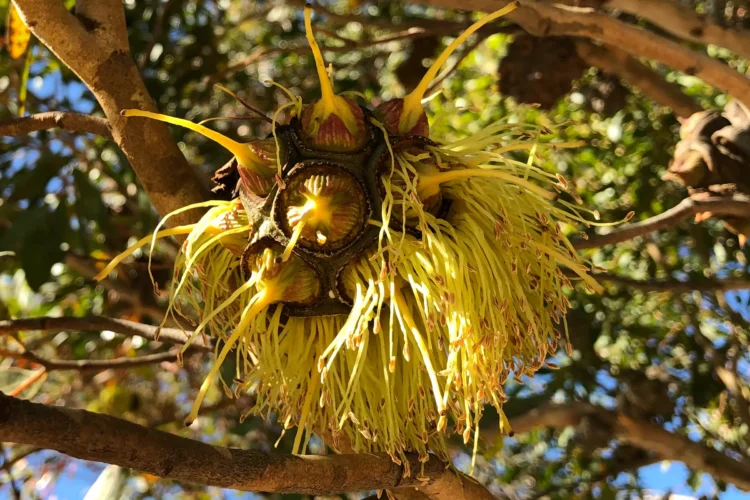
For something completely different, Eucalyptus conferruminata (Bald Island Marlock) produces brilliant scarlet flower buds that open to masses of golden-yellow flowers. The colourful buds are almost as ornamental as the flowers themselves and contrast beautifully with the tree’s blue-grey foliage.
Eucalyptus erythrocorys (Illyarrie) is another exceptional species. Large red bud caps open to reveal vivid yellow flowers with long stamens, creating one of the most dramatic flowering displays of any eucalypt.
If a long flowering season is important, Eucalyptus torquata (Coral Gum) is well worth considering. It produces coral-pink to deep red flowers over many months and is regarded as one of the most reliable flowering eucalypts for gardens.
Although these species differ in appearance and flowering season, they all attract nectar-feeding birds, bees and other pollinators. Together with the many outstanding cultivars of Corymbia ficifolia, they provide gardeners with an excellent range of colourful native trees for gardens large and small.
More Eucalyptus Species



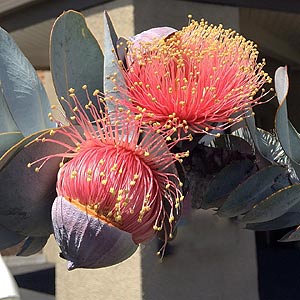
Spectacular Flowering Mallees
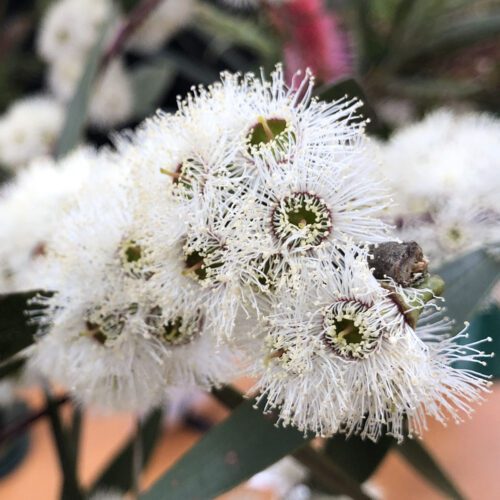
If you love the flowers of Corymbia ficifolia but don’t have room for a large tree, several mallee eucalypts provide equally impressive displays on a much smaller scale. Mallees are naturally multi-stemmed, growing from a woody lignotuber, making them excellent choices for smaller gardens and waterwise landscapes.
Eucalyptus kruseana (Book-leaf Mallee)
One of the most distinctive of all mallees, the Book-leaf Mallee is grown as much for its foliage as its flowers. The rounded, silver-blue leaves are stacked closely along the stems, creating a unique architectural appearance throughout the year. Bright yellow flowers appear from winter into spring, contrasting beautifully with the glaucous foliage.
Best feature: Outstanding silver-blue foliage with bright yellow flowers.
Eucalyptus rhodantha (Rose Mallee)
Few Australian natives produce flowers as large or as colourful as the Rose Mallee. Huge pink to rose-red blossoms, often 6–10 cm across, appear on a compact shrub or small tree with attractive blue-grey foliage. Even the large flower buds are highly ornamental, making this one of the finest flowering eucalypts for dry gardens.
Best feature: Massive rose-pink flowers among the largest in the genus.
Eucalyptus lansdowneana (Crimson Mallee)
The Crimson Mallee produces masses of rich crimson to deep pink flowers over blue-green foliage. Compact, drought tolerant and highly attractive to nectar-feeding birds, it makes an excellent feature plant or informal screen in full sun.
Best feature: Brilliant crimson flowers over an extended flowering period.