
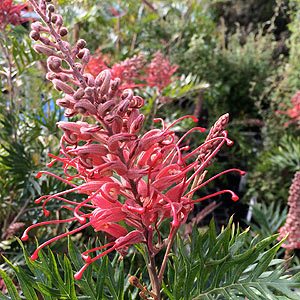
A truely unique species from Western Australia, Grevillea magnifica ( Grevillea petrophiloides ‘magnifica’) has flowers that are an unusual pink iridescent purple before opening to a pink and white.

The main flowering period is from late winter to spring and the flowers appear as terminal buds, making them conspicuous.
This is naturally upright shrub reaching around 4m in height. A good light screening plant, and excellent for attracting nectar seeking birds to the garden.
Main Features
- Unique two-tone flowers, purple-pink in bud fading to pink and white.
- Upright shrub to around 3–4 metres tall.
- Fine, deeply divided foliage with a soft texture.
- Strong bird-attracting qualities.
- Ideal as a light screening plant.
How To Grow Grevillea magnifica -Basic Care
Being from Western Australia good drainage is essential for this species.
It is also best grown in an open position where it gets good air flow.
Growing Conditions and Care
Position
- Full sun is ideal.
- Requires open airflow to prevent fungal issues.
Soil
- Must be free-draining.
- Prefers sandy or gravelly soils.
- Avoid heavy clay and poorly drained sites.
Soil Preparation
- Dig the soil to twice the width of the pot.
- Improve drainage with coarse sand or fine gravel if needed.
- Add a small amount of compost, but avoid overly rich soil.
- Do not use high-phosphorus fertilisers.
When to Plant
- Best planted in autumn or early spring.
- Autumn planting is preferred in southern Australia for root establishment.
- Avoid planting during extreme heat or cold.
Planting Guide
- Plant at the same depth as in the pot.
- Water in with a seaweed solution to reduce transplant shock.
- Apply mulch to maintain soil moisture, keeping it clear of the stem.
Watering and Feeding
- Water lightly but regularly during the first summer.
- Once established, it is drought tolerant.
- Fertilise only if needed, using a low-phosphorus native fertiliser.

No fertiliser is requires in good soils. You can use a little specialist native plant fertiliser (low phosphate) in poor soils if desired.
During long dry periods a deep watering will keep the plant looking good.
Pruning
- Tip prune after flowering to maintain shape.
- Avoid hard pruning into old wood.
- Regular light pruning improves density and flowering.
How to Get the Best Out of This Plant
- Prioritise drainage above all else.
- Avoid humid, enclosed planting positions.
- Use light tip pruning to encourage bushier growth.
- Do not overwater—this plant prefers slightly dry conditions once established.
- Avoid root disturbance once planted.
Summary Information
- Botanical Name – Grevillea magnifica (syn. grevillea petrophiloides ‘magnifica’)
- Common Name – Grevillea Pink Pokers
- Origins – South West of Western Australia
- Position – Full sun to a little shade.
- Soil – Humus rich well drained.
- Height – To around 3-4 metres.
- Spread – To around 2-3 metres.
- Growth habit – Open
- Growth rate – Medium.
- Flowers – Purple to pink, cylindrical in form.
- Flowering time – Winter to Spring with spot flowering year round.
- Foliage – Pale to Mid green and deeply divided.
- Frost tolerant – Light frosts only.
- Drought tolerant – Yes once established.
- Dislikes – Humidity, Poor draining soil and Phosphate fertilisers.
Grevillea Magnifica may be available for sale from the following nurseries
Muchea Tree Farm WA.
Goldfields Revegetation VIC.
Vaughans Native Plants VIC.
Related Varieties
- Grevillea oligomera X magnifica is a smaller growing hybrid, very long flowering.
- Magnifica ssp magnifica
- Grevillea magnifica ssp remota
- Grevillea magnifica dwarf
You May Also Like


We are Asked
How fast does Grevillea magnifica grow?
It has a moderate growth rate, typically reaching full size within a few years under good conditions.
Does Grevillea magnifica need full sun?
Yes, full sun is ideal for flowering and plant health.
Can it grow in humid climates?
It prefers dry air and good airflow, and may struggle in high humidity.
How do you improve flowering?
Ensure full sun, excellent drainage, and light pruning after flowering to promote new growth.