
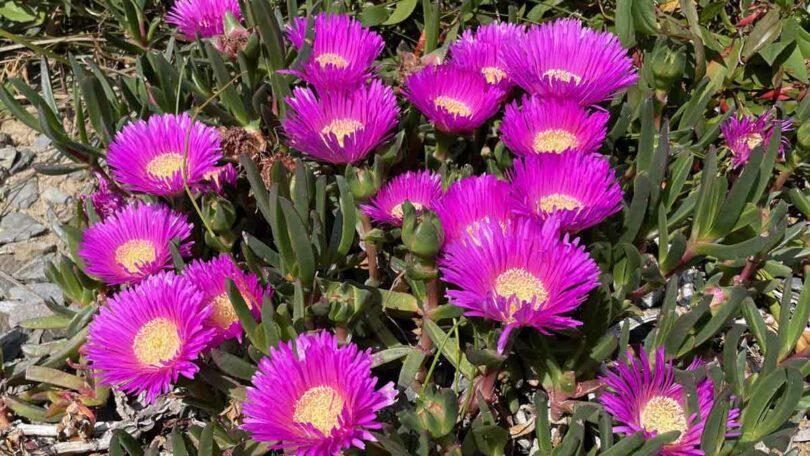
The idea of ground cover plants is to make gardening easier, and the best varieties solve a lot of problems.
Bare soil causes many problems and allows weeds to grow. Ground cover plants can help overcome these issues.

The very nature of these plants is that they are low growing and form a dense mat of foliage. It is this dense foliage that works to help suppress weeds and conserve moisture, as well as helping control erosion.
The denser the foliage, the better they are at performing their duty.
Ground cover plants can also be used to create a flowering carpet, soften hard landscaping, fill gaps in the garden border and provide an attractive transition between different areas of the garden.
- Best Uses for Ground Cover plants.
- What Do Ground Cover Plants Do?
- Characteristics of the best groundcover plants :
- Ground Cover Plants for shade:
- Best Groundcovers for sun:
- Drought-Tolerant Ground Cover Plants
- Ground Covers for Slopes and Erosion Control
- Ground Covers Between Pavers
- Australian Native Ground Cover Plants
- Where To Buy
- List of Ground Cover Plants
Best Uses for Ground Cover plants.
Besides helping prevent weeds and protecting the soil, ground covers have many other uses.
They make a great addition to any garden and can be used to create a flowering carpet.
Some can be used as a lawn substitute, while others provide different height levels in the garden.
- They can be used between pavers and in rock and crevice gardens, as well as in the general garden border.
- Some also have great flowers, making a colourful addition to the overall garden design.
- They are widely used as erosion control plants on slopes and banks.
- They can help cover bare areas where grass is difficult to grow.
- They can be used as a landscaping element to soften paths, retaining walls and garden edges.
- Many ground covers help conserve moisture by shading the soil.
Choosing the right plant for the right landscaping solution is important before planting. A plant that works well in full sun may struggle in shade, while a vigorous spreading plant that is useful for covering a large bank may be unsuitable for a small garden bed.
The best varieties will spread naturally without becoming invasive, some will spread by underground rhizomes, others by sending out runners. Some such as Casuarina glauca prostrate, grow from a single stem, yet are still very effective.
What Do Ground Cover Plants Do?
Ground cover plants have several useful functions in the garden.
- They form a dense mat and help with suppressing weeds.
- Some create a cover of flowers near ground level.
- They act as low-growing foliage plants.
- They can also act as a ‘living mulch’ and help preserve moisture in the soil.
- They are useful as erosion control plants.
- They can be used as a lawn or grass alternative.
- They assist with decreasing garden maintenance.
- They help protect bare soil from drying out and being washed away.
The best varieties will spread naturally without becoming invasive. Some will spread by underground rhizomes, others by sending out runners. Some, such as Casuarina glauca ‘Prostrate’, have a different spreading habit but are still very effective as ground cover plants.
It is worth checking the behaviour of a plant before planting, particularly in areas where a vigorous spreader could escape into surrounding bushland or neighbouring gardens.
Characteristics of the best groundcover plants :
Characteristics of the best ground cover plants include:
- Dense, attractive, mat-forming foliage.
- Creeping or spreading growth habit.
- Non-invasive or well-behaved growth.
- Easy care and low maintenance.
- Insect and disease resistance.
- Ability to cope with the conditions in the position where they are planted.
- Good coverage of bare soil.
Not every ground cover needs to be evergreen, and not every variety needs to spread quickly. In some situations, a slower-growing plant is the better choice because it is easier to control.
Ground Cover Plants for shade:
Some of the best types for shade include Hosta, Bergenia, Epimedium, Cornus canadensis, Parthenocissus, Potentilla, ferns including Athyrium, Brunnera, Helleborus, Pultenaea pedunculata and Tiarella, all of which can make great choices depending on the climate and conditions.
For Australian gardens, Native Violet (Viola banksii) is another excellent choice for shady areas. It forms a low-growing cover and produces small purple and white flowers.
Kidney Weed (Dichondra repens) is another useful Australian native ground cover. It has small rounded leaves and is well suited to shady or partly shaded positions where the soil is reasonably moist.
Mondo Grass (Ophiopogon japonicus) is often used where a neat, low-maintenance covering is required. It is not a true grass, but its strap-like foliage gives a similar effect and makes it useful around paths, under trees and along garden borders.
When planting ground covers in shade, remember that dry shade can be much more difficult than moist shade. The soil beneath established trees can be particularly competitive, with tree roots taking much of the available moisture.
Best Groundcovers for sun:
There are many excellent choices for sunny positions.
Achillea, Armeria, Arabis, Coreopsis, Dampiera diversifolia, Euphorbia, Gazania, Nepeta x faassenii (catmint), Stachys byzantina (Lamb’s Ear) and low-growing or dwarf conifers are all useful choices.
Thymus longicaulis, or creeping thyme, works well as a low-growing flowering ground cover, particularly where the soil is well drained.
Verbena and Veronica can also work well, depending on the variety and local conditions.
Other useful choices for sunny gardens include:
Creeping Thyme
Creeping thyme forms a low mat of foliage and can produce masses of small flowers. It is particularly useful between pavers, along paths and in areas where a low-growing cover is required.
It prefers a sunny, well-drained position and is not suited to wet soils.
Blue Convolvulus
Blue convolvulus can be used as a spreading ground cover where a colourful flowering plant is required. The blue flowers can make an attractive contrast against surrounding foliage.
Prostrate Rosemary
Prostrate rosemary is an excellent low-growing plant for sunny, well-drained positions. It can spill over walls and garden edges and works particularly well in rockeries and Mediterranean-style gardens.
It is also useful where a tough, drought-tolerant plant is required.
Drought-Tolerant Ground Cover Plants
Drought-tolerant ground covers are particularly useful in Australian gardens where water can be limited.
Acacia redolens is an interesting low-growing acacia. It is fairly dense and shrubby, reaching around 1 metre, and works well as a ground cover plant for larger areas.
Hardenbergia violacea can be used as a sprawling cover, while Rhodanthemum species from Morocco are very tough plants and can cope with dry conditions once established.
Myoporum parvifolium, or Creeping Boobialla, is dense growing and tough. Look for the newer cultivar Myoporum parvifolium ‘Yareena’, which is particularly useful as a low-growing ground cover.
Also try Chrysocephalum apiculatum, or Yellow Buttons. This Australian native produces yellow flowers and can be a useful choice for a sunny, relatively dry position.
Drought tolerance does not mean a plant needs no water. New plantings still need regular watering while they establish. Once established, however, the right plant in the right position should require considerably less supplementary watering.
Flowering Ground Cover Plants
One of the great advantages of ground cover plants is that they do not have to be just green foliage.
Flowering ground covers can create a colourful carpet and are useful for filling large areas of garden without introducing too many different plant heights.
Some useful flowering ground covers include:
- Creeping thyme
- Gazania
- Verbena
- Armeria
- Arabis
- Nepeta
- Veronica
- Native Violet
- Chrysocephalum apiculatum (Yellow Buttons)
- Rhodanthemum
When choosing flowering ground covers, consider how much sun the plant receives and how long you want the flowering display to last. Combining plants with different flowering periods can provide colour over a much longer period.
Low-Maintenance Ground Cover Plants
Ground covers are often planted to decrease garden maintenance, but not all ground covers are low maintenance.
The best low-maintenance varieties are those that establish reasonably quickly, remain dense without constant pruning and do not need frequent watering once established.
Mondo grass, native violet, creeping thyme, prostrate rosemary, Myoporum parvifolium and some low-growing native plants can all be useful, depending on the situation.
Preparation of the soil is important. Removing perennial weeds before planting is much easier than trying to remove them after the ground cover has formed a dense mat.
Mulching between young plants can also help suppress weeds while the ground cover becomes established.
Fast-Growing Ground Cover Plants
Fast-growing ground covers are useful when a large area needs to be covered quickly. They can establish a dense cover and help reduce bare soil and weed growth.
However, fast growing does not always mean better.
Some vigorous ground covers can spread well beyond the area where they were planted, so it is important to choose a variety that suits the size of the garden and the surrounding environment.
For a large bank or open area, a vigorous spreading plant may be exactly what is required. In a small garden bed, however, a slower-growing and more compact variety can be a better choice.
Always check the mature spread of a plant before planting and avoid varieties known to become invasive in your local area.
Conifers as Ground Cover Plants
Low-growing conifers such as Juniperus squamata ‘Prostrata’ make outstanding ground covers.
They can provide year-round foliage and are particularly useful in rock gardens, banks and sunny garden areas.
Their low, spreading habit can also provide an interesting contrast to upright plants and shrubs.
Ground Covers for Slopes and Erosion Control
Ground cover plants are particularly useful on slopes because their roots help hold the soil together while the foliage protects the soil surface from rainfall and drying winds.
A dense planting is usually more effective than scattered individual plants. On a new slope, plants should be spaced according to their mature spread so that the area eventually develops a continuous cover.
It is also important to consider drainage. A plant that is drought tolerant may still struggle if water sits around its roots, particularly on heavy clay soils.
Ground Covers Between Pavers
Low-growing ground covers can soften the hard lines of paths and paving.
Creeping thyme is one option for sunny areas, while other low-growing plants can be used in partly shaded positions.
The plant needs to be tough enough to cope with some foot traffic and should not grow so vigorously that it quickly covers the paving.
A small amount of soil between pavers can provide enough room for a low-growing plant to establish, creating a softer and more natural-looking path.
Australian Native Ground Cover Plants
See our full guide to Australian Native Plants suited for use as ground cover.
Where To Buy

357 Monbulk Road SILVAN VIC 3795
Guaranteed "garden worthy" bulbs, plants and perennials. Visit the website to browse our large range of daffodils or request the latest free catalogue.
www.tesselaar.net.au

www.planterspatch.com.au

470 Monbulk-Silvan Road Monbulk VIC 3793
"Guaranteed mail order flowering bulbs, perennials, roses, trees, landscaping plants, garden accessories and community fundraising Austra lia-wide."
www.gardenexpress.com.au

'Umbango' 750 Humula Rd, Humula NSW 2652
Phone 0408692773 Great Range of Perennial plants available for sale by mail order.
www.nutshellnursery.com.au

52 Rodd St Canowindra NSW 2804
An online nursery specialising in drought and frost tolerant perennials and fragrant, edible and herbs.
www.perennialle.com.au
Wholesale Suppliers

111 Stanhope Road Theresa Park NSW 2570
Offering a variety of sun hardy Australian natives and exotic trees, shrubs, groundcover's and perennials from semi advanced through to super advanced and semi-mature stock.
www.downesnursery.com.au

email [email protected]
One of Australia's largest wholesale trade nurseries. Over 30,000 species available, tubestock to advanced trees, an almost unlimited choice of plants.
www.plantmark.com.au
Choosing the Right Ground Cover Plant
There is no single best ground cover plant for every garden.
Before planting, consider:
- How much sun or shade the area receives.
- Whether the soil is wet, dry, sandy or heavy clay.
- How much room the plant has to spread.
- Whether the area needs erosion control.
- Whether the plant needs to tolerate some foot traffic.
- How much maintenance you are prepared to do.
- Whether the plant is suitable for your local climate.
- Whether it is known to become invasive.
The best ground cover plants are those that suit the conditions rather than plants that simply look good in a nursery.
Choose the right plant for the right place and ground covers can make gardening easier, reduce bare soil and weeds, help conserve moisture and add another layer of interest to the garden.
They can be used in almost every part of the landscape, from sunny banks and rock gardens to shady borders, paths and the spaces between pavers. With the right selection, ground cover plants are one of the simplest ways to create a healthier and more attractive garden.
List of Ground Cover Plants
- Acacia Cognata – Low growing forms
- Agastache
- Ageratum
- Ajuga
- Armeria
- Bacopa
- Bergenia
- Brunnera
- Campanula
- Carpobotrus glaucescens (Pigface)
- Casuarina ‘Cousin It’
- Coleus
- Conifers (low growing)
- Crowea
- Cyclamen
- Convolvulus
- Diascia
- Dichondra Repens
- Dymondia
- Epimedium
- Eremophila Kalbarri Carpet
- Hellebores
- Heliotrope
- Lamium
- Lobelia
- Ornamental Grasses
- Phlox subulata (Creeping Phlox)
- Rhodanthemum
- Saxifraga
- Stachys byzantina (Lambs Ears )
- Stachys thirikei (Miniature Lambs Ears )
- Thyme
- Veronica
- Vinca
- Westringia fruticosa (prostrate forms)