
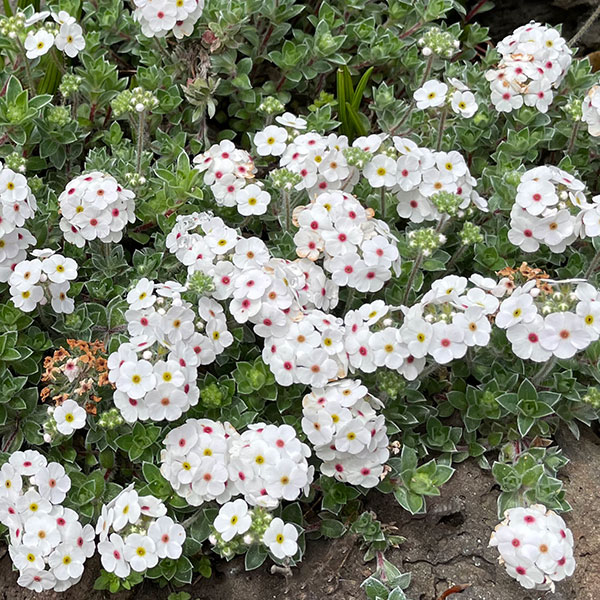
A low growing ground cover plant Androsace lanuginosa is widely used in rock gardens and containers. Originating in the Himalayas this is a trailing mat forming plant that grows well in light to part shade. Small grey green foliage and attractive white to pale pink flowers with deeper pink centres cover the plant when in flower.
Flowers are fragrant although the scent is light. Over time it can reach around 10 cm (4 inches) in height and spread to around 30cm (12 inches)
This is an evergreen plant and flowering time depends on the climate however from early to mid summer. This plant was awarded the Royal Horticultural Society Award of Merit in 1993.
How To Grow
Good drainage in winter is essential, so this makes this low growing plant an ideal candidate for a rock garden or crevice garden, also suited to growing in containers and troughs. Over time it will form a dense clump and propagation is easiest by division.
Where to Grow
- Alpine rock gardens – ideal, as they mimic the plant’s natural Himalayan habitat.
- Raised beds – excellent drainage prevents root rot.
- Rock crevices or wall pockets – cooler roots and sharp drainage suit it well.
- Troughs or alpine containers – good for controlling moisture levels.
- Full sun to light partial shade – needs bright light but benefits from afternoon shade in hot climates.
- Cool, moist summers – performs best in temperate or alpine climates rather than hot, humid areas.
How to Grow
- Plant in very well-drained soil:
- 50–70% sharp grit or coarse sand
- Mixed with loam or compost.
- Position so water drains away from the crown; avoid flat, soggy spots.
- Keep soil evenly moist but never waterlogged.
- Water at the base; avoid wetting foliage to reduce rot.
- Mulch lightly with grit or small gravel around the crown to prevent moisture buildup.
- Provide good air circulation to reduce fungal issues.
- Protect from winter wet with a cold frame, alpine house, or overhead cover in rainy climates.
- Feed lightly in spring with a dilute, low-nitrogen fertilizer.
- Remove spent foliage and check for crown rot regularly.
- Divide or propagate the plant every 2–3 years to maintain vigor.
Propagation
When to Propagate
- Late spring to early summer – best time for softwood or semi-ripe cuttings.
- Late summer to early autumn – suitable for division if the clump is large enough.
- Early spring – start seed propagation indoors before the growing season.
How to Propagate – Cuttings
This is the most commonly used & most reliable method of propagation for us.
- Select non-flowering shoots with firm, semi-ripe bases.
- Cut pieces 4–6 cm long.
- Remove lower leaves; keep the top few intact.
- Dip cut end in rooting hormone (optional but helpful).
- Plant in a gritty mix:
- 50% sharp sand or horticultural grit
- 50% compost or seed-starting mix.
- Insert cuttings so the stem base is just below the surface.
- Mist lightly and keep humid but not wet.
- Place in bright shade, avoiding direct sun.
- Maintain a temperature around 15–18°C (59–65°F).
- Rooting typically takes 3–6 weeks.
Androsace lanuginosa Details
- Botanical Name: Androsace lanuginosa
- Common: Names: Wooly Rock Jasmine, Wooly Rock Cress.
- Family: Primulaceae
- Origins: Himalayas
- Position: Sun to afternoon shade depending on climate.
- Soil: Well drained.
- Flower Colour: White to Pink
- Foliage: Mid green.
- Height: 10cm (4 inches)
- Spread: 30cm (12 inches)
- Growth Rate: Slow
Where To Buy

138 Olinda-Monbulk Rd, Olinda VIC 3788
"Large range of rare and unusual plants.."
www.gentiananursery.au
PO Box 7040 Leura NSW 2780
Rare woodland plants, Trilliums Epimediums, Arisaemas, plus much more.www.lynnsrareplants.com.au
Author: JohnnyA