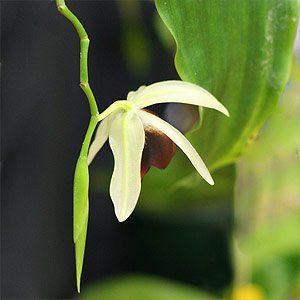
Coelogyne tenellum is a charming miniature orchid from the montane forests of Southeast Asia, prized for its delicate arching sprays of small, intricate flowers. Each bloom displays creamy-white to pale yellow segments, accented by a beautifully marked lip with amber and russet tones.

While its appearance is dainty, this species is surprisingly adaptable once its cultural needs are met, making it a great addition to compact orchid collections and specialist growers’ shadehouses.
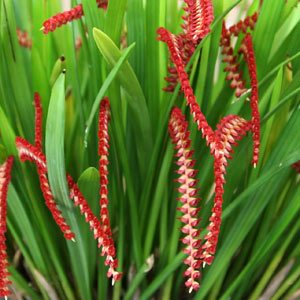
Grown for its subtle elegance and sequential flowering habit, C. tenellum will often produce multiple spikes from maturing pseudobulbs, rewarding attentive care with a prolonged display during its blooming period.
This is a species that has had a few name changes, so Coelogyne tenellum , Dendrochilum tenellum and Coelogyne tenella all refere to the same species.
Coelogyne tenellum typically flowers in the middle of winter to very early spring, brightening collections with its delicate blooms during the cooler months. In the wild, it is found in wet tropical forests of the Philippines and Southeast Asia, where it occupies elevations from around 1000 to 2000 metres.
This miniature orchid grows primarily as a pseudobulbous epiphyte, thriving in consistently humid montane environments, often amidst moss and lush undergrowth. Its preference for cloud forest habitats means that it experiences cool, misty conditions year-round, with more moisture and mist during summer and autumn, and drier, brighter conditions in winter.
How to Grow Coelogyne tenellum
Climate
In its natural range—at elevations of around 1,000 to 2,000 metres in Myanmar, Thailand, and surrounding regions—Coelogyne tenellum thrives in cool to intermediate conditions. It prefers:
- Cool to intermediate temperatures year-round
- High humidity, particularly during active growth
- Bright, filtered light (avoid direct midday sun)
- Excellent airflow to prevent fungal issues
It adapts well to cool-growing orchid collections, shaded patios, or protected outdoor spaces in frost-free climates.
Temperature Range
- Ideal daytime temperatures: 16°C to 26°C
- Night-time drop of 8–10°C is beneficial
- Tolerates down to around 10°C without damage
- Should be sheltered from hot extremes—above 30°C, increase shading and airflow
Soil / Growing Medium
C. tenellum prefers a fine, well-draining yet moisture-retentive mix. Recommended options:
- Fine-grade pine bark for structure
- Perlite for aeration
- A small proportion of sphagnum moss to maintain moisture
- Charcoal to keep the mix fresh
This species can be grown in small pots, hanging baskets, or mounted with moss backing for excellent drainage and air movement.
Watering
Consistent moisture is essential, especially from spring through early autumn.
- Keep the medium evenly moist during active growth
- In cooler months, let the mix just begin to dry before rewatering
- Avoid sustained dryness—it can cause bud blast and setback
- Use rainwater, distilled, or reverse-osmosis water for best results
- Ensure pots or mounts drain freely to prevent root rot
- Avoid watering the flower spikes as they form as they will mark easily.
Fertilising
Feed lightly but regularly during the growing season.
- Apply a weak (¼–½ strength) balanced orchid fertiliser every 2 weeks from spring to late summer
- Reduce to monthly feeding in autumn and winter
- A bloom booster fertiliser low in nitrogen can encourage stronger flowering
- Flush with plain water once a month to avoid salt accumulation

Repotting Coelogyne tenellum
Like many Coelogynes, C. tenellum dislikes frequent disturbance. Repot only when:
- The medium has broken down (around every 3 years)
- The plant has clearly outgrown its pot
The best time to repot is immediately after flowering, as new growth begins.
- Use minimal division; ensure each section has strong pseudobulbs and a healthy root system
- Trim away dead or rotted roots before repotting
- Choose a snug pot—overpotting can reduce flowering performance
Common Pests and Problems
While generally hardy, C. tenellum can be vulnerable to:
- Scale and aphids on flower spikes and undersides of leaves
- Spider mites in low humidity
- Root rot in poorly aerated or waterlogged conditions
- Leaf spotting in stagnant air
Top Tip: Maintain good air circulation and inspect regularly—early intervention keeps plants healthy.
Best Uses in the Garden
- Miniature Feature Orchid – Ideal for small greenhouses, orchidariums, or balconies where space is limited.
- Mounted Display – Shows off its arching spikes beautifully when grown on cork or tree fern mounts.
- Cool Climate Shadehouse – Great for combining with mosses, ferns, and other miniature orchids.
- Potted Accent – Place on shelves, orchid benches, or shaded verandas for close viewing when in bloom.
- Specialist Collections – Appeals to growers who appreciate sequential blooming and miniature dimensions.
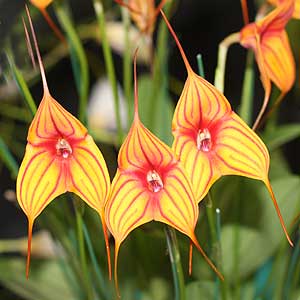
Grow it as a backgound plant for Masdevallia species
Related Species
Related Orchids with Similar Needs
Species with compatible temperature, light, and moisture requirements include:
- Coelogyne nitida – Another small, elegant Coelogyne with bright, arching sprays.
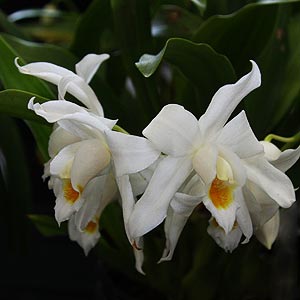
- Coelogyne cristata – A cool grower with larger white blooms.
- Masdevallia species – Enjoy similar cool, moist, shaded environments.
- Pleione formosana – Compact, cool-growing, and easily flowered in pots.
- Dracula sodiroi – Prefers cool, humid, and shaded spaces alongside C. tenellum.