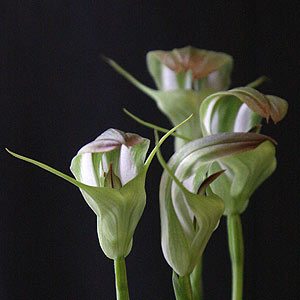
Calanthe orchids are a cool growing genus divided into evergreen and deciduous species. The Christmas Orchid, Calanthe triplicata (Christmas Orchid) and other Calanthe species are a wide spread group of terrestrial orchids some native to Australia and some not. C. discolor is from Japan where it grows in forested areas. Calanthe tricarinata is more wide spread.

C.sieboldii has large yellow flowers and is fairly hardy in a woodland situation and C. dominii is a very old hybrid. C. vestita is worth looking for as well.
How To Grow Calanthe Orchids – Basic Care
Plant Calanthe in semi shade for best results. However being a fairly varied group we suggest you seek specific growing and care instructions on purchase.
As a general rule they do require a well drained soil and a position in semi shade. It is best to amend the soil well before planting. Some blood and bone and a little lime can also be added at this time.
Dig through some well rotted compost, and some material to improve drainage. Perlite or course river sand is excellent to improve drainage in boggy soils. Although Calanthe Orchids can be grown in containers, they need to be kept out of the sun, especially in summer. High soil temperatures will kill these orchids.
They are also an orchid that requires a reasonably dry dormancy.
Planting
For best results:
- Prepare soil with well-rotted compost and a small amount of blood and bone.
- Add lime to suit their preference for neutral to slightly alkaline soils.
- Improve drainage using perlite or coarse river sand, especially in boggy areas.
- Calanthe orchids can also be grown in containers, provided they are well-drained and not exposed to direct summer sun.
Exposure: Sun or Shade
Calanthe orchids prefer:
- Part shade to dappled sunlight
- Protection from hot, direct afternoon sun, especially in warmer climates
- Indoor plants should be kept in bright, indirect light to prevent leaf scorch and maintain flower quality.
Fertiliser
Feed Calanthe orchids with:
- A balanced, slow-release fertiliser in spring and summer
- A low-nitrogen fertiliser during the flowering season
- Avoid overfeeding, especially during dormancy
Growth Habit
Calanthe orchids typically have long, arching flower spikes and lush green foliage. Depending on the species or hybrid, they may be:
- Evergreen (e.g., Calanthe triplicata)
- Deciduous, entering dormancy in winter (e.g., Calanthe sieboldii, C. discolor)
These orchids grow from pseudobulbs and are well-suited to woodland or shaded garden settings.
Dormancy
Most deciduous Calanthe species require a dry dormancy period during winter. Reduce watering when leaves begin to yellow and die back. Evergreen varieties may need slightly less water in cooler months but do not enter full dormancy.
Varieties and Species
Calanthe Orchids are now much hybridised and with long arching flower stems are a graceful addition to any orchid collection.
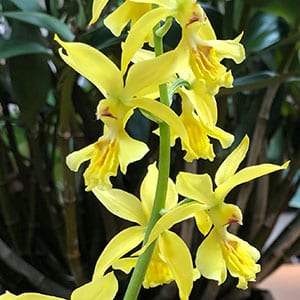
- C. sieboldii with its yellow flowers prefers part shade.
- C. rubes is originally from Thailand and has pinkish red flowers.
- C. discolor is from Japan and is a cold hardy species.
- C. reflexa is a late bloomer, also from Japan.
- C. triplicata is an evergreen species from Australia (Queensland) where it is known as the Christmas Orchid.
- C. vestita is a popular indoor plant.
- C. tricarinata is a beautiful species with lemony yellow petals and a pink to pale crimson lip. (Rarely offered)
- Takane Hybrids are a cross between C. discolor and C. sieboldii, giving as a range of orange to apricot coloured flowers
Japanese Calanthe Orchid Hybrids
The Japanese are responsible for many hybrids and they name these according to the species used.
Widely used species are C.discolour from Japan, China and Korea and C.seiboldii from Japan and Korea, to the Ryukyu Islands and Taiwan.
- Kozu hybrids – Discolor with izu-insularis, which is a species from Izu islands found growing in temperate forests at lower elevations..
- Saruebine hybrids – Other species with Calanthe tricarinata A widespread species from Japan, Korea, China, through to Northeastern India, Bhutan, Assam, Nepal,
- Satsuma hybrids – Discolor, seiboldii,and aristulifera, which is a rare species from from the mountains of Japan’s Kyushu island.
- Takane hybrids – Calanthe seiboldii and Calanthe discolor
Where To Buy

PO Box 7040 Leura NSW 2780
Rare woodland plants, Trilliums Epimediums, Arisaemas, plus much more.www.lynnsrareplants.com.au
Companion Plants
Calanthe orchids pair well with other shade-loving plants such as: