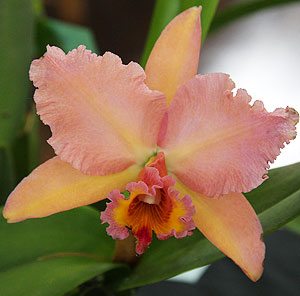
Cattleya coccinea (syn.Sophronitis coccinea) is a striking miniature orchid species native to the cloud forests of southeastern Brazil, particularly in the Atlantic Forest region.

It typically grows as an epiphyte at elevations between 800 to 1,500 meters, where the climate is cool to intermediate, humid, and often misty due to frequent cloud cover.
This is an orchid that thrive in environments with good air movement, moderate light, and consistent moisture, mimicking their natural, moss-covered tree habitats.
The plant is compact, forming dense clumps with short rhizomes and pseudobulbs that are topped by a single, leathery, ovate leaf. The foliage is a dull green, somewhat stiff in texture, and adapted to lower light conditions. The root system is fine and wiry, adapted for clinging tightly to bark and absorbing moisture from the air and rain.
What sets Cattleya coccinea apart is its brilliant scarlet to orange-red flowers, which are relatively large in proportion to the plant’s size. Each pseudobulb can produce one to two flowers, about 5 cm across, with broad, rounded petals and a similarly colored lip. Flowering typically occurs in late winter to early spring. This species has been highly valued in orchid hybridization, especially for introducing intense red coloration into miniature Cattleya hybrids.
How to Grow Cattleya coccinea – Basic Care
Substrate, growing media and repotting:
Cattleya coccinea grows naturally in the cloud forests with high humidity almost year round.
It grows mostly as an epiphyte (on trees), sometimes as a lithotype (on rocks) and in cultivation it can be mounted on cork, tree fern or indeed other backing.
Mostly Cattleya coccinea is grown in pots where it is easier to control moisture.
A free draining substrate such as mix of pine bark for orchids with charcoal.
You can find pre made mixes specifically for Cattleya Orchids OR make your own.
Simple homemade recipe.
A mix of
6mm to 12mm pine bark (4-5 Parts)
Horticultural charcoal (1 part)
5 parts fir bark, medium grade (¼ to ½ inch chunks) (NOT landscape mulch)
1 part horticultural charcoal. This will help to neutralizes fertilizer salts that can build up over time.
Repotting
Repot after flowering has finished for the season.
Terracotta pots are preferred as they drain more quickly and also have more weight which stabilises the pot.
Watering
The secret to watering Cattleya orchids is a quick wet dry cycle. They like to be watered well, allowed time for the growing medium to dry and then watered again. Use room temperature water to prevent shock from cold water.
Temperature
A tempersture of the 17-27 C range is ideal with a nighttime drop of around 8-15C works well. The nighttime drop is important for flower formation. Higher temperatures and low temperatures will cause stress.
You May Also Like