
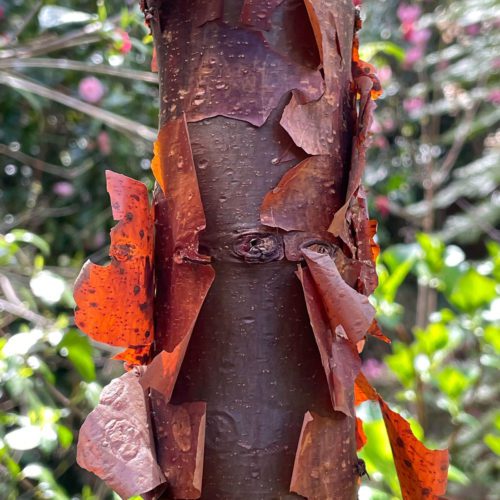
Acer griseum, commonly called the Paperbark Maple, is a maple tree you could grow for the bark alone. It is well known for its attractive peeling bark, which curls away to reveal a smooth coppery-red trunk underneath. The bark looks especially good in winter, particularly after rain when the colour really stands out.

Grown as a small feature tree, Acer griseum has a slow growth rate. A 10-year-old specimen is likely to reach around 3 metres (9 ft) in height, making it a good choice for smaller gardens. Over time it can reach around 9 metres, although this is not often seen in cultivation.
The foliage is a deep green through the growing season, turning brilliant orange to red in autumn. This makes it a good ornamental tree for year-round interest.
In its natural habitat Acer griseum is considered endangered, however it is easy care in cultivation. Many Maple trees are well suited to smaller gardens and make excellent feature trees.
How to Grow Acer griseum
- Position: Best grown in full sun to part shade. In warmer climates some afternoon shade is preferred.
- Soil: Requires a humus-rich, well-drained soil. Adding organic matter will improve soil structure and drainage.
- Mulch: Apply a layer of mulch around the base to help keep the root system cool and retain moisture.
- Watering: Water well during the first 3–4 summers while the tree is establishing.
- Fertiliser: Use a slow release organic fertiliser in early spring as new growth begins.
- Pruning: Little pruning is required, apart from removing dead or damaged branches.
Where to Plant Acer griseum
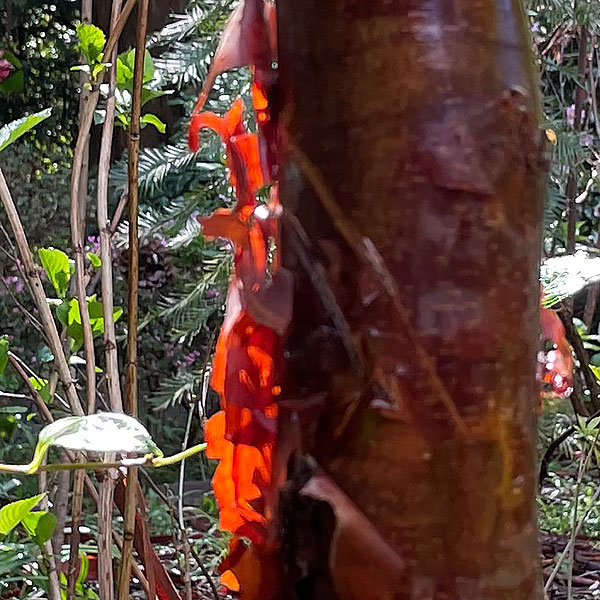
Regarded by landscapers as one of the best small feature trees for interesting bark, Acer griseum is best planted where the attractive peeling bark can be appreciated. Good positions include near a pathway, beside a deck, or close to an outdoor entertaining area where the trunk can be seen up close.
More Trees with Interesting Bark
If you like Acer griseum for its bark, you might also consider:
- Betula utilis var. jacquemontii (Himalayan Birch) – bright white bark that stands out in winter.
- Lagerstroemia indica (Crepe Myrtle) – smooth, mottled bark that peels to reveal multiple colours.
- Eucalyptus pauciflora (Snow Gum) – twisting trunk with patchy cream, grey and green bark.
- Platanus orientalis (Plane Tree) – exfoliating bark with a camouflage pattern effect.
- Prunus serrula (Tibetan Cherry) – glossy mahogany bark with a polished look.