
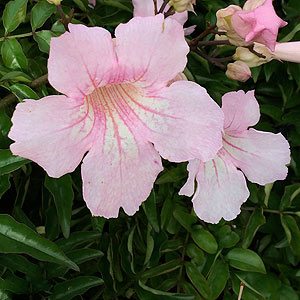
Podranea ricasoliana, commonly known as the Pink Trumpet Vine or Port St Johns Creeper, is a vigorous evergreen climber grown for its masses of soft pink, trumpet-shaped flowers.
Also referred to as Bignonia ricasoliana, this fast-growing vine originates from South Africa and performs well across a wide range of climates, including temperate regions.
Flowering from spring through to late summer, and sometimes into early autumn in warmer areas, the blooms resemble large foxglove-like trumpets and are produced in abundance, making it an excellent choice for covering fences, walls, pergolas, and trellises.
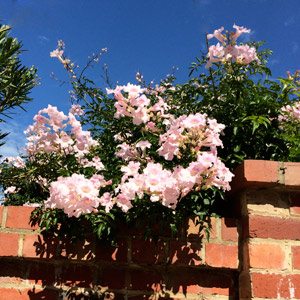
Given ideal conditions, plants can reach over 10 metres in height, however they respond well to pruning and are easily maintained at a manageable size
Growing Conditions and Care
Sun
Best growth and flowering occur in full sun.
- Plant with the root zone shaded and the top growth in full sun for optimal performance.
- Will tolerate light shade, but flowering will be reduced.
- A warm, sheltered position will encourage stronger growth and more prolific blooms.
Watering
Podranea ricasoliana benefits from regular watering, especially during establishment.
- Keep soil consistently moist while establishing.
- Once established, it is moderately drought tolerant but performs best with occasional deep watering.
- Increase watering during extended dry periods and hot summers.
- Avoid waterlogging, as poor drainage can affect root health.
Soil
A fertile, well-drained soil will give the best results.
- Improve soil before planting with well-rotted compost and aged manure.
- Prefers slightly enriched soils but will adapt to average garden conditions.
- Mulch well to keep roots cool and retain moisture.
Fertiliser
Regular feeding will promote strong growth and heavier flowering.
- Apply a balanced slow-release fertiliser in spring.
- Use liquid fertiliser (such as seaweed or compost tea) during the growing season.
- Avoid excessive nitrogen, which can lead to leafy growth at the expense of flowers.
Pruning
This is a vigorous climber that benefits from regular pruning.
- Prune after flowering to control size and shape.
- Can be cut back hard if needed to rejuvenate older plants.
- Light pruning throughout the growing season can help manage growth and encourage branching.
- Train onto supports early to direct growth where needed.
Propagation
Podranea ricasoliana is easy to propagate using several methods.
Cuttings
- Take semi-hardwood cuttings in late spring to summer.
- Use healthy, non-flowering stems.
- Remove lower leaves and plant in a free-draining propagation mix.
- Keep warm and lightly moist until roots develop.
Layering
A very reliable method, particularly for home gardeners.
- Select a low-growing flexible stem.
- Bend it down to the soil and cover a section with soil while still attached to the parent plant.
- Roots will form along the buried section.
- Once established, cut and transplant.
Seed
- Can be grown from seed, although less commonly used.
- Sow in a warm position in well-drained mix.
- Germination is variable and slower than cuttings.
Natural Spread
- Will often self-seed in warm climates.
- Cuttings can root easily if left on moist soil.
This ease of propagation contributes to its tendency to become invasive in some regions.
Growth Habit and Use
A fast-growing climber suited to a range of garden styles.
- Ideal for covering fences, pergolas, arches, and walls.
- Useful for creating shade over outdoor living areas.
- Can be trained as an informal screen or feature climber.
- Suitable for cottage gardens and subtropical-style plantings.
Allow space for growth and provide strong support structures.
Notes on Invasiveness
In warmer climates, Podranea ricasoliana can become invasive.
- Spreads by seed and vegetative growth.
- Prunings left on the ground may take root.
- Regular maintenance will help keep growth under control.