
Nurseries Online
  • Home
  • A-Z Plant Index
  • Trees and Shrubs
    • Fruit Trees
    • Advanced Trees
    • Evergreen Trees
  • Native Plants
  • Roses
  • Buying Plants Online
    • Mail Order Nurseries
    • Retail Plant Nurseries
    • Wholesale Nurseries
  • Garden Pots
  • Water Features for the Garden
  • Garden Accessories
  • About Us
  • Water Features for the Garden
  • Garden Pots
  • Garden Accessories
Home  »  A-Z Plant Index  »  Climbing Plants  »  Mandevilla alice dupont

Mandevilla alice dupont

  • Facebook
  • Pinterest
Mandevilla x amabilis 'Alice dupont'
Mandevilla x amabilis ‘Alice Du Pont’

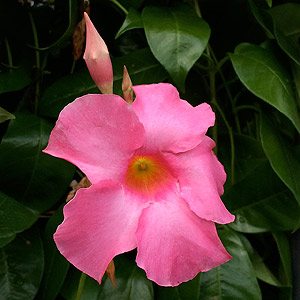
One of the most reliabe of all of the cultivars Mandevilla x amabilis ‘Alice du pont’ with its attractive pink flowers has many desirable characteristics.

This is not a climber that turns rampant, so maintenance is fairly easy. This is an evergreen twining climber, flowers will last around a week and Mandevilla Alice dupont will repeat flower.

All Mandevillas are originally from South America and do like a warm climate, or at least a warm position. They do not like cold wet winters.

In Australia they are reliable from Sydney to North Queensland in all but ranges where winters can get a little cold. The warmer the climate the more shade, and even in the southern states some protection from the hoy afternoon sun is recommended

They also grow well in Victoria and South Australia as long as they are in a warm sunny position, well drained in winter. However they can decide to die back in cold winters, to bounce back in spring.

Where to grow

Mandevilla ‘Alice du pont’ looks great growing on a fence, a trellis or allowed to climb over a shed. Yes you can grow ‘Alice dupont’ in a container,so it could be grown in a courtyard or on a balcony, it will need a trellis of some sort.

  • humus rich soil
  • sunny position, with protection from hot afternoon sun in summer
  • water well in dry or very hot conditions
  • can reach 5m high, but easily pruned.

Care


Very little care other than pruning in spring to remove any growth damaged in the winter or to maintain a more shrubby / bushy habit.

Fertilize with a slow release type fertilizer in spring, mulch well to maintain a cool root run and water with some liquid seaweed fertilizer every month for great flowers.

Comments

Climbing Plants

Climbing Plants
  • Actinidia – How To Plant, Grow and Prune Kiwi Fruit
  • Akebia
  • Allamanda neriifolia
  • Antigonon leptopus
  • Bomarea
  • Bougainvillea
  • Canarina canariensis
  • Clematis
  • Clematis amandii ‘Apple Blossom’
  • Clematis Blue Angel
  • Clematis florida Sieboldii
  • Clematis henryii
  • Clematis maximowicziana
  • Clematis montana
  • Clematis x cartmanii ‘Sweet Hart’
  • Clerodendrum bungei
  • Clerodendrum thomsoniae
  • Climbing Plants
  • Clytostoma callistegioides
  • Cobaea Scandens
  • Dipladenia – The Rock Trumpet
  • Epipremnum aureum – Pothos Plants
  • Ficus pumila
  • Gelsemium sempervirens
  • Gourds
  • Hoyas
  • Humulus lupulus: Growing Hop Plants in the Garden
  • Jasminum polyanthum
  • Lapageria – The Chilean Bellflower
  • Lonicera ‘Honeysuckle’ Plants
  • Mandevilla
  • Mandevilla alice dupont
  • Ornamental Grape
  • Parthenocissus Tricuspidata
  • Passiflora
  • Phaedranthus buccinatorus
  • Philodendron Birkin
  • Podranea ricasoliana
  • Potato Vine
  • Pseudocalymma alliaceum
  • Rhodochiton astrosanguineus
  • Schizophragma hydrangoides
  • Solandra maxima
  • Standard Wisteria
  • Stephanotis floribunda
  • Tecoma capensis ‘Aurea’
  • The Firecracker Honeysuckle
  • Thunbergia gibsonii
  • Tibouchina laxa ‘Skylab’
  • Trachelspermum jasminoides
  • Tropaeolum
  • Tropaeolum tricolor
  • Veronicastrum latifolium
  • Vigna caracalla
  • Virginia Creeper
  • Wisteria
  • Wisteria floribunda
  • Wisteria sinensis

Copyright © 2026 · Advertise with Us · Contact Us