

Anthuriums are some of the most widely grown indoor or houseplants in the world. They are easy to grow, have great foliage and wonderful colourful flowers. They can be grown outdoors in warmer climates, however it is as indoor plants that they are most popular.
The Anthurium plants and species most widely sold as indoor plants include Anthurium andraeanum, commonly known as the Flamingo Flower, Flamingo Lily or Tail Flower. This is one of the most popular indoor plants. However, a number of other species, including Anthurium scherzerianum, are also called the Flamingo Flower. The two are similar, although A. scherzerianum has a distinctive curled or corkscrew-like spadix.
All are relatively easy-care plants and have very few problems when grown in suitable conditions. Large green leaves and very colourful flower bracts in red, pink, orange or white make these an attractive houseplant. They are also popular as cut flowers.
The colourful part that we usually call the flower is actually a spathe, with the small true flowers carried on the central spadix. The spathes are long lasting and are one of the main reasons Anthuriums are so popular indoors and as cut flowers.
For something different, look for the species grown as foliage plants. These include Anthurium plowmanii and Anthurium schlechtendalii, as well as other popular foliage Anthuriums grown for their large, patterned or unusual leaves.
Anthurium Care and Growing Hints
Being a naturally epiphytic plant, and while requiring moisture, Anthuriums also require a well drained growing medium.
Seen as an indoor plant in all but tropical climates, Anthuriums are valued for producing long-lasting white, pink, red and mauve to lavender flowers. They prefer warmth, bright indirect light, good humidity and an open, fast-draining growing medium.
Flowers are very popular in the cut flower industry.
Basic Care
- Grow Anthurium in a well drained soil, a temperature of 25-32°C with a watering regime that lets the soil almost dry out and then give the plant a thorough watering.
- Provide lots of light, but not direct sunlight. Filtered or bright indirect light is ideal.
- After a few years Anthuriums may form aerial roots and a larger clump. This is generally a good time to consider repotting and dividing the plant. Some aerial roots can be guided into the growing medium when repotting.
- A good slow-release fertiliser would be appropriate during active growth.
In summary: IIn cooler climates, grow Anthuriums indoors and warm; in warmer areas, they can be grown outdoors in tropical and subtropical conditions. Provide filtered light wherever you grow them and reduce watering during the cooler months, while still avoiding prolonged dry conditions.
Anthurium Light Requirements
Anthuriums are naturally understory plants, so filtered or bright indirect light is best. A position with plenty of natural light but protected from strong direct sun will generally produce the best results.
Too little light can result in slower growth and fewer flowers, while strong direct sunlight can scorch the leaves. An east or west-facing window can be suitable indoors, depending on the amount of direct sun received.
Watering Anthurium
Anthuriums need moisture, but they do not like sitting in constantly wet soil. Allow the surface of the potting mix to dry slightly before watering thoroughly.
Never leave the pot sitting in water. Good drainage is essential because prolonged wet conditions can lead to root rot. Rainwater or filtered water can be useful, particularly where tap water is hard or heavily treated.
In winter or during cooler conditions, reduce watering as growth slows.
Soil and Potting Mix
Anthuriums require a well drained growing medium. A fine orchid potting mix is a good choice, or use an open aroid-style mix that allows both moisture retention and good drainage.
The important thing is to avoid heavy, waterlogged soil. Anthuriums are naturally adapted to growing in warm, humid conditions and many species are epiphytic, so the roots benefit from air as well as moisture.
Do not overpot. Anthuriums generally grow best with a restricted root run and a pot that is only slightly larger than the existing root system.
Temperature and Humidity
Anthuriums prefer warm conditions and high humidity. A temperature range of around 16–30°C is suitable for general growing, although consistently warm conditions are particularly useful for active growth and flowering. Protect plants from cold conditions, cold draughts and sudden temperature changes.
Provide some extra humidity by sitting the pot on a saucer filled with pebbles and water. The pebbles should raise the pot above the level of the water.
Wet, cold conditions can kill these plants, so overwinter indoors in cooler climates and cut back on water.
Fertilising Anthurium
Fertilise with a slow-release type fertiliser during active growth. A liquid fertiliser can also be used periodically according to the directions on the product.
Avoid over-fertilising. Excess fertiliser can cause salts to build up in the growing medium and may result in yellow or brown leaves.
Repotting Anthurium
Anthuriums do not need to be repotted every year. Repot when the plant has outgrown the container, the growing medium has broken down or the plant has developed a large clump with aerial roots.
The best time to repot Anthuriums is in spring or autumn, when the weather is warm but not excessively hot.
When repotting, use a fresh, free-draining potting mix and avoid moving the plant into a pot that is much larger than the existing root system.
Care Summary
- Excellent drainage – try a fine orchid potting mix.
- Filtered light – These are naturally an understory plant.
- Do not overpot, Anthiriums grow best with a restricted root run.
- Never over water.
- Provide some extra humidity by sitting the pot an a saucer filled with pebbles and water.
The pebbles should raise the pot above the level of the water. - Fertilise with slow release type fertiliser. Use a liquid foliar spray once a month during active growth for improved results.
- Wet cold conditions will kill these plants, so overwinter indoors and cut back on water.
Propagating Anthurium
These are plants that can grow into a clump over time. Established plants can be divided into sections, with each division retaining healthy roots and growing points, and replanted.
If the plant has developed aerial roots, sections of stem with leaves and aerial roots can also be taken and grown on. These can be potted into a free-draining growing medium once established.
It is also possible to propagate Anthuriums from seed. You will need fresh seed and it can be sown directly into pots. Seeds require warmth and humidity to germinate, so use a cloche or the top half of a plastic bottle to provide these conditions.
Germination should occur within several weeks under suitable warm, humid conditions.
When dividing an established plant, avoid unnecessarily removing healthy roots. The aim is to create smaller plants with roots and growing points intact, rather than simply reducing the root system.
Common Problems
Leaves Turning Brown
- One of the most common problems with Anthuriums is the leaves turning brown is usually an indication of over watering. This need to be remedied quickly as it can end up creating a fungal problem and root rot. The solution is stop watering until the soil dries out, you may also wish to consider repotting in a free draining potting mix.
Leaves turning yellow or brown
- This can be caused by over fertilising. The solution is to hold back on fertiliser, and to water the plant well until the water runs through the soil. Then stop watering to allow the soil to dry out. To much fertiliser causes a build up of salts, a deep watering can help flush these away.
Few or No Flowers
If an Anthurium is growing well but not flowering, light is one of the first things to check. Too little light can result in fewer flowers and slower growth.
Move the plant to a brighter position with filtered or indirect light. Avoid strong direct sunlight, which can scorch the leaves.
Anthurium Species and Varieties
Anthurium flowers are also commonly known as the Flamingo Flower, although this common name can refer to more than one species.
Anthurium andraeanum is one of the most widely grown flowering Anthuriums, with glossy green leaves and colourful spathes in red, pink, orange and white.
Anthurium scherzerianum, also known as the Pigtail Plant or Scherzer’s Flamingo Plant, is another popular flowering species. It is generally smaller than A. andraeanum and has the distinctive curled or corkscrew-like spadix.
For foliage, try Anthurium warocqueanum, commonly called the Queen Anthurium, which is grown for its very large, elongated foliage. It is an epiphytic species native to Colombia and is more demanding than the common flowering Anthuriums.
Anthurium hookeri, commonly called the Bird’s Nest Anthurium, is another large-growing type and forms a distinctive rosette of leaves.
Anthurium plowmanii and Anthurium schlechtendalii are also worth looking for if foliage rather than flowers is the main attraction.
Anthurium dussii is another recognised Anthurium species, although it is less commonly encountered as a houseplant.
Are Anthuriums Poisonous?
Anthuriums contain compounds that can cause irritation if parts of the plant are chewed or eaten. Keep plants away from children and pets and wear gloves if handling the plant causes skin irritation.
Anthurium plants are available for sale from the following suppliers


601 Sunnyholt Road Parklea NSW 2768
Parklea Pots and Plants are affordable, open 7 days and have everything you need for your garden - of any size!. Pots, plants, water features, fruit trees, hedging, potting mix and more.
Opening hours 7 days a week from 8:30am to 5pm
www.potsandplants.com.au
Anthuriums for foliage
A number of varieties are mainly grown for their foliage unlike their relatives.
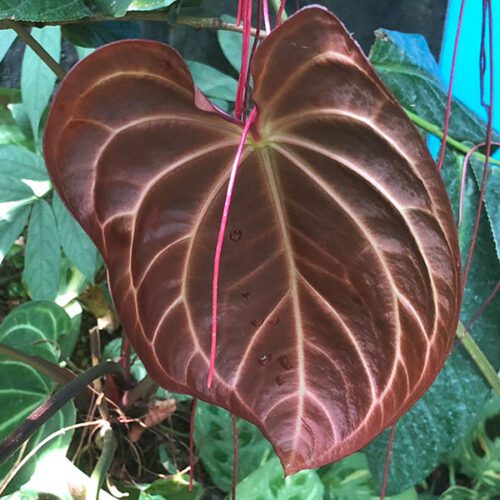
- A. crystallinum has large deep green rounded foliage contrasted with with heavy white veins, an excellent plant for foliage in tropical climates, or indoors.
- A. faustino-mirandae (fausto’s giant) has large glossy foliage.
- A. regale has velvety heavily veined foliage that can reach nearly 2m in length.
- Anthurium plowmanii (Wave Of Love)
- Anthurium schlechtendalii