

Birds Nest Ferns used in landscaping include two species, both wonderful foliage plants yet with different features and requiring different growing conditions.
- Asplenium australasicum is a striking, easy-care rainforest fern native to Australia. With its broad, arching fronds forming a natural “nest” shape, it’s widely used in both indoor and outdoor planting schemes.
- Closely related is Asplenium nidus, another popular Birds Nest Fern species found across tropical regions of Northern Australia, Southeast Asia, and Africa. While they share similarities, there are a few key differences worth understanding before planting.
Difference Between Asplenium australasicum and Asplenium nidus
Although often grouped together, these two species have distinct characteristics:
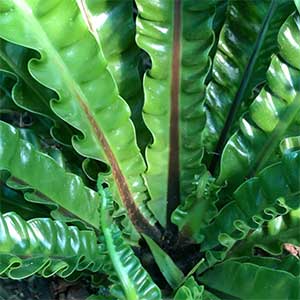
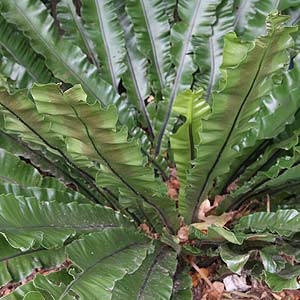
- Asplenium australasicum has broader fronds with a prominent dark brown to black midrib and tends to grow larger overall.
- Asplenium nidus has narrower, brighter green fronds with a lighter central vein and a slightly more compact habit.
- A. australasicum is better suited to cooler climates, including southern regions like Melbourne.
- A. nidus prefers consistently warm, tropical conditions and is more sensitive to cold.
In landscaping, A. australasicum is generally the better choice for temperate gardens, while A. nidus excels in tropical or indoor environments.
How To Grow Asplenium australascium – Birds Nest fern
This fern naturally grows in rainforest conditions, where it can be found on trees (epiphytic), rocks (lithophytic), or in soil.
Key growing conditions:
- Position: Filtered light or dappled shade; avoid direct sun.
- Soil: Humus-rich and well-drained; never waterlogged.
- Water: Keep soil consistently moist, but not wet.
- Climate: Suitable from Queensland down to Melbourne with protection from heavy frost.
The plant forms a rosette of large fronds that create a nest-like shape, making it an excellent feature plant in shaded gardens or large containers.
Growth details:
- Height: Typically 0.75 m, up to 1–2 m in ideal conditions.
- Spread: 1–2 m, sometimes larger on mature plants.
- Foliage: Pale to mid green with a dark central rib.
How to Grow Asplenium nidus – Birds Nest fern
Asplenium nidus thrives in warmer, more humid environments and is commonly grown indoors or in tropical gardens.
Key growing conditions:
- Position: Bright indirect light indoors or deep shade outdoors.
- Soil: Free-draining, organic-rich mix (similar to orchid or fern mixes).
- Water: Regular watering with good drainage; avoid soggy conditions.
- Climate: Best in frost-free zones or as an indoor plant in cooler climates.
Growth details:
- Height: Around 0.5–1 m.
- Spread: Up to 1 m.
- Foliage: Bright green, smooth-edged fronds with a lighter midrib.
Indoors vs Outdoors: Which is Better?
Both species can be grown indoors or outdoors, but suitability differs:
- Asplenium australasicum: Better for outdoor planting in shaded gardens, especially in temperate climates like Melbourne. Can be grown indoors, but prefers more space and airflow.
- Asplenium nidus: Ideal for indoor growing due to its compact size and preference for stable, warm conditions. Outdoors, it performs best in tropical or subtropical regions.
For indoor use, A. nidus is generally the easier and more reliable choice.
The Smaller Growing Birds Nest Ferns
Asplenium antiquum (Japanese Bird’s Nest Fern) is a naturally smaller growing species suited to smaller courtyards as well as indoor and general garden use.
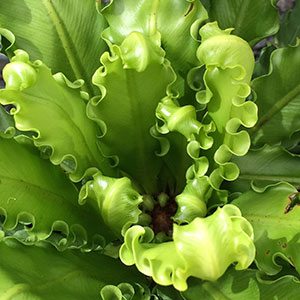
Asplenium nidus ‘Osaka’ — A small architectural fern with glossy green leaves that curl at the edges, forming a dense and tidy rosette.
Landscaping Uses
Asplenium australasicum is highly versatile in the garden:
- Feature plant in shaded positions.
- Mass planting in rainforest-style landscapes.
- Container planting for patios and courtyards.
- Can be mounted as an epiphyte, though most commonly grown in soil.
Its bold foliage makes it an excellent structural plant in low-light areas.
Asplenium nidus works well in warmer climate zones outdoors
- Use it as an understory plant in a tropical garden.
- As a feature plant in a container
- In cooler climates grow this one indoors or a warm microclimate on a patio or courtyard.
Propagation of Birds Nest Ferns
Propagation is typically done via spores rather than division.
Steps:
- Spores form as brown lines on the underside of mature fronds.
- Collect spores when they are dry and ripe.
- Sow onto a sterile, moist growing medium (such as peat or fine compost).
- Keep in a warm, humid environment with indirect light.
- Germination can take several weeks to months.
Unlike many other ferns, Birds Nest Ferns cannot be easily divided, as they grow from a single central crown.
Cultural Notes Summary.
- Position – Filtered light or Dappled shade.
- Soil – Humus rich well drained soil. The Birds nest fern does not to wet soil.
- Height – To around 1.25 metre.
- Spread – To around 1m.
- Folaige – Mid green.
- Fertiliser – In a good soil, Birds nest ferns require very little fertiliser. An application of compost and mulch each year is often sufficient. You can add a little blood and bone to the root zone at this time. You can foliar feed with a seaweed or vermicast tea if you wish.
- Pruning is generally not required, other than the removal of old dead fronds for cosmetic reasons.
Where To Buy

1052 Whittlesea-Kinglake Road Kinglake West 3757
Offering a specialist variety of Australian native Ferns plus Dendrobium/Dockrillia & Sarcochilus species & hybrids in pots, loose, or mounted. Species Cymbidium sauve and maddidum.
www.ferns.com.au

email [email protected]
One of Australia's largest wholesale trade nurseries. Over 30,000 species available, tubestock to advanced trees, an almost unlimited choice of plants.
www.plantmark.com.au