
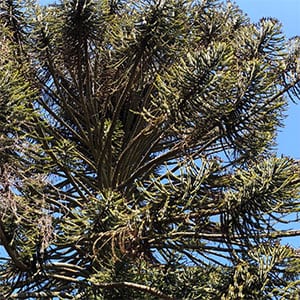
Araucaria bidwillii, commonly known as the Bunya Pine or Bunya Nut Tree, is one of Australia’s most impressive native conifers. Naturally occurring in the rainforests of Queensland, with smaller populations in northern New South Wales, it is now widely grown throughout Australia as a magnificent specimen tree.
Best known for its enormous cones and edible Bunya nuts, this ancient species has remained largely unchanged for millions of years. It is long lived, develops a broad symmetrical crown and makes a striking feature tree for large gardens, parks and rural properties.
In cultivation the Bunya Pine will usually reach around 25–35 metres in height, although in ideal conditions it can grow to around 40 metres.
Bunya Cones and Nuts
This is no ordinary pine tree and probably not one to sit beneath when the cones are maturing. Mature cones can weigh up to 10 kilograms and fall from considerable heights, so avoid planting where people regularly gather, beside paths or near driveways.
The large cones contain edible Bunya nuts that have been valued as a food source by Aboriginal Australians for thousands of years. The nuts can be roasted, boiled or baked and have a flavour often compared to chestnuts.
Growing Araucaria bidwillii
Bunya Pine grows best in full sun with deep, humus-rich, well-drained soil. Once established it is a tough tree that requires little maintenance, although regular watering through the first few summers will encourage strong growth.
Mulch around the base of young trees to conserve moisture and suppress weeds, keeping mulch away from the trunk. A slow-release native fertiliser or well-rotted compost applied in spring will assist growth while the tree is establishing.
Because of its eventual size, Bunya Pine is best suited to large gardens, parks and rural properties where there is plenty of room for the canopy and root system to develop.
Container Growing
Young plants grow well in containers and make attractive specimen plants indoors or on patios for a number of years. As they mature they will eventually require planting into the ground if they are to reach their full size.
Pruning
Very little pruning is required. Remove only dead, damaged or diseased branches as needed.
Propagation
Propagation is usually from fresh seed, which germinates readily when planted soon after harvest.
Landscape Uses
Bunya Pine is widely used as a feature tree in botanic gardens, parks and large landscapes. Its symmetrical habit and distinctive foliage make it an outstanding specimen, although its eventual size and heavy cones make it unsuitable for smaller suburban gardens.
Summmary Information
- Botanical Name – Araucaria bidwillii
- Common Names – Bunya Pine.
- Family – Araucaracae
- Position – Full sun.
- Soil – Humus rich well drained.
- Height – To around 35 metres sometimes smaller.
- Spread To around 15 metres in larger specimens.
- Growth rate – Medium.
- Flowers – Large Cones.
- Flowering Time – Spring
- Foliage – Mid green
- Frost tolerant – Light frosts once established
- Drought tolerant – Medium once established.
- Container growing – When young
Where To Buy

email [email protected]
One of Australia's largest wholesale trade nurseries. Over 30,000 species available, tubestock to advanced trees, an almost unlimited choice of plants.
www.plantmark.com.au
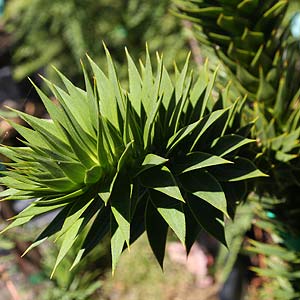
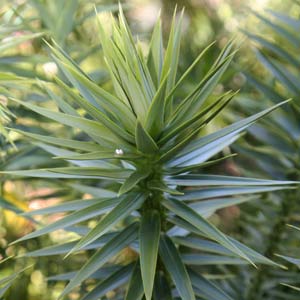
More Araucaria Species


Frequently Asked Questions
Are Bunya nuts edible?
Yes. The nuts inside the large cones are edible and can be roasted, boiled or baked. They have a mild flavour often compared to chestnuts.
How big does a Bunya Pine grow?
In cultivation most trees reach between 25 and 35 metres, although they can grow taller in ideal conditions.
How heavy are Bunya Pine cones?
Large mature cones may weigh up to 10 kilograms, so avoid planting the tree where falling cones could create a hazard.
Can Bunya Pine be grown in a pot?
Yes. Young plants grow well in containers, although they eventually need to be planted into the ground.
Is Bunya Pine suitable for small gardens?
No. Because of its eventual height, broad canopy and very heavy cones, it is best grown in large gardens, parks and rural landscapes.