

Araucaria are a group of evergreen conifers known for their striking, symmetrical forms, distinctive branching and impressive scale. Most gardeners will recognise several of these iconic trees, even if they don’t know the particular Araucaria Species by name.
Widely planted in parks and gardens across Australia, Araucaria species are valued as handsome landscaping trees, outstanding feature trees and effective windbreaks. Most are large-growing specimens best suited to broader landscape plantings where they have room to develop their full character and impressive form.
A growing number of specialist nurseries now produce these hardy and magnificent trees. While some species are native to Australia, others originate from South America (particularly Brazil, Chile and Argentina), New Caledonia and Norfolk Island.
The Norfolk Island Pine (Araucaria heterophylla) is by far the best-known Araucaria Species and is widely planted in coastal locations throughout Australia. Once established, all Araucaria species tolerate high temperatures, and many also cope well with coastal conditions, wind and salt spray. Interestingly, several species are commonly grown as indoor plants in Europe and other cooler climates.
Using Araucaria Species in Gardens and Landscaping
Araucaria species bring a bold architectural presence that few other trees can match. Their strong vertical lines, tiered branching and dense evergreen foliage create year-round structure and make them exceptional specimen trees.
In larger gardens and parks they are frequently planted as feature trees, where their distinctive silhouette can be appreciated from a distance. Positioned on an open lawn or at the end of a long vista, they become living sculptures that anchor the landscape. Because of their eventual size, they are ideal for estates, golf courses, public reserves, coastal properties and other expansive landscapes.
Many Araucaria Species also perform exceptionally well as windbreaks and shelter belts, particularly in exposed or seaside locations. Their tough, resilient nature and tolerance of salt-laden winds make them valuable for protecting more tender plants while creating comfortable microclimates.
In contemporary landscape design, Araucaria are increasingly used in avenue plantings and formal groupings. Their naturally symmetrical habit creates dramatic visual avenues, while their elevated canopy allows sufficient light for shrubs and groundcovers beneath.
Although most Araucaria Species eventually become large trees, some slower-growing species—particularly several endemic New Caledonian species—remain more restrained for many years. Even these smaller-growing species can eventually reach 10–20 metres or more under favourable conditions.
Their adaptability to a range of soil types, relatively low water requirements once established and excellent longevity make Araucaria practical as well as beautiful additions to larger gardens.
Whether used to evoke the grandeur of a coastal estate or simply to add a touch of prehistoric drama to the landscape, Araucaria Species reward gardeners with timeless elegance and commanding presence.
Popular Araucaria Species
The following are among the most widely grown Araucaria species.
- Araucaria cunninghamii — Hoop Pine
Commonly known as the Hoop Pine, this long-lived Australian native can reach 60 metres or more. It is widely used in parks, large gardens and commercial landscaping. - Araucaria heterophylla — Norfolk Island Pine
Perhaps the best-known species, the Norfolk Island Pine is a familiar sight along Australia’s coastline. It has a naturally symmetrical form and excellent tolerance of coastal conditions. Despite its common name, it is not a true pine. - Araucaria bidwillii — Bunya Pine
The Bunya Pine is famous for producing enormous cones weighing between 8 and 12 kilograms. Native to Queensland, it develops into a magnificent specimen tree for large landscapes. - Araucaria araucana — Monkey Puzzle Tree
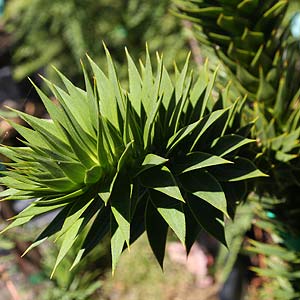
- Known as the Monkey Puzzle Tree, this distinctive South American species has rigid, sharply pointed foliage that discourages climbing and creates one of the most recognisable silhouettes of any conifer.
- Araucaria angustifolia — Paraná Pine
Native to southern Brazil, this attractive species develops a pyramidal habit while young before maturing into its distinctive umbrella-shaped crown. It also produces edible seeds commonly known as pine nuts. - Araucaria columnaris — Cook Pine
A tall, slender species with a narrow upright habit, the Cook Pine is commonly planted in coastal areas and is sometimes grown indoors as a living Christmas tree. - Araucaria montana
Recognised by its distinctive flattened crown and upright habit, this New Caledonian species is less commonly grown but highly ornamental. - Araucaria luxurians
Another attractive New Caledonian species, Araucaria luxurians develops a narrow conical crown and makes an elegant feature tree in suitable climates.
Why Grow an Araucaria?
Araucaria are unlike almost any other group of landscape trees. Their symmetrical form, evergreen foliage and extraordinary longevity give them a presence that only improves with age. Whether planted as a specimen tree, used to frame a driveway or grown as part of a larger landscape, they provide year-round structure with relatively little maintenance once established.
Although many species eventually become large trees, careful selection allows gardeners to choose one suited to the available space. With excellent tolerance of coastal conditions, drought resilience once established and the ability to live for generations, Araucaria remain among the finest evergreen trees for Australian landscapes.
For gardeners seeking a tree with history, character and lasting beauty, few genera can rival the timeless appeal of Araucaria.
Growing Araucaria Trees
Araucaria species are generally easy trees to establish provided they are planted in the right position. Most prefer a sunny, open location where they can develop their natural shape without competition from surrounding trees.
They grow best in well-drained soils but are adaptable to a wide range of soil types, from sandy coastal soils to heavier loams, provided drainage is adequate. While newly planted trees benefit from regular watering during their first few summers, established specimens are remarkably drought tolerant.
Most species require very little fertiliser once established. A light application of a balanced slow-release fertiliser in spring is usually sufficient to encourage healthy growth in younger trees.
Very little pruning is required. Damaged or dead branches can be removed if necessary, however the natural symmetrical habit is one of the tree’s greatest attractions and is best left unaltered. The main leader should never be removed as this can permanently affect the tree’s form.
Many Araucaria species tolerate coastal conditions extremely well, making them excellent choices for seaside gardens. Frost tolerance varies between species, with Australian natives such as Hoop Pine and Bunya Pine generally coping with light frosts once established, while Norfolk Island Pine is better suited to frost-free or only lightly frosted climates
How Fast Do Araucaria Trees Grow?
Growth rates vary between species, climate and growing conditions, however most Araucaria are regarded as moderate-growing trees when young before slowing as they mature.
In good conditions, many species will put on between 30 and 60 cm of growth each year. Faster growth is usually achieved in deep, well-drained soils with regular moisture during the establishment period.
Although they can take many years to reach their ultimate height, this is one of the reasons Araucaria have become such long-lived landscape trees. Many specimens planted more than a century ago continue to thrive in parks, botanic gardens and private estates.
Mature height varies considerably between species. Smaller New Caledonian species may eventually reach 10–20 metres, while larger species such as the Hoop Pine, Bunya Pine and Norfolk Island Pine commonly grow to between 40 and 60 metres in favourable conditions.
Because these trees are capable of living for many decades, and in some cases well over 100 years, it is always worth considering their eventual size before planting.
Araucaria Species Comparison
Although all Araucaria share the same distinctive architectural form, each species has characteristics that make it better suited to particular landscapes.
| Species | Mature Height | Origin | Best Landscape Use |
|---|---|---|---|
| Araucaria heterophylla (Norfolk Island Pine) | 40–60 m | Norfolk Island | Coastal plantings, feature tree |
| Araucaria cunninghamii (Hoop Pine) | Up to 60 m | Australia | Large gardens, parks, windbreaks |
| Araucaria bidwillii (Bunya Pine) | 35–45 m | Queensland | Feature tree, large landscapes |
| Araucaria araucana (Monkey Puzzle Tree) | 20–30 m | Chile & Argentina | Specimen tree |
| Araucaria angustifolia (Paraná Pine) | 25–40 m | Brazil | Large gardens, edible seed production |
| Araucaria columnaris (Cook Pine) | 40–60 m | New Caledonia | Coastal avenues, feature planting |
| Araucaria montana | 15–25 m | New Caledonia | Botanical collections, specimen tree |
| Araucaria luxurians | 15–30 m | New Caledonia | Feature tree, larger gardens |
Regardless of species, Araucaria are best suited to situations where their mature size can be accommodated. Given adequate space, they become some of the most impressive and long-lived trees available for Australian landscapes.
More Araucaria Species


Frequently Asked Questions
How big do Araucaria trees grow?
The eventual size depends on the actual Araucaria Species. Smaller New Caledonian species may mature at around 10–20 metres, while larger species including Hoop Pine, Norfolk Island Pine and Bunya Pine commonly exceed 40 metres and may reach around 60 metres in ideal conditions.
Are Araucaria trees fast growing?
Most Araucaria Species are regarded as moderate-growing. Growth is generally strongest while the tree is young, slowing as it matures. Good soil preparation, regular watering during establishment and a sunny position will encourage steady growth.
Can Araucaria be grown in pots?
Young plants can be successfully grown in containers for a number of years, particularly Norfolk Island Pine, which is widely sold as an indoor or patio plant. Eventually, however, most species require planting into the ground if they are to develop into healthy mature trees.
Which Araucaria species are native to Australia?
Australia is home to two of the best-known species, the Hoop Pine (Araucaria cunninghamii) and the Bunya Pine (Araucaria bidwillii). Other species originate from Norfolk Island, New Caledonia and South America.
Are Araucaria trees drought tolerant?
Once established, most species tolerate extended dry periods remarkably well. Like most trees, they perform best with occasional deep watering during prolonged drought, particularly in their early years.
What is the difference between a Norfolk Island Pine and a Cook Pine?
The two species are closely related and often confused. Norfolk Island Pine (Araucaria heterophylla) develops a broader, more symmetrical crown with widely spaced branches, while Cook Pine (Araucaria columnaris) is noticeably narrower and more upright, often developing a slight lean as it matures. Both make excellent coastal trees and are widely planted throughout warmer regions of Australia.
Where To Buy

email [email protected]
One of Australia's largest wholesale trade nurseries. Over 30,000 species available, tubestock to advanced trees, an almost unlimited choice of plants.
www.plantmark.com.au
History and Natural Distribution
Araucaria are among the world’s oldest groups of living conifers, with a history that stretches back more than 200 million years to the time of the dinosaurs. Fossil evidence shows that members of the genus were once widespread across the ancient supercontinent of Gondwana, long before Australia, South America and New Caledonia became separated.
Today, only a small number of Araucaria species remain in the wild. Their natural distribution is largely confined to Australia, Norfolk Island, New Caledonia, Papua New Guinea and parts of South America, particularly Brazil, Chile and Argentina. Many of these species have evolved in isolated environments and occur nowhere else in the world.
Australia is home to two well-known native species, the Hoop Pine (Araucaria cunninghamii) and the Bunya Pine (Araucaria bidwillii), both of which have played an important role in Australian forests for thousands of years. New Caledonia is recognised as a centre of diversity for the genus, with more than a dozen endemic species occurring naturally across the island’s varied landscapes.
Their ancient origins, remarkable longevity and distinctive architectural form have made Araucaria highly valued as ornamental and landscape trees throughout the world. Many species are now cultivated far beyond their natural range, where they have become familiar features in parks, botanic gardens and coastal landscapes.