
Grown as garden plants for many years, Vireya Rhododendrons are increasingly popular and are an easy care garden plant.
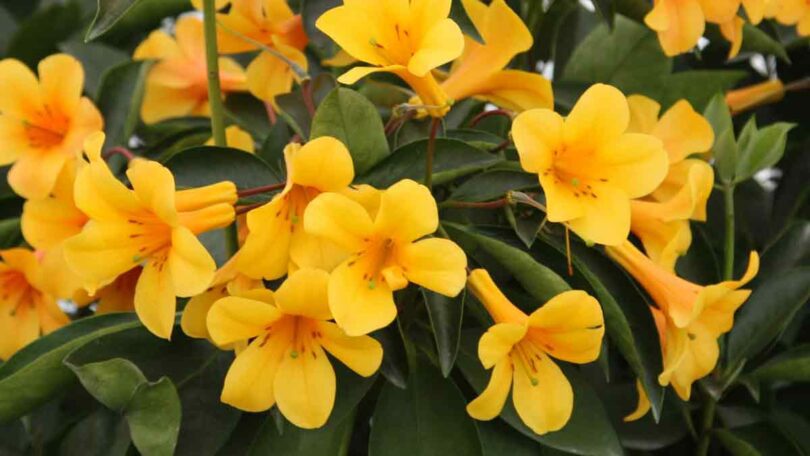
They grow well in part shade, most are small in size and many varieties are suited to cooler climates.
With many new cultivars available for sale from nurseries and specialist growers, some of the best varieties of these wonderful plants are readily available online.
How To Grow Vireya rhododendrons
Often seen as a tropical plant they do in fact grow well in cooler climate zones and will thrive in a sheltered position in the garden border.
Most are small shrubs reaching around 1 – 2m in height. Some are better suited to part shade than others.
Planting Vireya Rhododendons
Choose a position in filtered light, a deciduous tree can be ideal. A frost free dappled shade is the best position, with a well drained humus rich soil. Mulch well with an open mulch. The right time to apply liquid fertilizer is in Spring and Autumn.
Depending on the soil and the slope of the land, either plant on a mound or in the ground in a hole.
Vireyas do not like wet soil, they like moisture but not wet soils. So on slopes, or very free draining soils, you can plant them in the ground, perhaps mix in a little extra drainage material.
Best Planting Method.
- Choose a warm position in dappled shade – you are looking for bright dappled shade.
- A frost free position is essential.
- Dig the soil over and weed.
- Build up a mound of new soil on top, around 6 inches (15 cm) deep.
- Plant the Vireya onto the mound, this will ensure good drainage.
- Plant your Vireya, stake it and water in well with a liquid seaweed fertiliser.
- Apply a thick layer of mulch around the plant, again 6 inches (15 cm) deep.
Ongoing Care
- Fertilise regularly with a liquid fertiliser, we use Powerfeed.
- Small regular applications of fertiliser work best.
- An application of blood and bone each spring will enhance growth.
- Tip Prune to encourage a bushy growth habit.
Problems
- If the foliage if not looking very green, try a foliar spray of iron chelates, also water the plant with the same mixture.
Landscaping uses
Vireya Rhododendrons, are becoming increasingly popular in landscaping applications for the colorful flowers. More varieties are available from selected wholesale nurseries each year.
With colorful flowers they make great specimens in a pot on a sheltered patio or verandah as well as in the garden itself.
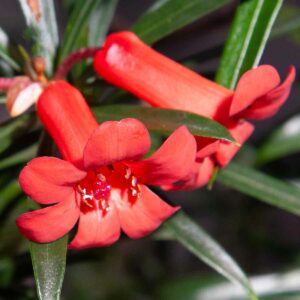
They can be grown in the garden, and they are an excellent choice for growing in containers, some forms that have a weeping habit can also be grown in hanging baskets.
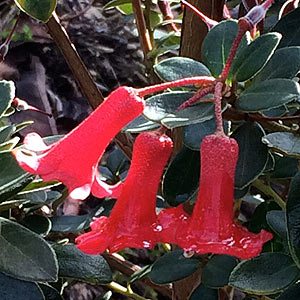
Pictured is the species Vireya Stenophyllum, however it is the colorful hybrids that are increasingly popular with gardeners.
How to Prune Vireya Rhododendrons
You can tip prune to maintain shape, long leggy stems can be removed after flowering is complete.
Always prune to a set of nodes, and always deadhead to promote new flowers and a bushy habit.
The best time to prune to shape is during spring through to early summer. Look for a good healthy section of leaf growth on the stem and prune just above this. Removal of spent flower heads and seed pods can be carried out at any time.
How to propagate Vireyas from cuttings
Vireyas strike easily from cuttings, and these can be taken at any time of the year. What you should look for is new growth that has hardened off a little, but not old woody growth.
- Cuttings should be around 10cm and ensure the cut is clean.
- Remove the outer layer of bark for 4cm at the end you are going to plant.
- Cut back the foliage by at least 1/2.
- Use a rooting hormone, liquid or powder and you are ready to put the cuttings into the growing media.
- About 5cm below the soil mix, and the rest above the mix. A fine pine bark mix works well.
- A greenhouse really helps to maintain the humidity, a little bottom heat is also useful, however a plastic bag over the top can do the same job.
- Cuttings should be kept moist, a spray with a misting spray now and then works well.
- In 12 weeks or so the cuttings should have developed a root system.
- You now have successfully taken your first cuttings.
Two Types of Vireya Rhododendrons
Both tropical and cool climate types are available, the tropical types will tolerate cold winters and hot summers, the cool climate varieties do not grow well in the hot tropical areas.
They are one of the most under rated rhododendron plants available for sale. Size wise, these are not as big as their cousins, however the flowers are beautiful. Many have colourful flowers, and the ability grow and flower well in shady positions is a real attraction.
Sometimes seen as a tropical plant, they are actually very versatile. In Australia they grow well in Queensland right through to the Dandenong Ranges. Always grow them in a sheltered position away from frosts and in a humus rich free draining soil.
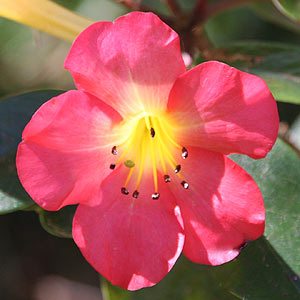
In terms or origin, Vireya Rhododendrons are small species of evergreen group of shrubs originally from the tropical forests of New Guinea, Borneo and the Philippines.
Summary
- Plant Vireyas in dappled shade NOT full sun.
- Good drainage and a humus rich soil
- Mulch to maintain a cool root run
- Always water well both before and after fertilizing to prevent root burn
- Do not dig around the base of the plant, Vireyas resent root disturbance.
- Vireyas grow well in containers and pots
You may also like


Where To Buy
Larger specimen plants suited for use by landscapers as well as those looking for ‘instant’ display plants are available from some nureries.

470 Monbulk-Silvan Road Monbulk VIC 3793
"Guaranteed mail order flowering bulbs, perennials, roses, trees, landscaping plants, garden accessories and community fundraising Austra lia-wide."
www.gardenexpress.com.au
Wholesale Suppliers

email [email protected]
One of Australia's largest wholesale trade nurseries. Over 30,000 species available, tubestock to advanced trees, an almost unlimited choice of plants.
www.plantmark.com.au
Wishing Well Nursery – PH 03 97566107
407 -409 Monbulk Rd Monbulk VIC. 3793
Fruit Trees, Roses, Perennials Rhododendrons and annuals. Includes Avocados for cold climates, persimmon and Olives.
National Rhododendon Gardens – Phone 13 1963
The Georgian Rd, Olinda VIC 3788
Rhododendrons, Camellias and some Vireyas