
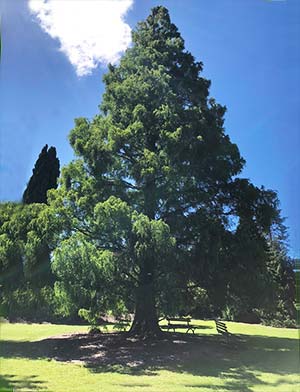
The Dawn Redwood
Metasequoia glyptostroboides is commonly known as the Dawn Redwood.
Once thought to be extinct and known only from fossil records, the Dawn Redwood was rediscovered in its native China during the 1940s. Today the species is protected in China and is grown in parks, arboretums and large gardens around the world.
This is a deciduous conifer, fast growing and an excellent specimen tree for larger gardens and parks.
Some magnificent examples can be found in Tasmania at the Eugenana Arboretum, where the cool climate and fertile soils suit it well. It can be used to create avenues or incorporated into larger landscape plantings in parks, rural properties and golf courses.
The bark becomes deeply fissured as the tree matures and each tree produces both male and female cones. With a naturally pyramidal habit and a buttressed trunk, this is a strong and stately tree.
Dawn Redwood Quick Facts
- Botanical Name – Metasequoia glyptostroboides
- Common Name – Dawn Redwood
- Plant Type – Deciduous conifer
- Height – 20 – 40 metres
- Spread – 6 – 12 metres
- Position – Full sun
- Soil – Moist, fertile soil
- Growth Rate – Fast
- Frost Tolerant – Yes
- Drought Tolerant – Moderate once established
Native Habitat
The Dawn Redwood is native to central China where it grows naturally in moist valleys and along waterways. This natural habitat explains its preference for fertile soils with reliable moisture and its ability to tolerate occasional flooding.
How To Grow the Dawn Redwood – Basic Care
This is a cool climate conifer and performs best in cooler regions and foothill areas where summers are not excessively hot.
A humus-rich moist soil is ideal. Although it prefers fertile soils, it will tolerate heavy soils, seasonal waterlogging and short periods of standing water once established.
This is a tree with a vigorous root system and it should be planted well away from buildings, paths, drainage pipes and paved areas. Allow at least 7 metres clearance as a guide.
Climate
The Dawn Redwood grows best in cool to temperate climates with reliable rainfall. It performs particularly well in Tasmania, southern Victoria and other regions where summer temperatures are moderate.
Once established it is reasonably hardy, however prolonged drought can affect growth and foliage quality.
Landscape Uses
The Dawn Redwood is widely used as a specimen tree where there is room for it to develop its full form. It is also suitable for avenue planting, large public gardens, arboretums, parks and rural landscapes.
Its attractive foliage, rapid growth and excellent autumn colour make it one of the finest deciduous conifers available for larger gardens.
A Tree with an Extraordinary History
One reason for the popularity of the Dawn Redwood is that it is often referred to as a “living fossil”. Unlike most ornamental trees, it was first known from fossil records before living specimens were discovered in China. Seeds were subsequently distributed to arboretums and botanical gardens around the world, helping to secure the future of the species.
Growth Rate
This is a fast-growing tree and in favourable conditions young specimens can put on between 60cm and 1 metre of growth each year.
Propagation
Usually grown from seed, although selected cultivars are propagated by cuttings and grafting to maintain their characteristics.
Popular Cultivars
- Gold Rush – A popular form with attractive golden foliage through spring and summer.
- Ogon (Golden Ogi) – Noted for its bright yellow foliage and strong contrast in the landscape.
Summary Information
- Common Name – Dawn Redwood, Golden Ogi, Gold Rush Redwood.
- Botanical Name – Metasequoia glyptostroboides
- Soil – Well drained, moist and humus rich. It will survive in wet soils.
- Position – Full sun
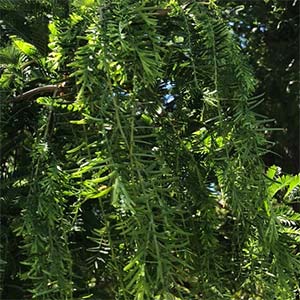
- Foliage – Mid to deep green with a very appearance. Turns a golden pink before dropping the leaves in winter.
- Flowers – Produces cones.
- Flowering time – Insignificant.
- Growth Rate – Fast.
- Height – To 20 – 40 metre (65 – 130 ft)
- Root system – Vigourous.
- Spread – 6 metres plus
- Frost tolerant – Yes
- Drought tolerant – No
- Pruning – Not generally required although lower limbs are sometimes removed for access.
Frequently Asked Questions
Is the Dawn Redwood evergreen?
No. Unlike most conifers, the Dawn Redwood is deciduous and sheds its foliage during winter after developing attractive autumn colour.
How fast does the Dawn Redwood grow?
It is regarded as a fast-growing tree and can add 60cm to 1 metre of growth per year when planted in suitable conditions.
Can Dawn Redwood tolerate wet soils?
Yes. It is one of the few conifers that will tolerate wet soils and occasional waterlogging once established.
Can Dawn Redwood be grown in a small garden?
Generally it is not recommended for smaller gardens. The mature size and vigorous root system make it better suited to larger properties, parks and arboretums.
Notable Specimens and Collections
Since its rediscovery in China during the 1940s, the Dawn Redwood has been widely planted in arboretums and botanical gardens around the world. Some of the finest specimens can be found in:
- Arnold Arboretum – One of the first institutions to receive seed collected from China. The Dawn Redwood became so important to the collection that it was later described as the “tree of the century” by the arboretum.
- Cambridge University Botanic Garden – Home to several mature specimens, including trees grown from some of the earliest seed introductions outside China.
- The Dawes Arboretum – Holds one of the largest accredited collections of Dawn Redwood cultivars and wild-origin material outside China.
- Bailey Arboretum – Home to a famous specimen that was reported to have one of the largest trunk girths of any cultivated Dawn Redwood in the world.
- Eugenana Arboretum – Features some outstanding examples of Dawn Redwood growing in conditions very similar to those found in its native habitat.
The Largest Dawn Redwoods
Although still relatively new to cultivation compared with many tree species, some specimens have already exceeded 40 metres in height. Particularly notable trees can be found in the eastern United States, where favourable growing conditions have allowed them to develop rapidly.
Where To Buy
Available for sale from the following Nurseries

"Propagation and Production of Native and Exotic Trees
with Natural Root Systems from 2 to 2,000 lts."
www.njrivett.com.au

Carey Gully, Adelaide Hills.
Family business selling a large range of deciduous trees in pots 1-4m high. Crepe myrtle specialist. Includes Ornamental pears & plums, Red maples, Japanese maples, Gingko, Cercis, Ash, Birch, Crab apples, Weeping cherries, Gleditsia, Liquidambar and more. Hedging plants, evergreen trees & fruit trees.
www.adelaidetreefarm.com.au