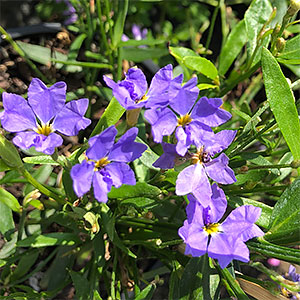
Dampiera is a charming genus of Australian native plants admired for its vivid blue to purple flowers and hardy nature. With over 50 recognized species spread across Australia—from Western Australia’s Dampiera diversifolia to the cool coastal areas of Queensland—these versatile perennials thrive in sunny, well-drained locations and slowly form neat, suckering clumps over time.
Known for their long flowering season and low maintenance needs, Dampieras add vibrant colour and texture to native gardens, rockeries, and containers. They’ve proven their garden-worthiness in many regions, including Karwarra Gardens in Victoria’s Dandenong Ranges.

Most species will grow in light shade, however they do tend to get ‘leggy’ and do not flower as well as they do when grown in full sun. They also do not like humidity, so tropical climates do not suit.
They are a wide spread genus. Found across Australia, from Western Australia (D. diversifolia and others) to Queensland, so with that sort of spread they are a diverse lot.
With over 50 species in the genus, variety occurs in foliage form, size and flower colour. The flower colour will vary form blue to purple and pale mauve.

How to grow Dampiera – Basic Care
Grow Dampiera in humus-rich, well-drained soil with at least 6 hours of morning sun; light afternoon shade prevents legginess in hotter areas.
- Light: Full sun is best for compact growth and abundant blooms. Most species tolerate light shade but may become leggy or flower less.
- Soil: Plant in well-drained, sandy or loamy soil. Improve drainage with grit or scoria, and avoid heavy clay or humid tropical zones.
- Watering: Deep water every 2–3 weeks through the first summer; mature plants handle dry spells well.
- Fertiliser: Use low-phosphorus native formulations (e.g. Troforte M) in spring where soils are poor. Dampiera rarely needs heavy feeding.
- Mulching: A layer of organic mulch helps retain moisture and keeps roots cool.
- Pruning: Lightly trim after flowering to encourage bushiness and repeat blooming.
Pro tip for Victoria: Plant in autumn for root establishment before summer heat.
Popular Dampiera Varieties
| D. linearis ‘Blue Moon’ | Compact, deep blue flowers, long bloom Suits Rockeries, containers, coastal. – 0.5m H / 0.6m W |
| D. purpurea (Purple Dampiera) | Suckering, purple-blue flowers, frost-tolerant Suits Open woodland, mass planting – 0.3-0.6m H / spreading |
| D. rosmarinifolia | Will reach around 70 cm in height |
| D. diversifolia | Prostrate, bright blue-purple, drought-hardy, Suits Groundcover, low borders – 0.25m H / 1m W |
| D. alata (Winged Dampiera) | Vigorous groundcover, blue flowers suits Meadows, early succession planting, Low-spreading |
| D. stricta | Compact, blue flowers post-fire suits Edges, well-drained beds. 0.1-0.3m H. Dampiera stricta ‘Glasshouse Glory‘ is from the cooler areas of Queensland and is very popular. |
Common Dampiera Species and Varieties
Below are some of the most popular Dampiera species found in cultivation, along with their common names and growth habits.
Low-growing and Groundcover Types
- Dampiera diversifolia (Kangaroo Lobelia): Prostrate, bright blue–purple flowers, drought-resistant. Ideal for groundcover and borders (0.25m H / 1m W).
- Dampiera linearis (Common or Wedge-leaved Dampiera): Upright, suckering habit (15–60cm H). Many named cultivars, including ‘Blue Moon’ and ‘Violet Princess’.
- Dampiera stricta (Blue Dampiera): Compact species with deep blue flowers; tolerates light shade and cooler climates. Cultivar ‘Glasshouse Glory’ is especially popular.
- Dampiera alata (Winged-stem Dampiera): Vigorous, spreading groundcover with bright blue flowers—excellent for meadow and succession planting.
Medium to Tall Shrubby Types
- Dampiera purpurea (Mountain or Purple Dampiera): Frost-tolerant, suckering perennial with purple-blue flowers (0.3–0.6m high). Great for mass plantings or woodland edges.
- Dampiera altissima (Tall Dampiera): The tallest species, reaching 0.5–1m. Striking purple-blue flowers native to Western Australia.
- Dampiera lanceolata var. lanceolata (Grooved or Lance-leaf Dampiera): Erect shrub to 1m tall.
- Dampiera dysantha (Shrubby Dampiera): Compact, twiggy shrub to 70cm high.
- Dampiera galbraithiana: Erect perennial herb around 60cm tall.
Other distinct species include D. eriocephala (Woolly-headed Dampiera), D. fusca (Kydra Dampiera), D. hederacea (Karri Dampiera), and D. sylvestris (Blue Beauty-bush).
Propagation and Maintenance
Dampieras propagate easily from cuttings or sucker divisions during spring. D. linearis often roots readily in water or sandy mixes.
- Tip prune twice yearly to maintain shape and promote fresh growth.
- Drainage is crucial during wet winters to prevent rot.
- Containers: Use pots with good drainage and native soil mixes for a compact, long-blooming display
Best Dampiera Species for the Garden
Dampiera diversifolia (Blue Dampiera)
Its mat forming and makes a good groundcover. Amazing blue flowers and it also grows well for coastal conditions.
Climate range: Best suited to warm temperate to subtropical climates, including coastal regions. Tolerates some dryness once established but prefers well-drained soils.
Dampiera linearis (Upright/Spreading Dampiera)
A more upright to spreading species with narrow foliage and vivid blue flowers. It works well as a low filler plant in native borders and mixed plantings, adding colour through the warmer months. Less dense than groundcover forms, but useful for structure and contrast.
Climate range: Adaptable to a range of climates from temperate through to semi-arid regions. Handles drier conditions better than some species once established, provided drainage is good.
Dampiera purpurea (Mountain Dampiera)
A hardy, low-growing species with a spreading habit, suited to cooler regions. It produces masses of rich blue to purple flowers and is well suited to rockeries and naturalistic plantings. Performs well in more exposed positions compared to other species.
Climate range: Best in cool temperate to alpine and tableland regions. More tolerant of cold and light frost than other Dampiera species.
Other Popular Dampiera Species to Consider
- Dampiera stricta – A variable species with an upright habit and bright blue flowers, often used in native gardens for its adaptability.
- Dampiera triloba – A low-growing, spreading plant suited to sandy soils and coastal conditions.
- Dampiera rosmarinifolia – Fine, rosemary-like foliage with a neat habit, useful for borders and smaller spaces.
Endemic Range and Family
Dampiera belongs to the Goodeniaceae family and is endemic to Australia. Wild populations occur from Western Australia across to Queensland, with Dampiera purpurea especially common along the southeast coast—from southern Queensland through New South Wales and into Victoria.
While most species prefer full sun, varieties such as D. diversifolia, D. stricta, and D. purpurea also perform well in light shade—making them adaptable across Australian garden conditions. Cultivars often differ in size structure, and flowering intensity, selected for their garden appeal and resilience.
We are Asked
How to Keep Damiera from getting Leggy
Increase sun exposure
Why is my Dapiera not flowering well
Check proper drainage and fertiliser use.
Can Dampiera handle frost?
Yes, most tolerate light frosts to -3°C. Check with your local nursery for species specific tolerance.
More Damperia