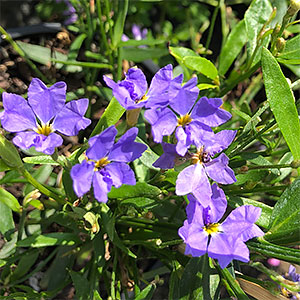
Dampiera linearis, commonly called Common Dampiera, is a small, spreading Australian native valued for its vivid blue to violet flowers and neat habit. It works well as a groundcover, tumbling over rocks, or softening the edge of paths and native garden beds.

This is a low, branching perennial with narrow wedge‑shaped to linear leaves held on wiry stems. Plants form a loose mat or small mound, ideal for filling gaps between other natives or spilling over rock walls.
Bright blue to violet flowers are produced over a long season, usually from late winter or early spring, and can continue into summer in favourable conditions. The flowers attract bees and other pollinators, adding colour and life to small native gardens.
Care at a glance
- Height: around 15–60 cm, with a spreading, mounding habit.
- Position: full sun to light shade.
- Soil: well‑drained sandy or gravelly soils; suitable for coastal conditions.
- Water: low once established; enjoys occasional extra water in hot, dry periods.
- Flowering: mainly late winter through spring, often extending into the warmer months in suitable climates.
How to grow Dampiera linearis

Position and climate
Plant in full sun for best flowering, although light or dappled shade is tolerated, especially in hotter regions. It suits Mediterranean, temperate and coastal climates, particularly areas with dry summers and well‑drained soils such as much of south‑western Western Australia.
Dampiera linearis will handle light frosts once established but may need protection from severe, prolonged frosts in colder inland areas. In very humid climates, choose an open, airy position to reduce the risk of fungal problems.
Soil and drainage
Good drainage is essential. Dampiera performs well in sandy, gravelly or light loam soils and is often seen in naturally sandy or lateritic conditions. Avoid heavy, waterlogged clay; if soil is heavy, improve drainage with raised beds, mounds or coarse sand and gravel.
A low‑phosphorus, native‑friendly fertiliser applied in spring is usually sufficient, particularly in poor soils. Mulch lightly around plants to keep roots cool while avoiding burying stems.
Water and feeding
Once established, Dampiera linearis is relatively drought tolerant and will manage on natural rainfall in many areas. During extended dry or very hot periods, occasional deep watering helps maintain flowering and plant vigour.
Use a gentle, slow‑release native fertiliser once or twice a year if needed, taking care not to over‑fertilise, especially in naturally nutrient‑poor soils.
Pruning and maintenance
Light, regular pruning will keep plants compact and encourage fresh growth and flowering. After the main blooming flush, trim lightly to remove spent stems and tidy the plant. Avoid cutting back into very old, woody stems; focus on soft, leafy growth.
Check plants periodically for any dieback or congestion and remove dead or damaged stems to improve airflow. In older plantings, occasional tip pruning through the growing season helps maintain a dense, attractive shape.
Propagation
Dampiera linearis can be propagated from cuttings taken from firm, non‑flowering shoots. Cuttings placed in a free‑draining mix and kept just moist generally root reliably under warmth and high humidity.
Seed may also be used where available, although cuttings are usually preferred to maintain selected forms and flowering colour.
Landscaping uses
This species makes an attractive, low groundcover in native garden beds, rockeries and banks. It is particularly useful for:
- Spilling over retaining walls and rock edges
- Filling gaps between larger shrubs and grasses
- Coastal gardens with sandy soils and good drainage
- Waterwise and low‑maintenance native plantings
It combines well with small‑scale Western Australian natives such as low Grevillea, Scaevola, and compact Banksia or Hakea, which enjoy similar conditions.
Varieties and related plants
Named forms and selections, such as compact or especially floriferous clones, may be available from specialist native nurseries, along with closely related Dampiera species. Where available, named cultivars like Dampiera linearis ‘Blue Moon’ offer particularly showy, deep blue flowers and a neat habit suited to garden use.
Varieties
- Cobalt Mound
- Velvet Crush
- Blue Moon
- Early Bird
Summary Information
- Botanical Name – Dampiera linearis
- Family – Goodeniaceae
- Common Name – Wedge leafed Dampieria
- Position – Full sun to semi shade.
- Soil – Humus rich, well drained.
- Height – To around .5m.
- Spread – To around .5 metre to 1 metre.
- Growth Rate – Medium to Fast.
- Flowers – Violet/Purple to Blue
- Flowering Time – Mid Spring however through the year in good conditions.
- Foliage – Grey/green and slightly toothed.
- Frost tolerant – Light frosts only.
- Drought tolerant – Moderate.
- Coastal conditions – Yes
Some Dampiera Species