
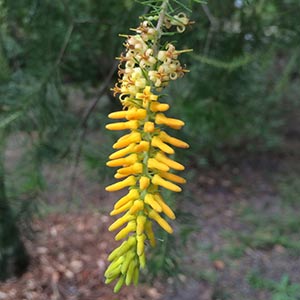
‘The Fine Leaf Geebung’
Persoonia pinifolia, commonly known as Fine Leaf Geebung, Pine-leaved Geebung or sometimes the Australian Christmas Tree, is an attractive Australian native shrub from the forests and heathlands of New South Wales.
It is prized for its soft, pine-like foliage, masses of yellow flowers in late summer and its ability to grow in a range of garden situations. The flowers are followed by small purple fruits that can be collected for seed.
Growing naturally in sandy soils from coastal districts to inland areas, Fine Leaf Geebung is a tough, attractive shrub that suits native gardens, wildlife gardens and informal mixed plantings.
Quick Facts
| Botanical Name | Persoonia pinifolia |
|---|---|
| Common Names | Fine Leaf Geebung, Pine-leaved Geebung, Australian Christmas Tree |
| Plant Type | Australian native shrub |
| Height | 1–3 m |
| Spread | Up to 2 m |
| Position | Full sun to light shade |
| Soil | Well-drained sandy or humus-rich soil |
| Flowers | Yellow |
| Flowering Season | Late summer to autumn |
| Foliage | Fine, pine-like green foliage |
| Frost Tolerance | Good once established |
| Drought Tolerance | Moderate to good |
| Container Growing | Yes, in large containers |
| Coastal Gardens | Suitable for second-line coastal positions |
How to Grow Persoonia pinifolia

Fine Leaf Geebung is one of the easier Persoonia species to grow provided it has excellent drainage. Like many Australian natives, it dislikes heavy, poorly drained soils.
Choose a position in full sun or light shade and plant into well-drained soil. Sandy soils are ideal, although plants will also perform well in lighter loamy soils that have been improved with organic matter.
Mulch around the base of the plant to help keep the roots cool and conserve moisture, but avoid piling mulch against the stem.
Once established, Persoonia pinifolia is reasonably drought tolerant, although occasional deep watering during extended dry periods will keep it looking its best.
A light application of a specialist native plant fertiliser in spring can encourage healthy growth and flowering.
Pruning and Maintenance
Very little pruning is required.
Light tip pruning from an early age encourages a dense, bushy habit and produces a much better-shaped shrub than attempting heavy pruning later.
Remove any dead or damaged branches as needed, but avoid cutting back into old wood, as regeneration can be slow.
- Landscape Uses
Fine Leaf Geebung is a versatile Australian native shrub that can be used in many garden styles.
It works well as:
- a feature shrub
- an informal native hedge
- a screening plant
- part of a mixed native border
- a wildlife-friendly planting
- a specimen in larger native gardens
- a container plant when young
Its fine foliage provides an attractive contrast to plants with broader leaves and adds texture throughout the year.
Comparing Persoonia pinifolia with Other Persoonia Species
Although all Persoonia species produce the distinctive yellow flowers that geebungs are known for, each has its own garden uses.
Persoonia pinifolia is grown for its upright habit and fine, pine-like foliage, making it an excellent screening or feature shrub.
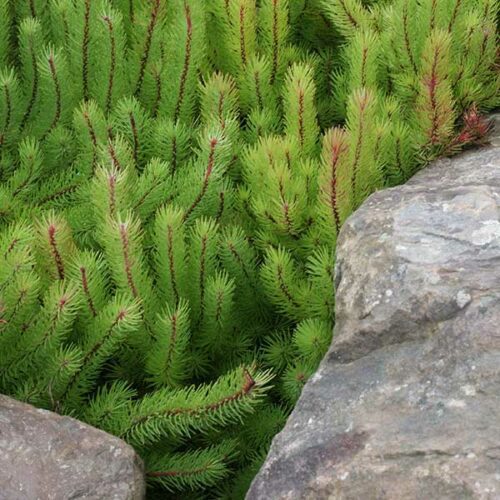
Persoonia chamaepitys is a much lower-growing species, this is our favourite species, and consider that it is better suited as a groundcover in rockeries, native gardens and on embankments.
Persoonia levis grows into a much larger shrub or small tree and is valued for its attractive peeling bark as well as its flowers.
Persoonia linearis has narrow leaves and a taller, more open habit, making it suitable where a lighter screening plant is required.
If you’re looking for a compact shrub with fine foliage and long-lasting ornamental appeal, Persoonia pinifolia is one of the best choices in the genus.

Wildlife Value
The flowers provide nectar for native bees and other pollinating insects, while the fruit attracts birds and other wildlife. Growing native plants such as Fine Leaf Geebung helps support local biodiversity and provides habitat in the home garden.
Frequently Asked Questions
Is Persoonia pinifolia the same as Fine Leaf Geebung?
Yes. Persoonia pinifolia is the botanical name for the Australian native shrub commonly known as Fine Leaf Geebung. It is also sometimes called Pine-leaved Geebung because of its fine, needle-like foliage.
How tall does Persoonia pinifolia grow?
Fine Leaf Geebung typically grows between 1 and 3 metres (3–10 feet) tall with a spread of around 2 metres (6–7 feet). Growth will vary depending on soil, rainfall and growing conditions.
Is Persoonia pinifolia fast growing?
It has a moderate growth rate. Plants establish steadily in well-drained soils and grow more quickly with regular watering during dry periods and an occasional application of a low-phosphorus native plant fertiliser.
When does Fine Leaf Geebung flower?
Fine Leaf Geebung produces its distinctive yellow flowers from late summer into autumn. The flowers are followed by small fleshy purple fruits.