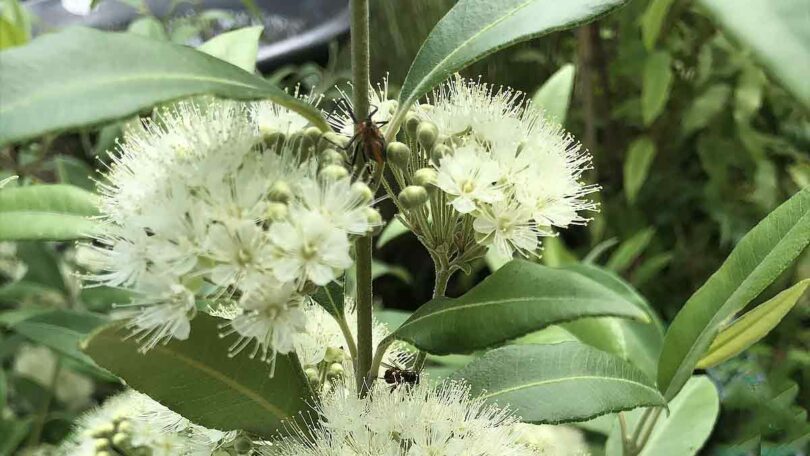
Backhousia myrtifolia, commonly known as Cinnamon Myrtle or Grey Myrtle, is an attractive Australian rainforest tree valued for its aromatic foliage, masses of creamy white flowers and usefulness as both a garden plant and native food species.

Naturally occurring from southern Queensland through to New South Wales, this evergreen tree adapts well to cultivation and is commonly planted in parks, streetscapes and larger home gardens throughout south-eastern Australia, including Melbourne.
Although capable of reaching around 7 to 8 metres in height in favourable conditions, it is often smaller in cultivation. The gently weeping branches and dense canopy give the tree an elegant appearance, while the clusters of creamy white flowers produced from spring into summer provide a beautiful display.
One of its most distinctive features is the foliage. When crushed or rubbed, the leaves release a pleasant cinnamon-like fragrance, giving rise to its common name.
Backhousia Myrtifolia Information
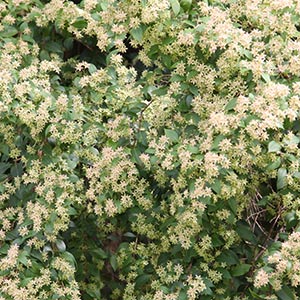
- Plant Type – Small Tree
- Country of origin – Australia New south Wales to Queensland.
- Common Name – Cinnamon Myrtle, Grey Myrtle
- Growth Rate – Medium
- Evergreen / Deciduous – Evergreen
- Soil – Moist well drained
- Position – Sun to light shade
- Height – 7 – 8m often smaller in cultivation.
- Width 4m
- Habit – Upright bushy
Growing Conditions
Backhousia myrtifolia performs best in moist, fertile soils with good drainage. While established trees are reasonably hardy, young plants require regular watering while developing a strong root system.
Protection from prolonged dry periods during the first few summers is important. Applying mulch around the root zone helps conserve moisture and encourages healthy growth.
The tree grows well in full sun through to light shade and adapts to a range of garden situations provided the soil does not remain waterlogged.
Propagation
Although Backhousia myrtifolia produces abundant flowers, viable seed can sometimes be difficult to source.
For this reason, propagation from semi-hardwood cuttings is the preferred method and generally provides reliable results. Cuttings taken during the warmer months strike readily when provided with bottom heat and consistent moisture.
Pruning and Maintenance
This species naturally develops a dense canopy and responds well to pruning.
Tip pruning young plants encourages bushier growth and helps develop a more compact form. Established specimens generally require little maintenance beyond occasional shaping and the removal of damaged branches.
Regular pruning can also be used to maintain the plant as a dense screening tree or large hedge.
Cinnamon Myrtle as an Australian Native Food Plant
Backhousia myrtifolia has become increasingly popular as an Australian native food plant thanks to its highly aromatic leaves.
The foliage contains naturally occurring compounds that provide a warm cinnamon-like flavour with subtle spicy notes. Fresh or dried leaves are used as a seasoning in a wide range of savoury dishes.
The leaves can be:
- Added to slow-cooked meat dishes.
- Used to flavour sauces and marinades.
- Infused in stocks and soups.
- Added to spice blends and rubs.
- Used in native food baking recipes.
- Brewed as a herbal tea.
The leaves are usually harvested, dried and crushed before use, allowing the flavour to be stored for extended periods. As interest in bush tucker continues to grow, Cinnamon Myrtle is increasingly being cultivated both commercially and in home gardens.
Landscaping Uses for Backhousia myrtifolia
Backhousia myrtifolia is a versatile landscape plant with a number of practical applications.
Its dense evergreen canopy makes it an excellent screening tree for larger gardens, providing privacy and year-round foliage cover. The attractive form and masses of flowers also make it a useful feature tree in parks and public landscapes.
Other uses include:
- Native garden plantings.
- Informal screening and privacy hedges.
- Street tree plantings.
- Wildlife-friendly gardens.
- Rainforest and bushland-style landscapes.
- Bush tucker gardens.
The flowers attract pollinating insects while the dense growth provides shelter for small birds and other garden wildlife.
Wildlife Value
As an Australian native species, Backhousia myrtifolia contributes to local biodiversity. The nectar-rich flowers attract beneficial insects and pollinators, while the dense foliage offers protection and nesting opportunities for small birds.
Where to Buy

Specialist Native Food Nursery with thirty species available in both forestry tubes and 14 cm pots, from ground cover to canopy. Twenty years experience supplying landscape scale projects to backyard gardens.
www.peppermintridgefarm.au .
email [email protected]
One of Australia's largest wholesale trade nurseries. Over 30,000 species available, tubestock to advanced trees, an almost unlimited choice of plants.
www.plantmark.com.au