
Golden Japanese Sedge

One of the outstanding ornamental grasses, Carex oshimensis ‘Evergold’ is a variegated form of the species. A Japanese sedge that is widely used in landscaping. The common name is Oshima kan suge, suge meaning Sedge in Japanese, or simply Golden Japanese Sedge.
Carex oshimensis ‘Evergold’ (Golden Japanese Sedge) is one of the most reliable evergreen foliage plants for adding year-round colour and movement to the garden. While often grouped with ornamental grasses, it is actually a sedge—valued for its finer texture and superior shade tolerance.
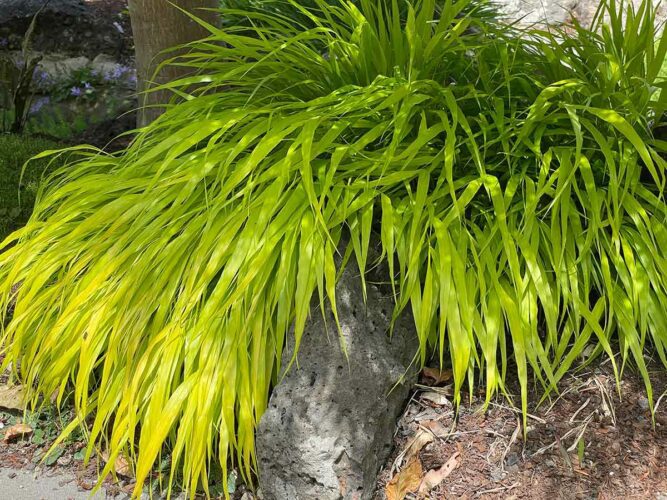
With arching leaves striped in creamy gold and deep green, ‘Evergold’ forms a soft, cascading mound that works equally well in garden beds, borders, and containers. Its elegant, slightly weeping habit makes it especially effective for softening edges and adding contrast to structured landscapes.

Carex Evergold Quick Facts
- Botanical Name: Carex oshimensis ‘Evergold’
- Common Names: Golden Japanese Sedge, Carex Evergold
- Plant Type: Evergreen ornamental sedge
- Height: Around 30 cm
- Spread: 30–45 cm
- Climate: Ideal for temperate regions
- Foliage: Creamy gold with dark green margins
- Flowers: Small brown flower spikes in spring
- Position: Part shade to full sun in cooler climates
- Soil: Moist, humus-rich and well-drained
- Water Needs: Moderate
- Frost Tolerant: Yes
- Best Uses: Borders, edging, pots, underplanting and Japanese-style gardens
How to grow Carex oshimensis ‘Evergold’
You can use this as a feature plant or as a low border plant. It gradually forms a neat mound over time and performs best in a moist but well-drained soil.
Light Requirements
‘Evergold’ performs best in part shade, particularly in Australian climates. Morning sun with afternoon protection helps maintain the intensity of its gold variegation. In full sun, especially during hot summers, leaf scorch can occur.
Soil and Position
Plant in well-drained, humus-rich soil that retains moisture. It adapts to most soil types but performs best when organic matter is added before planting. Avoid dry, exposed sites.
Mulch annually to regulate soil temperature and retain moisture.
Watering and Feeding
Keep soil consistently moist during establishment. Once established, it tolerates short dry periods but looks best with regular watering.
Apply a slow-release fertiliser in early spring to encourage fresh, vibrant growth.
Growth Habit and Spacing
Carex Evergold forms a dense clump approximately 30 cm high and 30–45 cm wide.
- Plant 30–40 cm apart when creating borders.
- Allow around 6–9 plants per square metre for mass plantings.
- Divide established clumps every two to three years to maintain vigour.
Maintenance and Pruning
Very little maintenance is required.
- Remove dead or damaged leaves by hand or with a light rake
- Avoid hard cutting back (unlike deciduous grasses)
- Divide every 2–3 years in early spring to refresh growth
Common Problems
- Brown leaf tips: Usually caused by dry soil, hot afternoon sun or drying winds.
- Faded foliage: Often the result of too much shade.
- Sparse growth: May indicate poor soil or a need for feeding.
- Poor drainage: Can lead to root problems, so avoid waterlogged soils.
Landscaping Uses
Carex ‘Evergold’ is highly versatile across different garden styles:
- Edging plant: Creates soft, flowing borders along paths and driveways
- Ground cover: Effective in part shade where turf struggles
- Containers: Ideal for pots, especially where foliage can spill over edges
- Underplanting: Works well beneath trees or alongside shrubs
- Japanese-style gardens: Complements minimalist and naturalistic designs
- Rock gardens: Adds contrast against stone and structural elements
It pairs well with plants like Heuchera, Liriope, dwarf Nandina, and ferns for layered texture.
More Carex Varieties and other Grasses
Explore other Carex species to create contrast in colour and form, particularly when designing low-maintenance or shade-focused planting schemes.


Where To Buy

138 Olinda-Monbulk Rd, Olinda VIC 3788
"Large range of rare and unusual plants.."
www.gentiananursery.au
Frequently Asked Questions
Is Carex Evergold an ornamental grass?
Not technically. It is an evergreen sedge, although it is commonly grouped with ornamental grasses because of its similar appearance and garden uses.
Is Carex Evergold evergreen?
Yes. One of its greatest strengths is that it retains its attractive variegated foliage throughout the year.
Does it grow in shade?
Yes. It is one of the best evergreen foliage plants for part shade, although it also performs well in morning sun.
Is Carex Evergold suitable for pots?
Absolutely. Its compact size and cascading habit make it an excellent choice for containers, either on its own or combined with other shade-loving plants.