
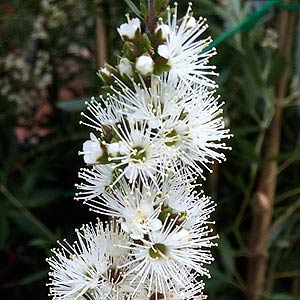
he white-flowering Kunzea ambigua is a large evergreen shrub that can reach around 3m in height, although plants can become larger in favourable conditions. It has masses of white flowers from spring through summer. Related to Callistemon and with similar flowers, this species is also known as the ‘Tick Bush’ and ‘Poverty Bush’.
The foliage is aromatic and the white flowers are produced in masses, making this a very attractive Australian native shrub when in full flower. In the right conditions Kunzea ambigua can form a dense shrub and is useful where a larger screening plant or informal hedge is required.
Some lower-growing cultivars and forms are available that will reach around 2m and, with a little pruning, can be kept even smaller. A prostrate form that reaches around 30–50cm is also available.
As a landscaping plant, this is a tough character that requires little attention once established. The lower-growing forms are good open-ground cover plants, and all forms work well in rock gardens or the native border.
Kunzea ambigua is also used to produce essential oils, which are distilled from the foliage and new growth. So why ‘Tick Bush’? It is the aromatic oils released from the plant that are traditionally associated with its use as a tick-repelling plant. This is the origin of the common name, although it should not be regarded as a guaranteed tick repellent.
How To grow Kunzea Ambigua – Basic Care
Kunzea ambigua prefers a well drained soil and full sun. New plants should receive a little extra water and some protection from full sun through the first summer, drought tolerant once established Propagation is best from semi hardwood cuttings. Tip prune after flowering to promote a more bushy and compact habit.
Kunzea ambigua prefers a well-drained soil and full sun. It is a hardy Australian native and is well suited to low-maintenance gardens once established.
Position
Plant in full sun for the best flowering, although Kunzea ambigua will tolerate some light shade. Allow plenty of room for the larger forms to develop, particularly if the plant is being used as a screen or informal hedge.
The prostrate and lower-growing forms are more useful where space is limited and can be planted in rock gardens, native borders or as open-ground cover.
Soil
A well-drained soil is preferred. Kunzea ambigua is adaptable to a range of soil types as long as drainage is reasonable. Avoid constantly wet or poorly drained positions.
Watering
New plants should receive a little extra water while establishing, particularly through the first summer. Once established, Kunzea ambigua is drought tolerant and generally requires little additional watering.
As with most newly planted Australian natives, regular watering during the establishment period will help develop a strong root system. Once established, allow the soil to dry between watering rather than keeping it constantly wet.
Pruning
Kunzea ambigua responds well to pruning. Tip prune after flowering to promote a more bushy and compact habit and to help maintain the desired size.
The larger forms can become quite substantial, so regular light pruning is useful if you are growing Kunzea ambigua in a smaller garden. Lower-growing forms generally require less maintenance.
Propagation
Propagation is best from semi-hardwood cuttings. Taking cuttings from healthy, established plants allows desirable forms to be reproduced, including compact and prostrate plants.
Using Kunzea ambigua in the Garden
Kunzea ambigua is a useful Australian native for gardeners looking for a hardy, free-flowering shrub. The combination of aromatic foliage, masses of white flowers and drought tolerance makes it suitable for low-maintenance native plantings.
The larger forms can be used as informal screening plants or hedges, while smaller and prostrate forms are useful in rock gardens, native borders and as ground cover.
When in flower, Kunzea ambigua is particularly attractive and can also provide a useful source of nectar for insects and other garden wildlife. In natural areas, flowering plants can be covered in insects and butterflies, adding another benefit to growing this hardy native shrub.
Kunzea ambigua is a tough plant, but it does need room. If space is limited, choose one of the smaller or prostrate forms and use light pruning to maintain the shape.
You may also be interested in
- Australian Native Plants
- Bird Attracting Plants
- Bush Tucker Plants
- Callistemon
- Drought Tolerant Plants
- Kunzea species
- Kunzea ericoides
- Kunzea parviolia
- Kunzea ambigua
Kunzea ambigua and species are available for sale from the following nurseries

146 Dignams Crk Rd via Narooma NSW 2546
Tubestock - [50mm forestry tubes and 70mm supertubes] specializing in Bush Tucker Plants , Natives indigenous to the NSW South Coast , Permaculture Plants - Fruits, Nuts & Berries .
www.southcoastflora.com.au