
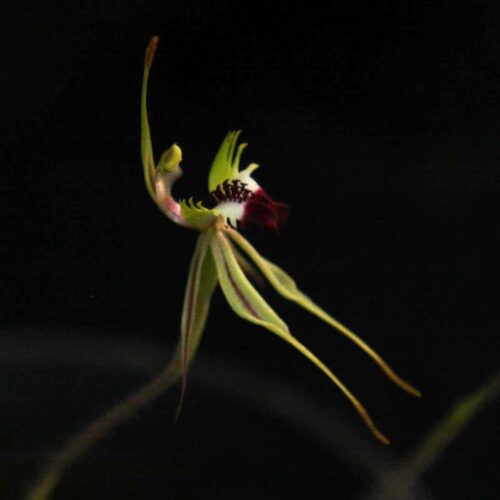
It is rare both in its natural environment and certainly in cultivation, however Caladenia phaeoclavia is worth looking for. It is a rather diminutive species that hide amongst grasses, so finding it in the wild usually means waiting for it to flower.
When it does flower it reaches around 25cm in height and had one of the most intriguing flowers of any orchid species.
They grow in open woodlands, a little shade and excellent drainage. The flower is a combination of green red and cream, however it is the form of the flower that makes the search for this elusive orchids well worthwhile.
Caladenia are a wonderful genus of native orchids, and Caladenia phaeoclavia is no exception.
Known as the Brown Clubbed spider orchid Caladenia phaeoclavia is a fascinating species found from Victoria through to New South Wales. Usually in the cooler foothills to around 600m.
The flower of Caladenia phaeoclavia is attractive, green with a white stripe and maroon tip.
At a glance
- Common name: Brown‑clubbed Spider Orchid
- Scientific name: Caladenia phaeoclavia (syn. Arachnorchis phaeoclavia)
- Family: Orchidaceae
- Plant type: Terrestrial native orchid
- Height: Up to aroiund 25 cm
- Flowering time: Spring (October–November)
- Habitat: Open eucalyptus forest and woodland, part shade to full sun
- Distribution: Victoria through to New South Wales, cooler foothills to around 600m
- Cultivation difficulty: Very difficult; does not transplant well
Caladenia phaeoclavia Care
Caladenia phaeoclavia is a spring‑flowering species with a nice upright habit to around 25 cm. Like many terrestrial native orchids, it dies back as soon as the heat of summer hits and goes into dormancy.
- Position: Near forest margins, part shade to full sun
- Habitat preference: Open Eucalyptus forest with a little shade
- Soil: Very well‑drained, sandy or loamy native orchid mix
- Drainage: Excellent drainage is essential
- Watering: Lightly moist during active growth; keep drier in summer dormancy
- Flowering time: Early summer (in cultivation terms), naturally spring in the wild.
These orchids are difficult to grow in cultivation. They do not transplant well, and established plants usually die if you attempt to move them. If you can find seed, you may be able to start plants from seed, but seed is hard to source. Your best chance is often to find a potted specimen from a specialist nursery. Otherwise, the most reliable way to enjoy them is to admire them in the wild in their natural habitat.
You may also be interested in