
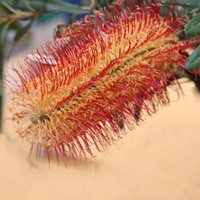
Another lovely species is Banksia occidentalis (picture right) a smaller growing banksia, to 2 -4 m or more depending on conditions also known as the Red Swamp Banksia.
A very ornamental flowers. It grows well in cool to temperate and Mediterranean type climates, however not in tropical or humid areas.
Native to the south coast of Western Australia the bright red flowers in summer and autumn make this an attractive addition to the garden.
Like all Banksias B. occidentalis has no Lignotubers, so hard pruning is out, as it will not reshoot from the base.
How To Grow Banksia occidentalis
Banksia occidentalis performs best in sunny positions with moisture-retentive but well-drained soil.
Although it tolerates seasonal wet conditions, it should not be grown in permanently waterlogged sites.
- Choose a sunny position.
- Plant in well-drained soil that retains some moisture.
- Improve drainage in heavy soils before planting.
- Water in well after planting.
- Apply mulch around the plant to help conserve moisture.
- Water regularly during the establishment period.
- Fertilise lightly using a low-phosphorus fertiliser suitable for native plants.
Top Tips
- One of the best red-flowering Banksias for the home garden.
- Excellent for cool temperate and Mediterranean climates.
- Avoid hot, humid tropical conditions.
- Protect young plants from severe frosts.
- Do not use high-phosphorus fertilisers.
Pruning Banksia occidentalis
Banksia occidentalis responds well to light pruning after flowering.
Remove spent flower spikes and any damaged growth to maintain a neat shape and encourage bushier growth.
Avoid hard pruning into old wood as this species has limited ability to regenerate from older stems.
Landscaping Uses
- Use as a feature shrub or small tree.
- Excellent for bird-attracting gardens.
- Suitable for screening and informal hedging.
- Grow as a cut flower plant.
- Plant near ponds, swales and seasonally moist areas.
- Suitable for native and water-wise landscapes.
A Bird-Attracting Banksia
The nectar-rich flowers of Banksia occidentalis are highly attractive to wildlife.
Honeyeaters, wattlebirds and other nectar-feeding birds are regular visitors when the plant is in flower. Native bees and other beneficial insects are also attracted to the abundant nectar supply.
For gardeners wanting to encourage wildlife into the garden, Banksia occidentalis is one of the most rewarding species to grow.
Companion Plants
Banksia occidentalis combines well with other Australian native plants that appreciate sunny positions and moderate moisture.
Good companion plants include:
- Melaleuca species
- Callistemon species
- Grevilleas
- Westringia
- Anigozanthos (Kangaroo Paws)
- Dianella and Lomandra species
These plants provide seasonal colour and habitat while thriving in similar conditions.
Growing Banksia occidentalis in Pots
Dwarf selections of Banksia occidentalis can be grown successfully in large containers.
Use a premium native plant potting mix and position the container in full sun. Regular watering will be required, particularly during warmer months.
Container-grown plants are useful for patios, courtyards and smaller gardens.
Banksia occidentalis as a Cut Flower
Banksia occidentalis is highly regarded as a cut flower due to its vibrant colour and excellent vase life.
The flower spikes add striking colour and texture to floral arrangements and are often used in both fresh and dried displays.
Harvest flowers as they begin to fully open for the longest vase life.
Why Is It Called Red Swamp Banksia?
Unlike many Banksias that prefer dry sandy soils, Banksia occidentalis naturally grows in low-lying areas that can become seasonally wet.
This ability to tolerate periodic inundation has led to the common name Red Swamp Banksia.
Although it appreciates moisture, it still performs best in soils that drain freely rather than remaining permanently waterlogged.
Propagation
Banksia occidentalis is usually propagated from seed.
The woody cones hold the seed until exposed to heat, which helps trigger seed release. Germination is generally reliable when fresh seed is used. Germination is quicker with heat treatment.
Plants grown from seed may take around five years to reach flowering size.
Summary Information
- Botanical Name – Banksia occidentlis
- Common Name – Red Swamp Banksia
- Family – Proteacae
- Height – Varies from 3 to 7 metres with a dwarf form available.
- Spread – Varies from 2.5 to 5 metres.
- Position – Full Sun
- Soil – Well drained.
- Flowers – Yellow to Red.
- Flowering Time – Spring although it will spot flower through the year.
- Foliage – Deep green with an open habit.
- Frost tolerant – Yes
- Drought tolerant – Medium
Banksia occidentalis vs Banksia menziesii
Banksia occidentalis and Banksia menziesii are both admired for their colourful flowers, however they differ in growth habit and garden performance.
Banksia occidentalis typically develops as a large shrub or small tree with deep green foliage and rich red flower spikes. It is notable for its ability to tolerate seasonally moist soils and performs well in cool temperate and Mediterranean climates.
Banksia menziesii, commonly known as the Firewood Banksia, generally grows as a larger shrub or small tree and produces striking flower spikes in shades of red and pink with cream or gold highlights. It naturally grows in drier conditions and prefers free-draining sandy soils.
For gardeners with heavier soils or areas that experience seasonal moisture, Banksia occidentalis is often the better choice. In very well-drained sandy soils, Banksia menziesii can provide an equally spectacular floral display.
Both species are excellent bird-attracting plants and make outstanding feature specimens in Australian native gardens.
BANKSIA NURSERIES Banksia ericifolia Banksia integrifolia Banksia occidentalis Banksia spinulosa Banksia ‘Coastal Cushion’
You may also be interested in