
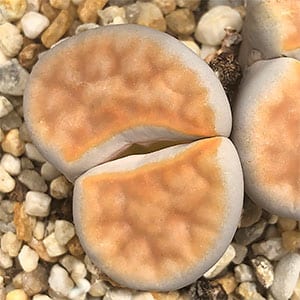
Lithops karasmontana is one of the most popular and recognisable living stones, valued for its beautifully patterned foliage, clump-forming habit, and ease of care compared to many other Lithops species.
It is named after the Great Karas Mountains of southern Namibia, between Keetmanshoop and the Orange River, with its natural range extending into South Africa.
This is a species that many growers fall in love with early — and often the one that starts a lifelong Lithops collection.
Description & Characteristics
Lithops karasmontana forms low-growing clumps made up of paired leaves that closely resemble small stones, an adaptation that helps it blend into its native environment.
Key features:
- Paired leaves with a grey to brown base colour
- Intricate mottled or reticulated surface patterns
- White flowers appearing from late summer to autumn
- Flowers emerge from the central fissure, pushing the leaf pair apart as they grow
It makes an excellent container plant, especially in shallow bowls or specimen pots where its patterns can be appreciated up close.
How to Grow Lithops karasmontana
Lithops karasmontana is easy to grow when its basic requirements are met.
Growing Medium
- Excellent drainage is essential
- Use a cactus or succulent mix with at least 40% added coarse grit, stone, or pumice
Light
- Requires bright light for at least 6 hours per day
- Some direct sun is beneficial
- Avoid harsh afternoon sun in hot climates, which can cause burning
Watering
- During active growth (spring to summer), water deeply about every 10 days
- In winter, keep plants almost completely dry
- Always allow the growing medium to dry fully between waterings
Fertiliser
- If repotted annually, only minimal fertiliser is required
- A light application of slow-release fertiliser (such as Osmocote) is sufficient
How to Plant or Repot Lithops karasmontana
Lithops develop a long taproot, so correct pot choice is important.
Step-by-step repotting guide:
- Choose a pot twice as deep as the root system, with a good drainage hole
- Cover the drainage hole with mesh to prevent soil loss
- Half-fill the pot with a free-draining succulent mix
- Add a small amount of slow-release fertiliser
- Position the plant and backfill gently around the roots
- Do not water for 7–10 days
- After this period, water thoroughly
General Care Notes
- Overwatering is the most common cause of failure
- Always use free-draining pots and soil
- The growing medium must dry out completely between waterings
- High humidity can cause problems — good airflow is essential
Popular Varieties & Forms
Several cultivated forms of Lithops karasmontana are prized for unique colours and patterns:
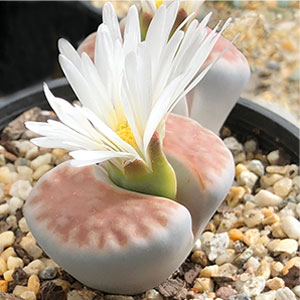
- ‘Lateritia’ – Reddish-brown tones with fine reticulated markings
- ‘Bella’ – Smooth grey surfaces with delicate striping
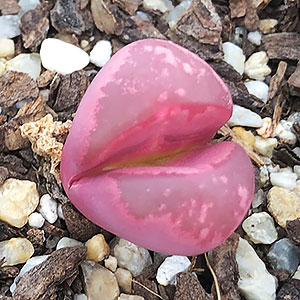
- ‘Mickbergensis’ – Distinctive red-tinted tops
- ‘Opalina’ – Olive to pinkish-grey bodies with dark windowing
- Subsp. eberlanzii – Rounded lobes, strong grey-brown patterns, and large yellow flowers
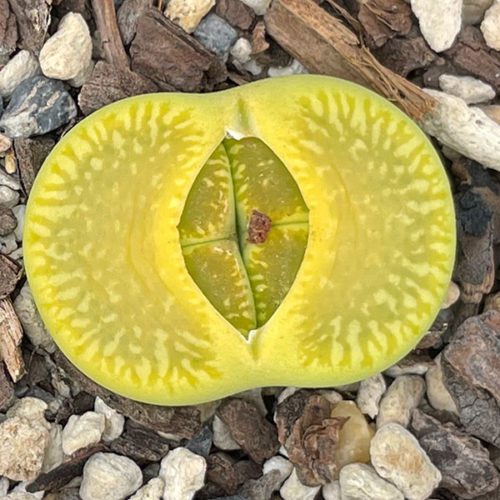
Colour intensity and patterning can vary depending on light levels and soil tone, making each plant subtly unique.
Why Grow Lithops karasmontana?
- One of the best Lithops for beginners
- Forms attractive clumps over time
- Highly decorative foliage patterns
- Reliable flowering when grown correctly
- Excellent specimen plant for containers
How to Plant/Repot Lithops karasmontana
- Step 1: You will need a pot that is around twice as deep as the root system on the plant. Lithops send down a tap root and this need room to grow. A good drainage hole is essential.
- Step 2: Place some mesh over the drainage hole to prevent the growing medium from falling through.
- Step 3: Half fill the pot with a free draining cactus and succulent mix with extra drainage material mixed through.
- Step 4: Place a little slow release fertiliser on top of this layer of soil.
- Step 5: Gently place the plant in the container, backfilling around with the soil mix.
- Step 6 : Do not water for 7 – 10 days
- Step 7: Water well after 7 – 10 days
A number of forms are available all with differing foliage colours.


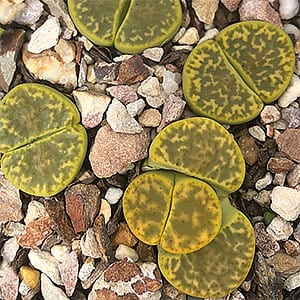
Growing Lithops karasmontana is about observation and restraint. Let the soil dry completely between light waterings, give bright light, and respect the plant’s natural growth rhythm. In return, you’ll enjoy a living stone garden of infinite variety — proof that nature’s most intriguing designs often come in miniature form.