
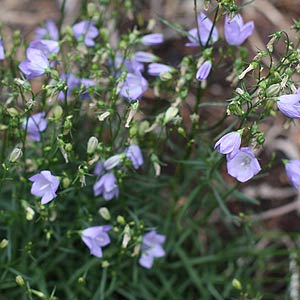
Although this looks like a delicate plant, Campanula rotundifolia is remarkably hardy and drought tolerant. If you are looking for a long flowering, low maintenance plant for a cottage garden or rock garden, this little beauty is well worth considering. Attractive blue flowers, good green foliage and a real no fuss plant.
It is a plant that has lax stems and can fall over a little in wet weather, however we find it to be an attractive and long flowering addition to the cottage garden. As a drought tolerant perennial, it has proven itself reliable even in difficult conditions.
A tough drought tolerant perennial, Campanula rotundifolia is also known as the Scottish Harebell, a charming alpine flowering plant found growing naturally in cooler regions. Two forms are available, the blue flowering variety and a white form, Campanula rotundifolia ‘Alba’.
Not widely seen in nurseries in Australia, however you can often pick them up at rare plant fairs. The flowers are small, however they do appear in masses from early spring through summer and well into autumn. The nodding blooms are among the prettiest blue cottage garden flowers, bringing colour to the garden over many months.
In flower the plant will reach around 50cm in height, foliage is a nice green, and this really is a great little plant for the front of the border, rock garden or alpine garden.
Quick Facts
Botanical Name: Campanula rotundifolia
Common Name: Scottish Harebell, Harebell
Plant Type: Herbaceous perennial
Height: 40 – 50cm
Spread: 30 – 40cm
Flower Colour: Blue or white
Flowering Season: Spring through to autumn
Foliage: Green, semi-evergreen in mild climates
Position: Full sun to part shade
Soil: Well-drained soil
Water Needs: Low once established
Frost Tolerance: High
Drought Tolerance: High
Campanula rotundifolia Care
When it comes to Campanula rotundifolia care, this is one of the easiest perennials we have grown. For a little plant that is really an alpine species, this one is exceptionally tough.
In our garden Campanula rotundifolia has flowered well through the summer. It coped with a series of 40°C days and no real rain for weeks. We have confidently declared it drought tolerant.
Give it a little seaweed fertilizer and bit of a trim to keep it in shape and Campanula rotundifolia will reward you with pretty little flowers and trouble free gardening for many years.
Light
For best flowering grow Campanula rotundifolia in full sun to light shade. In hotter climates some protection from intense afternoon sun may help prolong flowering.
Soil
Like many alpine plants, the Scottish Harebell prefers a well-drained soil. Sandy soils, gravel gardens and raised beds all work well. Heavy clay soils should be improved with organic matter and coarse sand to improve drainage.
Watering
Water regularly while plants are establishing. Once established this drought tolerant perennial requires very little supplementary watering. During extended dry periods an occasional deep watering will help maintain flowering.
Fertiliser
Campanula rotundifolia is not a heavy feeder. A light application of seaweed solution through the growing season is generally sufficient.
Pruning and Maintenance
Remove spent flowers to encourage further blooms and lightly trim plants after flowering to maintain a compact habit. Established clumps can be divided every few years to rejuvenate growth.
Landscaping Uses
Campanula rotundifolia is a versatile perennial that fits naturally into many garden styles.
- Cottage gardens
- Rock gardens
- Alpine gardens
- Gravel gardens
- Front of mixed borders
- Naturalistic meadow plantings
- Containers and patio pots
The soft blue flowers mix beautifully with salvias, dianthus, nepeta and other traditional cottage garden plants. As one of the more adaptable blue cottage garden flowers, it is especially useful in low maintenance and water-wise gardens.
Propagation
Easy from root cuttings taken in early spring. Established clumps can also be divided in spring or autumn.
Propagation from seed is possible although plants may take 2–3 years to reach flowering size. Sow seed into a free-draining seed raising mix and keep lightly moist until germination occurs.
Division is generally the quickest and most reliable method of propagation, producing flowering-sized plants much faster than growing from seed.
You may also like
- Campanula vidalii
- Campanula persicifolia
- Campanula glomerata
- Campanula medium
- Campanula plants for sale
PO Box 7040 Leura NSW 2780
Rare woodland plants, Trilliums Epimediums, Arisaemas, plus much more.www.lynnsrareplants.com.au