
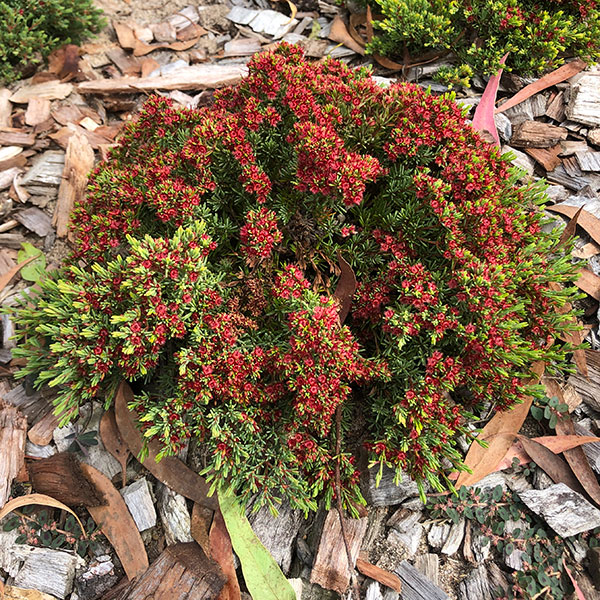
Mouse Featherflower

Verticordia fastigiata, commonly known as Mouse Featherflower, is a low growing Australian native shrub with fine foliage and colourful flowers. It makes an attractive ground-hugging plant for a sunny position, especially in well-drained soils.
This neat, compact Verticordia species usually grows to around 0.5 m high and spreads to about the same width, though it is often smaller in garden conditions. It is best suited to open, sunny sites where the soil drains freely.
Flowers appear from mid summer through to autumn, depending on climate and growing conditions. Flower colour can vary, with red being the most common, although yellow and orange-flowering forms are also seen.
Once established, Mouse Featherflower is relatively low maintenance and drought tolerant. It is a good choice for gardeners looking for a small native shrub with strong seasonal colour and a tidy growth habit.
Growing conditions
Verticordia fastigiata grows best in full sun and free-draining soil. It performs well in raised garden beds, rock gardens, gravel gardens, and other areas where water does not linger around the roots.
Avoid heavy clay soils unless they have been improved with coarse sand, gravel, and organic matter to improve drainage. In wetter climates, planting on a slight mound can also help reduce root problems.
Landscaping uses
Mouse Featherflower is a versatile small shrub for native and low-water garden designs. It works well as a soft-edged ground cover around paths, in rockeries, or near the front of mixed garden beds where its flowers can be appreciated up close.
It is also suitable for:
- Native cottage gardens.
- Gravel and Mediterranean-style gardens.
- Coastal gardens with good drainage.
- Feature planting in small spaces.
- Mass planting for seasonal colour.
- Erosion-prone banks where soil is light and free draining.
Because of its naturally compact habit, it can add structure without blocking views or overwhelming nearby plants.
Problems and care notes
The main problem for Verticordia fastigiata is poor drainage. If the soil stays wet for long periods, the plant may decline or struggle to establish properly.
Other care notes include:
- It dislikes heavy, sticky soils.
- It may perform poorly if overwatered.
- Pruning should be light, with only a small trim after flowering if needed.
- Feeding should be minimal; use a low-phosphorus native fertiliser if required.
- Watch for stress in humid or wet conditions, especially in poorly ventilated sites.
For best results, plant it in a position with good air movement and avoid overhandling the roots during transplanting.
Companion planting scheme
A simple companion planting scheme for Verticordia fastigiata should focus on plants that enjoy sun, sharp drainage, and low fertility. Good companions are other compact Australian natives and dry-climate plants that won’t compete too aggressively.
A balanced planting scheme could include:
- Foreground: small ground covers such as native daisies or prostrate austral natives with similar water needs.
- Mid layer: Verticordia fastigiata as the main colour plant.
- Background: small upright natives or fine-textured shrubs that provide contrast without shading it out.
- Soil surface: decorative gravel or crushed rock to keep the root zone dry and tidy.
For a natural-looking display, combine it with plants that have silver, grey-green, or fine-textured foliage to highlight the flowers and keep the planting soft and open.
Summary Information
- Botanical Name – Verticordia fastigiata
- Family – Myrtaceae
- Common Name – Mouse Featherflower
- Height – To around 0.5 m
- Spread – To around 0.5m
- Position – Full Sun
- Soil – Well drained
- Foliage – Mid to deep green
- Flowers – Red to orange and yellow
- Flowering Time – Summer to Autumn
- Drought Tolerant – Yes


