
Nurseries Online
  • Home
  • A-Z Plant Index
  • Trees and Shrubs
    • Fruit Trees
    • Advanced Trees
    • Evergreen Trees
  • Native Plants
  • Roses
  • Buying Plants Online
    • Mail Order Nurseries
    • Retail Plant Nurseries
    • Wholesale Nurseries
  • Garden Pots
  • Water Features for the Garden
  • Garden Accessories
  • About Us
  • Water Features for the Garden
  • Garden Pots
  • Garden Accessories
Home  »  A-Z Plant Index  »  Australian Native Plants  »  Lophostemon confertus ‘Variegatus’ (Variegated Brush Box)

Lophostemon confertus ‘Variegatus’ (Variegated Brush Box)

  • Facebook
  • Pinterest
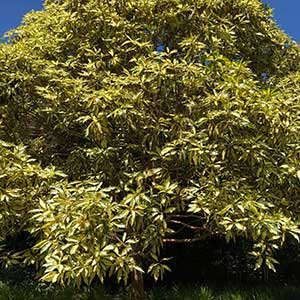
Lophostemon confertus 'Variegatus' - Variegated Brushbox
Lophostemon confertus ‘Variegatus’ – Variegated Brushbox

Lophostemon confertus ‘Variegatus’, commonly known as the Variegated Brush Box, is an attractive small to medium Australian tree grown for its distinctive variegated foliage and adaptable nature.

With leaves marked in green and creamy yellow, this cultivar offers year-round visual interest and works well as a shade tree for medium-sized gardens. Although the standard species (Lophostemon confertus) is widely planted as a street and park tree, the variegated form remains less common in cultivation, making it an appealing choice for gardeners seeking something a little different.

  • Key Features
  • Appearance and Growth Habit
    • Foliage
    • Flowers
  • Growing Lophostemon confertus ‘Variegatus’
    • Position
    • Soil
    • Watering
    • Frost Tolerance
  • Root System and Planting Near Buildings
    • Planting Distance Guidelines
  • Growth Rate and Mature Size
    • Managing Size
  • Alternative Trees for Smaller Gardens
    • Smaller Native Feature Trees
  • Landscaping Uses
    • Garden Uses
    • Urban Landscaping
  • Lophostemon confertus ‘Variegatus’ Growing Conditions
  • Brush Box vs Variegated Brush Box

This hardy tree tolerates many urban growing conditions, including poor soils, occasional drought, and frost.


Variegated Brush Box Quick Facts

FeatureDetails
Botanical NameLophostemon confertus ‘Variegatus’
SynonymTristania ‘Variegata’
Common NamesVariegated Brush Box, Brush Box, Queensland Brush Box
Plant TypeSmall to medium evergreen tree
Height8–12 m
SpreadUp to 7 m
PositionFull sun
SoilAdaptable, best in well-drained soils
FlowersWhite
Flowering SeasonSpring to summer
FoliageGreen with yellow variegation
Drought ToleranceModerate once established

Key Features

  • Attractive green leaves with yellow variegation
  • Small to medium sized tree suitable for suburban landscapes
  • Tolerant of urban conditions and pollution
  • Adaptable to a range of soil types
  • Produces white flowers in spring and summer

Appearance and Growth Habit

The Variegated Brush Box forms a rounded spreading canopy that provides useful shade while remaining manageable in size compared with many native shade trees.

Foliage

The foliage is the main ornamental feature of this cultivar. Leaves are:

  • Glossy mid-green
  • Variegated with irregular yellow or cream margins
  • Dense, creating an attractive leafy canopy

Flowers

Clusters of small white flowers appear from spring into summer. While not particularly showy from a distance, the flowers attract pollinators such as bees and beneficial insects.


Growing Lophostemon confertus ‘Variegatus’

This tree is considered adaptable and relatively low maintenance, making it suitable for both home gardens and public landscapes.

Position

Plant in full sun for the best foliage colour and growth. In very hot climates, some protection from harsh afternoon suncan help prevent leaf scorch.

Soil

Variegated Brush Box tolerates a wide range of soils, including:

  • Sandy soils
  • Clay soils
  • Poor urban soils
  • Areas with seasonal moisture

However, it performs best in well-drained soil enriched with organic matter.

Watering

  • Water regularly while establishing
  • Once mature, the tree shows good drought tolerance

Frost Tolerance

This species is reasonably frost tolerant, making it suitable for many temperate regions.

Lophostemon confertus 'Variegatus'  Foliage Detail
Lophostemon confertus ‘Variegatus’ Foliage Detail

Root System and Planting Near Buildings

The root system of Lophostemon confertus ‘Variegatus’ is generally considered less aggressive than many large eucalyptus species, which is one reason the Brush Box is widely used as a street and urban landscape tree.

Like most medium-sized trees, however, it still requires adequate space for healthy root development.

Planting Distance Guidelines

When planting near structures:

  • Allow at least 4–6 metres from buildings
  • Avoid planting directly beside underground pipes or drainage lines
  • Provide space for the canopy and roots to expand naturally

In urban environments the species adapts well to compacted soils and paved areas, which is why councils often use it in streetscapes and park plantings.

Mulching and maintaining healthy soil will encourage deeper root growth, reducing surface root issues.


Growth Rate and Mature Size

Variegated Brush Box has a moderate growth rate, typically establishing steadily once planted in favourable conditions.

In most garden settings the tree will eventually reach:

  • Height: 8–12 metres
  • Spread: around 6–7 metres

Growth is usually faster in warm climates with regular watering during the establishment phase.

Managing Size

If necessary, the tree responds well to light formative pruning while young, which can help develop a strong canopy structure.

Because the mature canopy spreads widely, it is best suited to medium to large gardens where there is sufficient space for shade development.


Alternative Trees for Smaller Gardens

If garden space is limited, a full-sized Variegated Brush Box may become too large over time. Fortunately, there are several attractive Australian trees that provide similar ornamental value while remaining smaller.

Good alternatives include:

Smaller Native Feature Trees

Crepe Myrtle (Lagerstroemia indica)
A popular ornamental tree with colourful summer flowers and attractive bark.

Water Gum (Tristaniopsis laurina)
A smaller relative of Brush Box that forms a neat canopy and produces yellow flowers.

Dwarf Flowering Gum (Corymbia ficifolia cultivars)
Compact varieties with vibrant red, pink, or orange flowers.

These trees are often better suited to compact suburban gardens while still providing shade and seasonal interest.


Landscaping Uses

Although the variegated form is less commonly planted than the standard species, it has many valuable landscape applications.

Lophostemon confertus 'Variegatus'  bark and trunk
Lophostemon confertus ‘Variegatus’ bark and trunk

Garden Uses

  • Shade tree for medium-sized gardens
  • Feature tree highlighting variegated foliage
  • Native garden plantings
  • Informal avenue planting

Urban Landscaping

Like the species form, this tree performs well in challenging urban environments. It tolerates:

  • Pollution
  • Compacted soils
  • Heat from paved surfaces
  • Partial shade from surrounding buildings

Because of this resilience, it can be used successfully as a street tree or park tree.


Lophostemon confertus ‘Variegatus’ Growing Conditions

For best results:

  • Plant in sunny, open positions
  • Allow adequate space for the canopy to develop
  • Improve soil with compost or organic matter
  • Mulch to conserve moisture and improve soil structure

Brush Box vs Variegated Brush Box

The Variegated Brush Box is a cultivated form of the standard Brush Box tree. While both share similar growth habits and adaptability, the main differences are in foliage appearance, availability, and landscaping use.

Brush Box (Lophostemon confertus)

The standard Brush Box is widely planted as a street and park tree throughout Australia. It forms a dense evergreen canopy and tolerates many urban conditions including pollution, compacted soils, and periodic drought.

Because of its larger mature size, it is often used where substantial shade is required, such as in parks, commercial landscapes, and along streets.

Variegated Brush Box (Lophostemon confertus ‘Variegatus’)

The variegated form is grown mainly for its decorative foliage, which features irregular yellow or cream markings on green leaves. This gives the tree a lighter and more ornamental appearance.

Although it has similar toughness to the species, it is typically used more as a feature tree in residential gardens rather than large-scale urban plantings.

Because it is less widely grown, it may be harder to find in nurseries compared with the standard Brush Box.

Comments

Full List of Australian Native Plants

Popular Australian Natives

  • Dwarf Flowering Gums
  • Small Gum trees or Eucalypts
  • Waratah
  • Australian Native Plants for Sale
  • Chamelaucium – The Geraldton Wax Flower
  • Scleranthus biflorus
  • Acacia cognata
  • Eucalyptus macrocarpa
  • Grevillea Species – Types, Varieties and Growing Guide
  • Boronia Plants
  • Xanthorrhoea australis
  • Standard and Weeping Grevilleas
  • Flowering Gum Trees
  • Bush Tucker Plants
  • Ficus macrophylla
  • Eucalyptus pulverulenta
  • Banksia Varieties
  • Adenanthos sericeus
  • Acacia Trees for Sale
  • Elaeocarpus reticulatus

Copyright © 2026 · Advertise with Us · Contact Us