
Lomandra species are hardy Australian native, clump-forming, grass-like perennial plants. They are not true grasses, but their long, strappy leaves give them a similar appearance and make them excellent landscaping plants.

Found across much of Australia, and particularly common along the east coast, with species growing in a range of habitats from Queensland through to Victoria and South Australia. A small number of species also extend into New Guinea.
Generally described as clump-forming perennials, Lomandra are popular for their drought tolerance, easy care and generally low maintenance requirements.
The species and cultivars do differ in growth habit, including height, foliage form and foliage colour. Some are better suited to damp conditions than others, while many perform very well in dry situations once established.
Lomandra are popular not only for their foliage but also for their small, often highly scented flowers, which form during spring and summer.
They are readily available for sale in a range of pot sizes and have become widely used in roadside plantings, streetscapes, general landscaping and home gardens.
Lomandra Varieties for Gardens and Landscaping
Increasingly popular with landscapers, these clump-forming Australian native plants are useful in both large-scale landscaping and smaller home gardens.
There are many different forms available, ranging from larger upright plants to compact varieties with fine foliage. Some have green foliage, while others have blue-grey or silvery foliage that can provide an excellent contrast with other plants.
A number of species and selected cultivars have become particularly popular with landscapers and gardeners.
Lomandra longifolia
L. longifolia, commonly called the Spiny-headed Mat Rush, is native to eastern Australia and is one of the most widely used Lomandra in landscaping.
It is a tough, adaptable plant with strappy leaves and fragrant flowers. It grows well in full sun to part shade and is useful as a ground cover, border plant, feature plant or for mass planting.
Cultivars include ‘Tanika’, ‘Katrinus’ and ‘Nyalla’.
Lomandra longifolia ‘Tanika’
L. longifolia ‘Tanika’ is a finer-leafed, more compact form with attractive yellow flowers. It has become widely used as a foliage plant in the landscaping industry.
It forms a dense clump and is useful for borders, mass planting and as a feature amongst other Australian native plants.
A great landscaping plant, ‘Tanika’ is also a good alternative to many exotic grass-like plants.
Lomandra filiformis ‘Savanna Blue’
L. filiformis, commonly known as the Wattle Mat Rush, is widely distributed from Victoria and South Australia through NSW to Queensland.
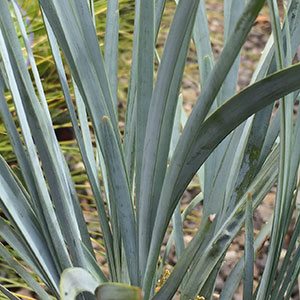
L. filiformis ‘Savanna Blue’ has attractive blue-green foliage and is particularly useful where a contrast in foliage colour is required.
It is a compact clump-forming plant, making it useful for edging, borders, mass planting and smaller garden spaces.
Lomandra confertifolia
L. confertifolia is another useful species for gardens and landscaping.
It forms a clump of attractive strappy foliage and is useful as a border plant, low planting or as part of a larger mass planting.
There are a number of cultivated forms available, including ‘Little Con’ and ‘Wingara’.
Compact forms are particularly useful where a lower-growing plant is required.
Lomandra confertifolia ssp. rubiginosa ‘Seascape’

L. confertifolia ssp. rubiginosa ‘Seascape’ has wonderful blue-grey foliage and a soft, weeping habit.
It is an excellent plant for the border or as a feature in a container.
The foliage makes it particularly useful as a contrast plant amongst greener foliage.
Lomandra ‘Silver Grace’
L. ‘Silver Grace’ has attractive silvery green-grey foliage and a graceful, weeping habit.
It makes an excellent low-growing landscaping plant and can be used in borders, rockeries or as a feature amongst other Australian native plants.
The silvery foliage is particularly useful where a contrast in colour and texture is required.
Lomandra longifolia ‘Katrinus’
L. longifolia ‘Katrinus’ is a larger weeping form and is useful for mass planting and as an effective ground cover.
It can also be used as a contrast plant amongst other strap-leaved plants and is well suited to larger garden beds.
Lomandra longifolia ‘Nyalla’
L. longifolia ‘Nyalla’ forms a substantial clump and is useful for mass planting, borders and general landscaping.
It is another useful choice for low-maintenance gardens where a larger Lomandra is required.
Other Lomandra Species
Other species and forms include:
- L. cylindrica
- L. glauca
- L.gracilis
- L.hystrix
- L. leptostachya
- L. nana
- L.patens
- L.multiflora
There are also a number of naturally occurring forms and cultivated selections available through specialist Australian native plant nurseries.
However, L. longifolia, L.confertifolia and their selected cultivars are among the most widely used Lomandra in gardens and landscaping.
How to Grow Lomandra
Most Species are generally very easy-care plants and are adaptable to a range of garden conditions.
Most grow well in full sun to part shade, although the preferred position can vary between species and cultivars.
A well-drained soil is generally preferred, particularly for plants grown in areas that receive regular rainfall.
Once established, many Lomandra are drought tolerant and require little supplementary watering.
Position and Soil
Lomandra grow well in full sun to part shade.
A well-drained soil is preferred, although many forms are adaptable to different soil types.
Some species can also be useful beneath trees where the soil is dry and root competition makes growing other plants difficult.
When choosing the best variety for you garden, consider the mature size of the particular cultivar rather than simply choosing a plant because it looks attractive in the nursery.
This is particularly important with the larger forms of Lomandra longifolia, which can eventually form substantial clumps.
Watering
Water plants regularly while they are becoming established.
Once established, many Lomandra will tolerate extended dry periods and require minimal supplementary watering.
However, drought tolerance does not mean that plants never need water, particularly during prolonged periods of hot, dry weather.
A deep watering during extended dry periods is generally more useful than frequent light watering.
Planting Lomandra
When planting, mulch around the base to help prevent weeds and retain some soil moisture while the plants establish.
Keep mulch away from direct contact with the centre of the plant.
Allow enough room for the plant to develop into a clump. Over time, Lomandra can form dense clumps that help suppress many weeds and reduce garden maintenance.
For mass planting, spacing will depend on the mature size of the cultivar and how quickly you want the plants to fill the area.
Fertilising Lomandra
This is a plant that generally does not require heavy feeding.
Fertilise with a slow-release fertiliser in spring, particularly if plants are growing in poorer soils or showing signs of slow growth.
A fertiliser formulated for Australian native plants can be used where appropriate.
Avoid excessive fertilising, as these plants are generally well suited to relatively low-nutrient conditions.
Pruning and Maintenance
One of the advantages of Lomandra is their relatively low maintenance nature.
Over time, older foliage can become untidy, particularly after periods of drought or harsh weather.
Established plants can be cut back to encourage fresh new growth.
For larger clumps, old foliage can be removed by cutting the plant back, allowing new foliage to develop from the base.
Pruning is generally best carried out when the plant has finished its main flowering period and conditions are suitable for regrowth.
Small compact cultivars will usually require less maintenance than older, larger forms.


Choosing the Right Lomandra Species for Your Garden
The large range of cultivars means it is worth choosing a plant based on the space available rather than simply selecting the variety with the most attractive foliage.
For Edging and Low Borders
Compact forms such as Lomandra filiformis ‘Savanna Blue’, Lomandra confertifolia ‘Wingara’ and other small cultivars are useful for edging and low borders.
For Mass Planting
Larger forms of L. longifolia are useful where a substantial clump is required, while compact cultivars can be planted more closely in smaller areas.
Lomandra are particularly effective when planted in groups rather than as isolated specimens.
For Foliage Contrast
If you want to introduce a contrast in foliage colour, look for blue-green, blue-grey or silvery forms such as ‘Savanna Blue’ and ‘Seascape’.
These can be particularly effective when planted with greener foliage plants.
For Containers
Smaller cultivars are excellent container plants.
Their strappy foliage provides interest throughout the year and the flowers add another feature during spring and summer.
Use a good-quality, free-draining potting mix and make sure the container has adequate drainage.
Container-grown Lomandra will generally need more regular watering than plants growing in the garden.

Landscaping Uses for Lomandra
Depending on the variety, these grass-like, strap-leafed plants are useful for street plantings, roadside plantings, streetscapes and as clumps in the general garden border.
They are also excellent for mass planting, low borders, garden edging and as container plants.
Lower-growing cultivars are particularly useful as edging plants, while taller Lomandra can provide structure and foliage in larger garden beds.
They can also be used on slopes and in areas where erosion control is required. Dense clumping forms provide good soil cover once established.
Lomandra are also useful beneath established trees where the conditions suit the particular variety.
Their ability to cope with dry conditions and root competition makes some forms particularly valuable in difficult garden situations.
Lomandra as a Feature Plant
Although many species are often planted in groups, individual plants can also make attractive feature plants.
The larger forms of Lomandra longifolia provide strong structure, while blue-grey and silver-foliaged cultivars provide a softer foliage contrast.
A well-chosen Lomandra can work particularly well amongst shrubs, grasses and other Australian native plants.
Where to Buy Lomandra

Online and Retail Melbourne and Geelong based garden centres. Check out their large range of indoor and outdoor plants, Australian Natives, Fruit Trees and Edibles, Succulents, Gardenias, Camellias, Hydrangeas plus a full range garden products for delivery in Melbourne.
www.diacos.com.au

Phone: 0411 435 314
Online Retailer of Landscaping Plants, large quantities of small pot sizes up to advanced sizes & plant Sourcing.
SYDNEY | NORTHERN NSW | GOLD COAST | BRISBANE | MELBOURNE | ADELAIDE
www.egardens.com.au

55 McDougal Rd Neerim South Victoria 3831 PH: (03) 56281507
Advanced ornamental trees and garden designs and concept plans. Direct to your property combined with specialist knowledge and outstanding service.
www.blericktreefarm.com.au

470 Monbulk-Silvan Road Monbulk VIC 3793
"Guaranteed mail order flowering bulbs, perennials, roses, trees, landscaping plants, garden accessories and community fundraising Austra lia-wide."
www.gardenexpress.com.au

111 Stanhope Road Theresa Park NSW 2570
Offering a variety of sun hardy Australian natives and exotic trees, shrubs, groundcover's and perennials from semi advanced through to super advanced and semi-mature stock.
www.downesnursery.com.au
146 Dignams Crk Rd via Narooma NSW 2546
Tubestock - [50mm forestry tubes and 70mm supertubes] specializing in Bush Tucker Plants , Natives indigenous to the NSW South Coast , Permaculture Plants - Fruits, Nuts & Berries .
www.southcoastflora.com.au

email [email protected]
One of Australia's largest wholesale trade nurseries. Over 30,000 species available, tubestock to advanced trees, an almost unlimited choice of plants.
www.plantmark.com.au