

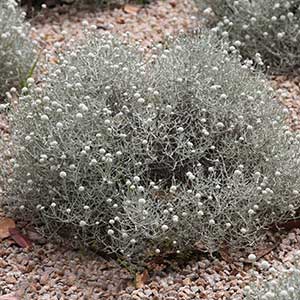
Leucophyta brownii, commonly known as Cushion Bush, is a hardy Australian native shrub valued for its dense rounded shape, striking silver-grey foliage, and distinctive textural growth habit. This tough plant naturally forms compact, bun-shaped mounds of silvery stems with tiny leaves, creating year-round contrast and structure in garden beds, rockeries, coastal gardens, and difficult planting areas.
Naturally occurring in exposed coastal environments, Cushion Bush thrives in harsh conditions where many plants struggle. Its excellent tolerance of drought, poor soils, strong winds, and salt spray makes it an outstanding choice for low-maintenance and coastal landscapes. During summer, it produces small rounded clusters of silver to pale gold flowers, adding subtle seasonal interest. Plant in a full sun position for best performance. It naturally maintains its neat, rounded form but can also be lightly pruned to shape if desired.
Cushion Bush Quick Facts
| Feature | Details |
|---|---|
| Botanical Name | Leucophyta brownii |
| Common Names | Cushion Bush, Silver Cushion Bush |
| Plant Type | Evergreen native shrub |
| Height | 0.3 – 1 m |
| Spread | Up to 1 m |
| Position | Full sun |
| Soil | Well-drained soils |
| Flowers | Small yellow flowers |
| Flowering Time | Spring to early summer |
| Growth Rate | Medium |
| Drought Tolerance | High |
| Frost Tolerance | Tolerates light frost |
Key Features
- Compact rounded growth habit
- Distinctive silver-grey foliage
- Excellent for dry and coastal gardens
- Tolerates poor soils and windy sites
- Low maintenance once established
Natural Habitat and Distribution
Cushion Bush is native to southern Australia and grows naturally in coastal regions from Western Australia across South Australia and Victoria to Tasmania.
In the wild it is often found in exposed rocky areas, sandy soils, and coastal cliffs, where it forms low mounded clumps adapted to wind, salt, and dry conditions.
Some Tasmanian forms tend to remain more compact, typically growing only 30–40 cm high, while plants in warmer regions may become larger and more rounded.
A commonly grown cultivar is ‘Silver Cloud’, valued for its dense habit and attractive foliage.
Appearance
Foliage
The foliage consists of fine, silvery-grey branchlets that give the plant its soft cushion-like appearance. The colour reflects sunlight, helping the plant cope with dry and exposed environments.
The foliage colour also provides excellent contrast with darker green plants in mixed plantings.
Flowers
Small yellow button-like flowers appear from spring through early summer. While the blooms are relatively subtle, they add seasonal interest and attract small pollinators.
Growing Leucophyta brownii
Cushion Bush is widely regarded as one of the easiest Australian native shrubs to grow, provided it is planted in the right conditions.
Position
Plant in a full sun location for best growth and foliage colour. The plant performs poorly in heavy shade and may lose its compact shape if light levels are too low.
Soil
The most important requirement is excellent drainage.
Suitable soils include:
- Sandy soils
- Gravelly soils
- Coastal soils
- Poor or nutrient-deficient soils
Heavy clay soils should be improved with gravel or organic matter to improve drainage.
Watering
- Water regularly while establishing
- Once established, the plant is highly drought tolerant
In many gardens it survives well with very little additional watering.
Fertiliser
Cushion Bush generally requires little or no fertiliser. Excess nutrients can actually reduce the plant’s natural compact form.
Pruning and Maintenance
This plant naturally develops a neat rounded shape, which is one of its main ornamental features.
For this reason:
- Pruning is usually unnecessary
- Heavy trimming can distort the natural mound
- Remove only damaged or dead growth if needed
Because of its tidy growth habit, Cushion Bush is considered a very low-maintenance garden plant.
Landscaping Uses
The unique texture and colour of Cushion Bush make it useful in a wide range of garden styles.
Ideal Garden Uses
- Coastal gardens
- Rock gardens and gravel landscapes
- Low-water or drought-tolerant gardens
- Native plant gardens
- Border or edging plantings
It also works well as a contrasting foliage plant, highlighting darker green shrubs or flowering plants.
Propagation
Leucophyta brownii can be propagated fairly easily from semi-hardwood cuttings taken during the warmer months.
Cuttings should be placed in a free-draining propagation mix and kept lightly moist until roots develop.
Leucophyta brownii ‘Silver Cloud’
‘Silver Cloud’ is a popular cultivated form known for its dense, uniform growth and bright silver foliage.
This variety is often preferred for landscaping because it forms tidy rounded mounds that require very little maintenance.
Top 5 Ways to Use Cushion Bush in Garden Design
With its soft silver foliage and naturally rounded form, Cushion Bush works well in many modern and low-maintenance garden styles. Its drought tolerance and compact growth make it especially useful in areas where hardy plants are needed.
- Coastal Garden Plantings
Cushion Bush is particularly suited to coastal landscapes, where it can cope with salt winds, sandy soils, and strong sun.
Plant it along:
• Seaside garden beds
• Pathways near the coast
• Exposed slopes and dunes
Its silver foliage also complements other coastal plants and grasses, creating a natural seaside look. - Rock and Gravel Gardens
The compact mound shape makes Cushion Bush ideal for rockeries and gravel gardens.
It works well when planted:
• Among large rocks and boulders
• In dry landscape beds
• Along raised rock walls
The silvery foliage contrasts beautifully with stone, gravel, and darker green plants, adding texture and colour to the design. - Low-Maintenance Garden Borders
Because it keeps a naturally rounded form without pruning, Cushion Bush can be used as a neat edging plant along garden beds or pathways.
Plant several together to create:
• Informal borders
• Repeating mounds along pathways
• A soft edging for native garden beds
This creates structure while keeping maintenance to a minimum. - Contrast Plant in Mixed Plantings
The pale foliage of Cushion Bush is excellent for creating contrast in garden beds.
It pairs well with plants that have:
• Dark green leaves
• Bold flowering colours
• Upright growth habits
Using it this way helps break up dense plantings and adds visual interest throughout the garden. - Container and Courtyard Plantings
Smaller forms of Cushion Bush can also be grown in large pots or containers, particularly in sunny courtyards and patios.
When planted in containers:
• Use a very free-draining potting mix
• Position in full sun
• Avoid overwatering
In pots it creates a sculptural, modern look, especially when combined with minimalist garden designs
Companion Plants
Cushion Bush pairs well with other drought tolerant Australian natives, including:
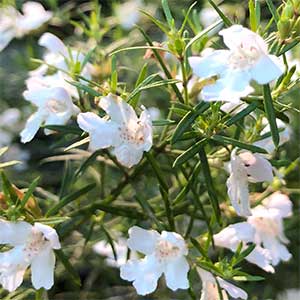


- Coastal rosemary
- Westringia
- Native grasses
- Low growing grevilleas
These combinations create low-water, low-maintenance garden designs.