

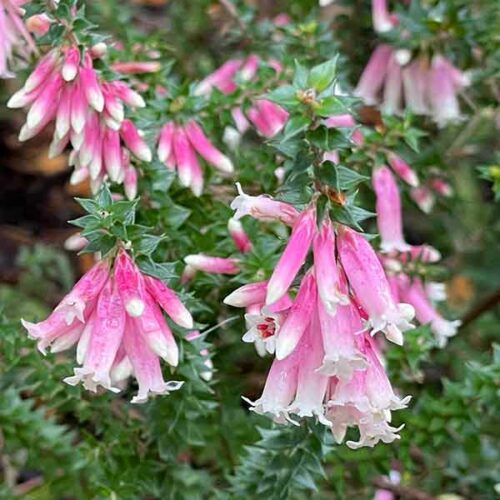
Epacris reclinata, commonly called ‘Fuchsia Heath’, is a small Australian native shrub with attractive white-tipped flowers. Flower colour ranges from pink to red and appears from June through to December, with a peak in spring (September to October) depending on climate.
This is an evergreen shrub that flowers profusely, and like most Epacris varieties can be grown in containers or in a rock garden.
When in full flower, the weight of the blooms causes the branches to droop slightly, giving it a graceful pendulous look. The foliage is held close to the stem and is sharp and pointed.
This is one of the Australian heaths and will flower for most of the year except during the hotter summer months.
Epacris reclinata – Quick Facts
- Common name: Fuchsia Heath
- Botanical name: Epacris reclinata
- Plant type: Evergreen shrub
- Height: 0.5 – 1.5 m
- Spread: 0.5 – 1 m
- Flower colour: Pink to red with white tips
- Flowering period: Winter to spring (June to December, peak in spring)
- Position: Full sun to part shade
- Soil: Well drained, acidic soil
- Water needs: Moderate, prefers consistent moisture
- Growth rate: Moderate
- Frost tolerance: Light frost tolerant once established
How to grow Epacris reclinata
- Best in a well drained soil so either build up the garden bed to improve drainage or add extra drainage material.
- A sunny position with a little afternoon shade is ideal.
- Mulch around the plant tp maintain a cool moist root run.
- Do not underplant the ‘Fuchsia Heath’ or move it after it is established as it resents root disturbance.
Pruning
This is a shrub that can become a little untidy over time, however it is also one that does respond well to pruning.
Two Type of Pruning
- Tip prune after flowering each year, this promote a nice bushy habit..
- As the plant matures you can hard prune it in spring to regenerate the plant.
Companion Plants
Epacris reclinata grows well with other Australian natives that enjoy similar free-draining, low-phosphorus soils.
- Leptospermum (Tea Trees) – similar soil and drainage needs, adds structure
- Grevillea (small to medium varieties) – complementary flowering and attracts birds
- Correa – winter flowering and similar growing conditions
- Banksia (dwarf forms) – for contrast in foliage and form
- Crowea – compact habit and long flowering period
- Westringia – useful as a contrasting foliage shrub in mixed plantings
Landscaping Ideas
Epacris reclinata is a versatile shrub suited to a range of garden styles.
- Rock gardens: Ideal due to its need for excellent drainage and compact size
- Native gardens: Works well as a mid-layer shrub among other Australian plants
- Container planting: Suitable for pots with a well-drained native potting mix
- Sloping sites: Naturally benefits from improved drainage
- Feature planting: Use where the pendulous flowering habit can be appreciated, such as near pathways or edges
- Informal borders: Adds seasonal colour and soft texture