
Quick Facts
- Common names: Gymea Lily, Flame Lily, Spear Lily
- Botanical name: Doryanthes excelsa
- Origin: New South Wales, Australia
- Height: Foliage 1–2m, flower spike 2–6m
- Position: Full sun to light shade
- Soil: Well-drained, humus-rich soil
- Type: Evergreen perennial, clumping architectural plant
Doryanthes excelsa – The Gymea lily An Overview
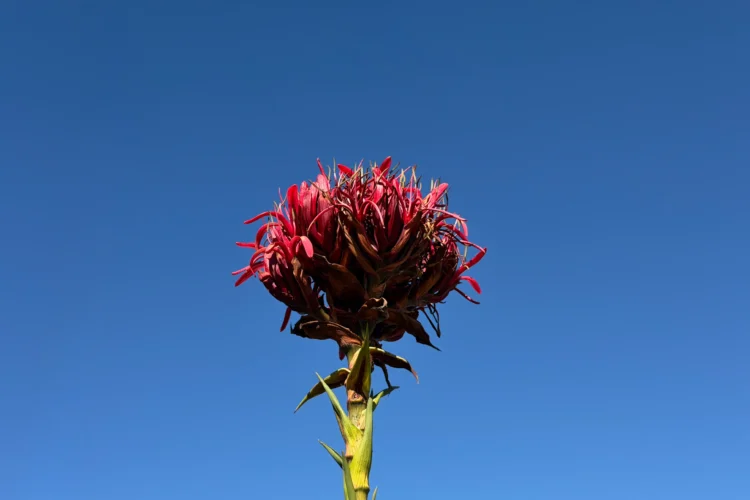
Doryanthes excelsa, commonly known as the Gymea Lily, is one of Australia’s most striking native plants. It is grown for its bold, sword-like foliage and its truly dramatic flowering spike, which can rise several metres above the garden.
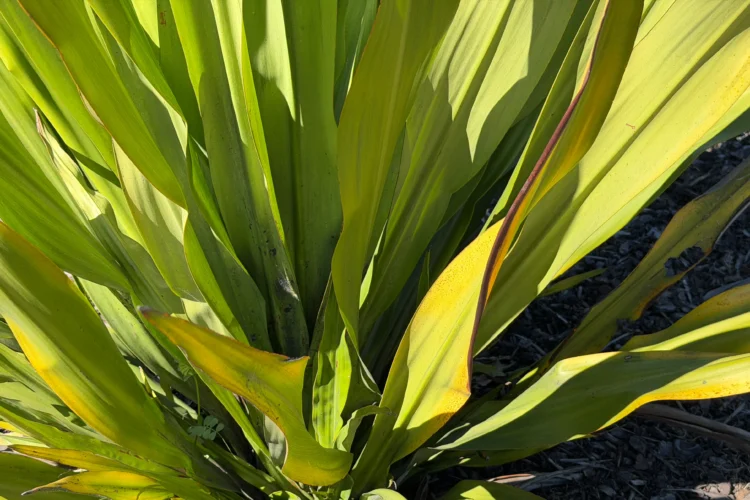
Native to woodland and coastal areas around Sydney, this plant forms a large, architectural clump of long, strap-like leaves. Each leaf can reach around 1 metre in length, creating a strong structural presence even when not in flower.
When mature, the plant produces an extraordinary vertical flower spike topped with a vivid red flower head. This makes it one of the most impressive feature plants in Australian gardens.
Although slow to establish, it is long-lived and highly rewarding once mature.
How To Grow Doryanthes excelsa – Basic Care
Gymea Lily performs best in a sunny to lightly shaded position with well-drained, humus-rich soil.
Once established, it is quite hardy and will tolerate periods of dryness. However, it performs best with consistent moisture during active growth, particularly in spring and summer when flower spikes are forming.
Key care points:
- Ensure excellent drainage, especially in wet climates
- Water regularly during active growth periods
- Avoid heavy, waterlogged soils
- Protect emerging flower spikes from frost in colder regions
While the foliage plant itself is frost tolerant, the flower spike can be easily damaged by late cold snaps.
In containers, Gymea Lily performs best when slightly root-confined. Start in a smaller pot and gradually increase size rather than over-potting early.
Flowering
One of the most common questions is why Gymea Lily does not flower.
This plant is naturally slow to reach maturity and can take 10–15 years or more before producing its first flower spike.
Flowering typically occurs from spring through to summer, although timing can vary depending on climate and seasonal conditions.
Factors that encourage flowering:
- Full sun exposure (light shade may reduce flowering)
- Well-established root system
- Good drainage (waterlogged soils delay maturity)
- Balanced nutrition (too much nitrogen encourages foliage at the expense of flowers)
- Warm spring conditions following winter dormancy
Why it may not flower:
- Plant is still too young
- Insufficient sunlight
- Over-fertilising with high nitrogen
- Poor drainage or root stress
- Competition in overly large garden beds or unstable conditions
There is a well-known gardening tradition suggesting placing a small stone into the centre of the plant to encourage flowering. While not scientifically proven, it remains a widely repeated anecdote among gardeners.
Landscaping Uses
Gymea Lily is widely used as a feature and architectural plant, valued for both its foliage and dramatic height.
It works particularly well:
- At the back of large garden beds and borders
- Roadside Plantings
- As a bold focal point in native gardens
- In drought-tolerant or low-maintenance landscapes
- In large pots for courtyards and patios
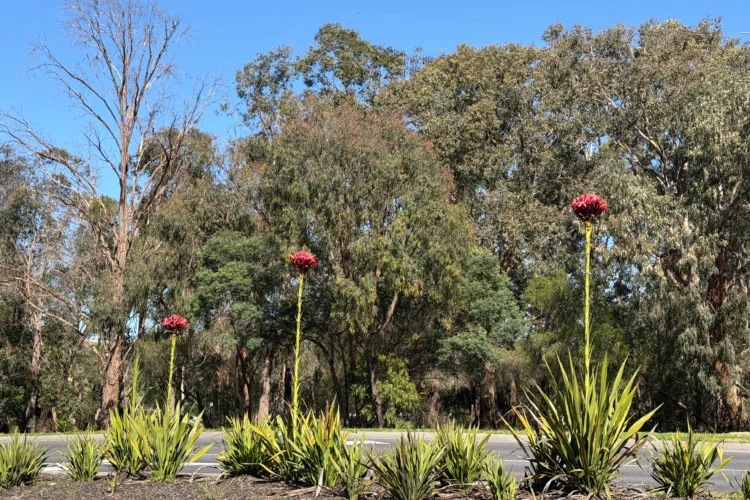
Even after flowering, the tall spent spike is often left standing as a sculptural element in the garden for months.
Maintenance & Propagation
Maintenance is minimal, as the plant naturally holds a neat, upright form.
General care:
- Remove dead or damaged leaves as needed
- Use low-phosphorus fertiliser suited to native plants
- Avoid overfeeding, which can delay flowering
Transplanting:
If moving the plant, take a large root ball and transplant during cooler months. Water regularly while it re-establishes, but avoid waterlogging.
Propagation:
Gymea Lily can be propagated by:
- Seed (slow but reliable)
- Offsets from mature clumps
Common Issues
The most common issue with Doryanthes excelsa is failure to flower, usually related to:
- Age (most common factor)
- Light levels
- Soil drainage
- Nutrient imbalance
Patience is essential—this is a long-term structural plant rather than a quick-flowering ornamental.
Comparison to Other Species
Gymea Lily is often compared with Doryanthes palmeri, the Queensland Spear Lily.
- Doryanthes excelsa
Best suited to temperate climates, particularly southern Australia. More reliable in cooler regions. - Doryanthes palmeri
Prefers warmer, subtropical to tropical conditions and can be more challenging in cooler climates.
Both species produce spectacular flower spikes, but differ in climate preference and adaptability.
Fast Facts
- Growth rate will depend on soil and climate, however they can take 10 years plus to flowering size. Flower quality will be better in light shade than full sun.
- Pruning Doryanthes excelsa is not generally required, the foliage tends to stay fairly neat and upright. Once they have flowered, most gardeners tend not to prune away the old flower stalk for some time. They leave it o stand for many months as a bit os a statement.
- If you are looking at shifting a Gymea Lily, you will need to take as large a root ball as possible. The best time to do this is in the cooler months of the year. Once transplanted, water regularly through the first summer without letting the soil become soggy.
- Fertilising is recommended and a low phosphate fertiliser is best.
- Propagation is from seed, or by the removal of small offsets.
- One problem with Gymea Lilies is them not flowering. It seems sometimes they do and other times they don’t. A bit of folk law says that you can stimulate them into flowering by pushing a small stone down into the centre of the plant. It is said to work, so if yours is reluctant to flower, it may be worth a try.
Species and varieties
The lesser known Doryanthes palmerii or ‘Spear Lily’ is the Queensland spear lily with large red flowers during spring, a little more difficult in cooler conditions.
- Plant Type – Perennial Shrub
- Country of origin – Australia.
- Common Name – Gymea Lily, Flame Lily , Spear Lily.
- Growth Rate – Medium to Fast
- Evergreen / Deciduous – Evergreen
- Soil – Well drained humus rich
- Position – Full sun
- Height – 2m with flower spike to 4m.
- Width – 1m
- Habit – Upright, clumping.
Gymea Lilies are available for sale form the following nurseries

Phone: 0411 435 314
Online Retailer of Landscaping Plants, large quantities of small pot sizes up to advanced sizes & plant Sourcing.
SYDNEY | NORTHERN NSW | GOLD COAST | BRISBANE | MELBOURNE | ADELAIDE
www.egardens.com.au

470 Monbulk-Silvan Road Monbulk VIC 3793
"Guaranteed mail order flowering bulbs, perennials, roses, trees, landscaping plants, garden accessories and community fundraising Austra lia-wide."
www.gardenexpress.com.au