
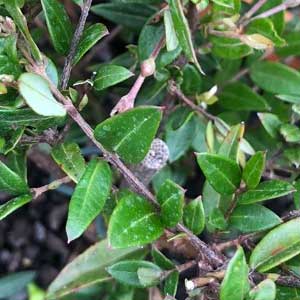
Austromyrtus dulcis, better known as Midyim Berry (sometimes written as Midgen Berry or Midjin), is one of the best-loved Australian bush tucker plants. It grows naturally along the coast from northern New South Wales up to Fraser Island in Queensland.
This low-growing, spreading shrub is perfect for edible gardens, native gardens, and coastal plantings. It reaches around 1 m in height but can spread well over 2 m, making it an excellent ground cover, border filler, or low hedge. It’s also small enough to grow successfully in a container.
Three varieties are available, with slightly different growth habits, foliage and taste.
Midyim Berry is prized for its delicious fruit and attractive appearance. In summer, it produces masses of white star-shaped flowers, followed by sweet, speckled berries that are eaten fresh or used in jams, baking, and desserts. Because the fruit does not travel or store well, it is rarely seen for sale away from its natural range.
The berries are a popular traditional bush food, eaten by Indigenous Australians for generations. They have a sweet, aromatic flavour with a pleasant peppery–gingery note and a melt-in-the-mouth texture.
How to grow Midyim Berry
Midyim Berry grows naturally in warmer, frost-free climates and is well adapted to coastal conditions. It’s flexible about soil type as long as drainage is good.
Position
Plant in full sun to part shade, ideally with light dappled afternoon shade in hotter areas. In cooler climates, choose a frost-free spot. It also tolerates light frost once established.
Soil
Use a well-drained soil. Avoid heavy, poorly drained soils that stay wet and soggy. It adapts well to sandy, loamy, and sandy-loam soils, and can also cope with coastal sands.
Mulch
Lightly mulch around the base to help keep the roots cool and maintain even moisture.
Watering
Once established, Midyim Berry is drought tolerant. For best fruit production, however, give it regular deep watering in spring and summer. Always allow the soil to dry slightly between waterings.
I water my Midyim Berry deeply once a week in spring and summer (If we don’t have adequate rainfall) , then I tend to let the soil dry a little before watering again. When I first tried keeping the soil constantly moist, the plant looked happier but didn’t produce much fruit. Once I switched to “dry between waterings”, fruit set improved noticeably.
Container growing
Because it stays relatively compact and responds well to pruning, Midyim Berry is one of the few bush tucker plants that grows very well in a large pot on a patio or balcony.
When to harvest Midyim Berry
The fruit appears after the summer flowers and ripens to a small, speckled white berry, about the size of a small bird’s egg. It has a sweet, unusual flavour that many people love.
When to pick
Harvest when the berries are soft and easily fall from the plant. Try spreading a sheet beneath the shrub and gently shaking the branches, or pick the berries by hand.
Using the fruit
Eat fresh, add to ice cream or yoghurt, or use in:
- jams and preserves
- baking and desserts
- chutneys and sauces
The fruit does not store well, so eat or process it as soon as possible after picking.
Pruning
The best time to prune is right after harvesting, usually in late summer to autumn. I prune mine lightly right after harvesting in autumn. I don’t cut back hard; I just trim the tips and tidy the shape. If I prune too early or too hard, I get fewer flowers the following spring.
- Light pruning is recommended.
- Flowers (and therefore fruit) form on older growth, so avoid heavy cutting.
- Tip-prune new foliage every few months to keep the plant compact and tidy.
In good conditions, Midyim Berry reaches about 90 cm in height and spreads to over 2 m. Because it responds well to pruning, it also makes an interesting low hedge or informal screen.
Quick Facts
- Botanical Name – Austromyrtus dulcis
- Common Name – Midyim berries, Midgen berry, sand berry.
- Position – Full Sun to part shade
- Soil – Well drained
- Height – .5m to 1m
- Spread to 1.5m
- Flowers – White star shaped
- Flowering Time – Summer
- Foliage – Mid to deep green
- Pruning – After harvesting berries.
- Uses – Bird attracting, fruiting plant, useful filler in the garden border.
Frequently asked questions about Midyim Berry
Is Midyim Berry frost tolerant?
Midyim Berry prefers frost-free positions, especially when young. Once established, it tolerates light frost, particularly if planted in a sheltered spot or under tree canopy. In cooler climates like Melbourne, planting beneath trees or near a warm wall helps protect it.
How long does it take for Midyim Berry to fruit?
Grown from cuttings, Midyim Berry can start flowering and fruiting within 2–3 years. Seed-grown plants may take longer, often 3–4 years or more, depending on growing conditions.
Can Midyim Berry grow in pots?
Yes. It’s one of the few bush tucker plants that works very well in containers. Use a large pot (at least 40–50 cm wide), well-drained potting mix, and place it in full sun to part shade. Prune regularly to keep it compact.
Does Midyim Berry attract birds?
Yes. The flowers attract bees and butterflies, and the fruit is enjoyed by seed-eating birds. It’s a good addition to bird-friendly gardens.
How much sun does Midyim Berry need?
It grows best in full sun to part shade. In hot, inland areas, some light afternoon shade helps prevent leaf scorch. In cooler or coastal areas, full sun is ideal.
Is Midyim Berry a good ground cover?
Yes. Its spreading habit and low height make it an excellent ground cover, especially on slopes or in coastal gardens. It also helps with erosion control.
Can I grow Midyim Berry inland?
Yes. While it’s coastal in the wild, it adapts well to inland gardens if given good drainage and regular water during dry spells. Mulching helps retain moisture.
Where To Buy

146 Dignams Crk Rd via Narooma NSW 2546
Tubestock - [50mm forestry tubes and 70mm supertubes] specializing in Bush Tucker Plants , Natives indigenous to the NSW South Coast , Permaculture Plants - Fruits, Nuts & Berries .
www.southcoastflora.com.au
Austromyrtus dulcis x tenuifolia ‘Copper Tops’ is a selected naturally occurring hybrid cultivar that generally stays compact, shows coppery new growth, and is commonly used as a low shrub or groundcover. By contrast, Austromyrtus dulcis and Austromyrtus tenuifolia are the two parent species, and they differ in leaf shape, habit, and often overall growth size and use.
We feel that taste also differs a little, with “Coppertops” having a stronger taste.
Midyim Berry Varieties Comparison
| Plant | What it is like | Typical size / habit | Fruit and flowers | Best use |
| Austromyrtus dulcis x tenuifolia ‘Copper Tops’ | Hybrid cultivar with copper new growth and dense, mounding form | Low, spreading shrub, about 0.5 m high and around 1 m wide in common nursery listings | White/cream spring flowers, edible berries in late summer to autumn | Groundcover, edging, small gardens, containers |
| Austromyrtus dulcis | Species known as midyim berry, usually grown for bush tucker and ornamental fruit | Generally a small spreading shrub, though exact size varies by source and conditions | White flowers and sweet-tangy berries | Edible native planting, wildlife gardens, bush food |
| Austromyrtus tenuifolia | Narrow-leaf myrtle / midgen berry type, with thinner leaves and often a taller, looser habit | Often listed as a small shrub up to about 1–2 m, with thin leaves | White flowers, edible fruit | Native shrub planting, screening, bush food |
How Copper Tops stands out
‘Copper Tops’ is mainly valued for its ornamental foliage and tidier landscape form, not just the fruit. Best described as being more compact and dense than the species plants, with bronze or copper-toned new leaves that deepen to green.
Compared with A. dulcis
Austromyrtus dulcis is the classic midyim berry type and is usually chosen for its edible berries and low, spreading habit. ‘Copper Tops’ does the same edible-job, but it is often preferred when you want a neater, more decorative plant with stronger bronze new growth.
Compared with A. tenuifolia
Austromyrtus tenuifolia is typically the narrower-leaved, more upright or looser of the two species, and some listings show it reaching a bit taller than ‘Copper Tops’. If you want a compact edging plant, ‘Copper Tops’ usually looks more controlled; if you want the species form with finer leaves and a more open shrub shape, A. tenuifolia is the closer match.
Practical choice
The choice usually comes down to form: pick ‘Copper Tops’ for a lower, denser, more decorative shrub, and pick the species forms if you want a more natural bush tucker planting with less emphasis on uniform appearance. All three like well-drained soil and sun to part shade, and all can be used for edible fruit