
Old Man Saltbush
This is a perennial plant that has a range of uses from the home garden to the grazing industry. A native to Australia, Atriplex nummularia is used widely in South Africa. Although it is widely used as a forage plant, you can use it as a hedging plant, and Old Man Salt Bush can be easily pruned with hedging shears.
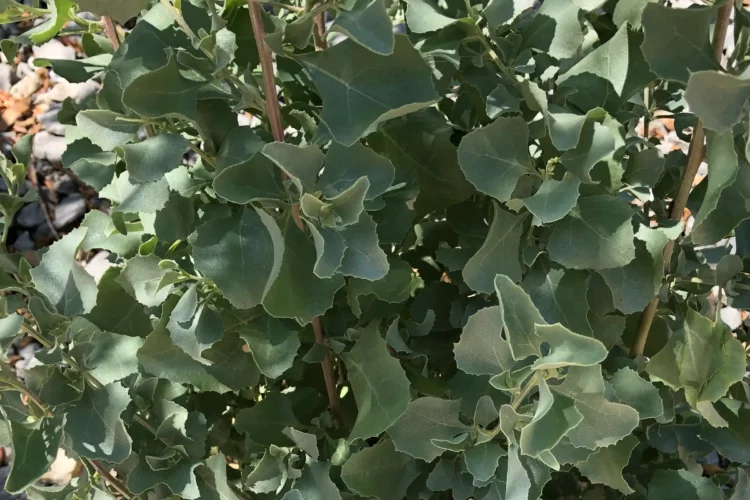
The foliage is also use in cooking, both as a food wrap for baking fish as well as dried and crushed. Also useful as a screening plant in arid areas. With attractive foliage and being easy to prune, this is plant that can also be used as a hedge, or as a filler plant in the dry garden border.
Old Man Saltbush or Atriplex nummularia has a long deep root system and is efficient at converting water to plant material. A valuable plant for grazing, regeneration and for use in saline affected soil.
Quick Facts
- Botanical Name: Atriplex nummularia
- Common Name: Old Man Saltbush
- Plant Type: Evergreen native shrub
- Origin: Australia
- Height: 2–3 metres
- Width: 2–4 metres
- Growth Rate: Moderate to fast
- Position: Full sun
- Soil: Free-draining soils including sandy and saline soils
- Drought Tolerance: Excellent once established
- Foliage: Silvery-grey evergreen leaves
- Uses: Bush tucker, hedging, screening, grazing, revegetation and erosion control
Growing Conditions
Old Man Saltbush thrives in full sun and is highly adaptable to difficult growing conditions. It performs particularly well in dry climates and is tolerant of saline soils where many other plants struggle.
A free-draining soil is essential. Although established plants are extremely drought tolerant, young specimens benefit from regular watering while developing their deep root system.
Once established, the plant requires very little maintenance and will tolerate heat, wind and extended dry periods.
Care and Ongoing Maintenance
Old Man Saltbush is a low-maintenance plant once established.
Pruning can be carried out regularly to maintain shape, encourage dense growth and create formal hedges or screens. Older plants respond well to rejuvenation pruning if they become sparse or untidy.
Avoid waterlogged soils, particularly during establishment, as excessive moisture can lead to root problems.
Old Man Saltbush as an Australian Native Food Plant
Old Man Saltbush has become increasingly popular as a bush tucker ingredient due to its distinctive edible leaves.
The foliage has a naturally salty flavour with subtle earthy notes, making it a useful seasoning and cooking ingredient. The leaves can be harvested fresh or dried for later use.
Traditional and modern culinary uses include:
- Wrapping fish and seafood before baking.
- Adding fresh leaves to salads.
- Using leaves as a seasoning for meat dishes.
- Drying and crushing leaves to create a native spice blend.
- Incorporating into breads and savoury baking.
- Adding to sauces and marinades.
The naturally salty flavour means the leaves can often reduce the need for additional salt in cooking.
As interest in Australian native foods continues to grow, Old Man Saltbush is increasingly planted in edible native gardens alongside species such as Warrigal Greens, Finger Lime and Lemon Myrtle.
Varieties of Saltbush
Several forms and related species are commonly grown.
Atriplex amnicola – River Saltbush
A larger species that is highly palatable to livestock and often used as a forage plant.
Atriplex nummularia – Old Man Saltbush
The standard species with excellent drought tolerance and an extensive root system. It remains one of the most widely planted forms.
Atriplex nummularia ‘De Kock’
A selected form that combines improved palatability for livestock with strong growth and a well-developed root system.
Landscaping Uses
Atriplex nummularia is a versatile shrub with a range of practical and ornamental applications.
In home gardens it can be used as:
- A drought-tolerant hedge.
- A screening plant.
- A feature shrub in native gardens.
- A background plant in dry-climate landscapes.
- A windbreak in exposed locations.
- A silver-foliaged contrast plant.
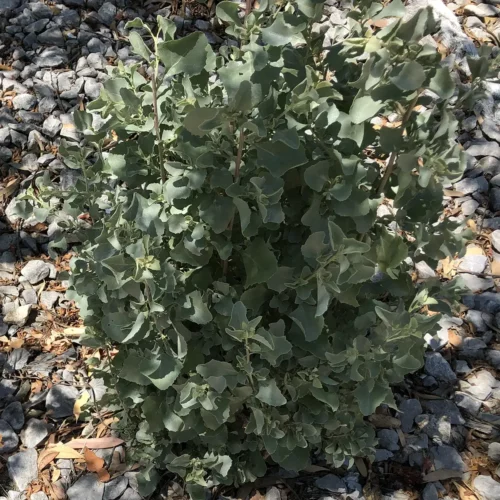
Its attractive foliage combines particularly well with flowering Australian natives and Mediterranean-style garden plants.
The species is also widely used in rural areas for:
- Stock forage.
- Land rehabilitation.
- Erosion control.
- Salinity management.
- Revegetation projects.
Propagation
Growing from Seed
Seed is commonly sown in autumn or spring.
Many growers soak seed before sowing to improve germination rates. Sow seed very shallowly, approximately 1–2 mm deep, in a free-draining propagation mix.
Seedlings should be protected from excessive moisture and transplanted once they have developed a strong root system.
Growing from Cuttings
Propagation from cuttings is also reliable.
Terminal cuttings approximately 15 cm long are usually taken during spring and placed in a well-drained propagation mix. Under suitable conditions they strike readily and quickly establish.
Young plants require supplementary watering until they become established.
Where To Buy

Specialist Native Food Nursery with thirty species available in both forestry tubes and 14 cm pots, from ground cover to canopy. Twenty years experience supplying landscape scale projects to backyard gardens.
www.peppermintridgefarm.au .
530 Burwood Hwy Wantirna. 3152
INLAND BOTANICS
phone: (02) 67753948 fax: (02) 67735937
Old Man Saltbush seedling specialists and producers of other bulk seedling crops such as trees, shrubs, vegetables, herbs or flowers.