
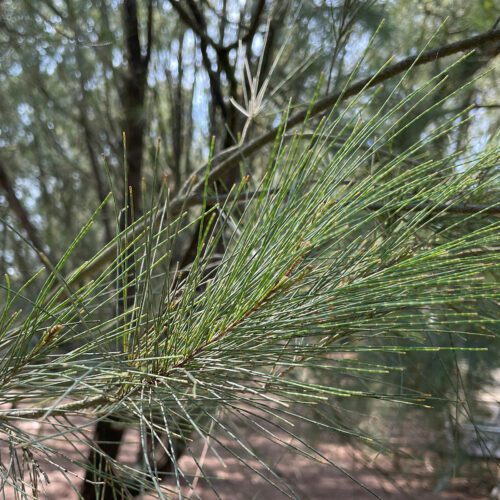
With an attractive weeping habit, Allocasuarina littoralis, commonly called the Black She-oak is a useful landscaping tree.
Best described as a medium sized tree, and having a natural upright habit, the mature bark is very dark, fissured and gives a textural appearance.
This is a fast growing tree which makes it valuable in a range of landscaping projects. It is also a species that fixes nitrogen into the soil.
Native to Australia with a natural habitat from the east coast of Tasmania and along coastal ranges areas from Victoria to Queensland this is a very adaptable and easy Allocasuarina species.
Quick Facts
| Feature | Details |
|---|---|
| Botanical Name | Allocasuarina littoralis |
| Common Name | Black She-oak |
| Family | Casuarinaceae |
| Origin | Eastern Australia |
| Height | 8–12 metres |
| Spread | 3–5 metres |
| Position | Full sun |
| Soil | Well-drained soils |
| Growth Rate | Medium to fast |
| Foliage | Evergreen, fine and needle-like |
| Drought Tolerance | Moderate to High |
| Frost Tolerance | Yes |
| Salt Tolerance | Moderate |
| Wildlife Value | Excellent |
How To Grow Allocasuarina littoralis – Basic Care
Very easy care once established as long as drainage is good. It is moderately drought tolerant, and will cope with frosts.
- Allocasuarina littoralis thrives in full sun to part shade and is very adaptable to a range of soil types including any well drained clay, sand or loamy soils, coastal, inland, and poor soils, provided drainage is good.
- Water regularly and deeply during planting and for the first three months, allowing the soil to dry a little between waterings; once established, this is a highly drought-tolerant and survives little to no extra water.
- Mulch around the base to retain moisture and suppress weeds.
- Pruning is generally not required — remove dead or damaged wood as needed; prune to shape if required in late winter or early spring.
- Apply a native slow-release fertilizer (low phospjate) once or twice yearly for best growth.
- Planting distance to form screens or windbreaks, 2–4m apart; feature trees try 6m apart.
- This is a nitrogen-fixing tree encourages native biodiversity, attracts seed-eating birds, and controls erosion.
- Avoid planting near pathways, drainage lines, pipes and buildings due to the large root syste
Male and Female Trees
Allocasuarina littoralis is a dioecious species, meaning male and female flowers occur on separate trees.
Male trees produce attractive reddish-brown flower spikes, often appearing in autumn and adding unexpected seasonal colour.
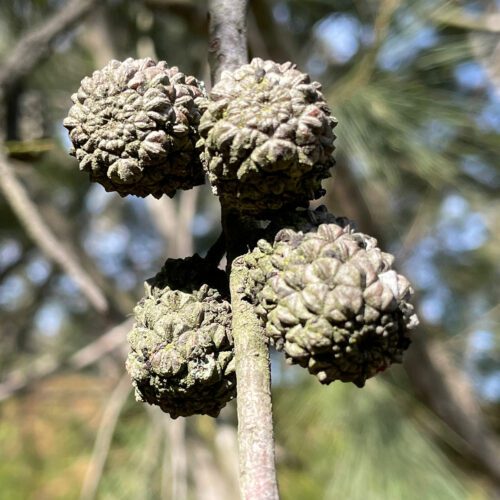
Female trees produce small woody cones that persist on the branches and provide food for a range of native birds.
Both male and female trees contribute to the ornamental value of the landscape.
Nitrogen Fixing Benefits
Like many members of the Casuarinaceae family, Allocasuarina littoralis forms a beneficial relationship with soil bacteria that allows it to fix atmospheric nitrogen.
This helps improve soil fertility over time and enables the tree to thrive in poorer soils where many other species struggle.
For revegetation projects and habitat plantings, this characteristic makes it particularly valuable.
Landscaping and Garden Uses
Excellent as a windbreak tree, it attracts native birds to the garden and the trunk with its deep fissured bark is also suited to growing some epiphytic orchids.
It grows well in coastal conditions and makes a good windbreak tree. It has shallow a root system so can also be useful for erosion control.
Wildlife Benefits
This is one of the best Australian native trees for encouraging wildlife into the garden.
The dense canopy provides shelter and nesting sites for small birds while the cones are an important food source for seed-eating species.
In some regions, Black She-oaks are particularly valuable for black cockatoos and other native parrots.
The tree also supports a range of insects that form part of the broader ecosystem.
Black She-oak and Black Cockatoos
One of the most valuable features of Allocasuarina littoralis is its importance as a food source for Australia’s black cockatoos.
The female trees produce woody cones containing small seeds that are highly sought after by several species of cockatoo. During feeding, birds use their powerful beaks to break apart the cones and extract the nutritious seeds inside.
In many parts of eastern Australia, Black She-oaks provide an important seasonal food source for:
- Yellow-tailed Black Cockatoos
- Glossy Black Cockatoos
- Gang-gang Cockatoos
- Other seed-eating parrots and native birds
The relationship is especially significant for Glossy Black Cockatoos, which rely heavily on the seeds of she-oaks and allocasuarinas throughout much of their range.
Gardeners who plant Black She-oaks are often rewarded with visits from these spectacular birds, particularly once trees begin producing cones. The sight of a flock of black cockatoos feeding high in the branches is one of the great pleasures of growing native trees.
For habitat gardens, wildlife corridors and revegetation projects, Allocasuarina littoralis is considered one of the most valuable food-producing trees for native bird populations.
Propagation
Propagation is usually from seed.
Seed germinates readily when fresh and is often sown in native propagation mixes with good drainage.
Young seedlings establish quickly and are generally easy to grow.
Where To Buy

1750 Westernport Rd Heath Hill VIC 3981
Australias largest grower of semi advanced native and deciduous trees. .9 - 2.6mts high. Supplying councils, developers and landscapers. Includes Acacia implexa, acacia melanoxlylon.
www.dream-time.com.au

"Propagation and Production of Native and Exotic Trees
with Natural Root Systems from 2 to 2,000 lts."
www.njrivett.com.au