
Actinodium cunninghanii with its daisy like flowers is a small shrubby plant with very attractive flowers.
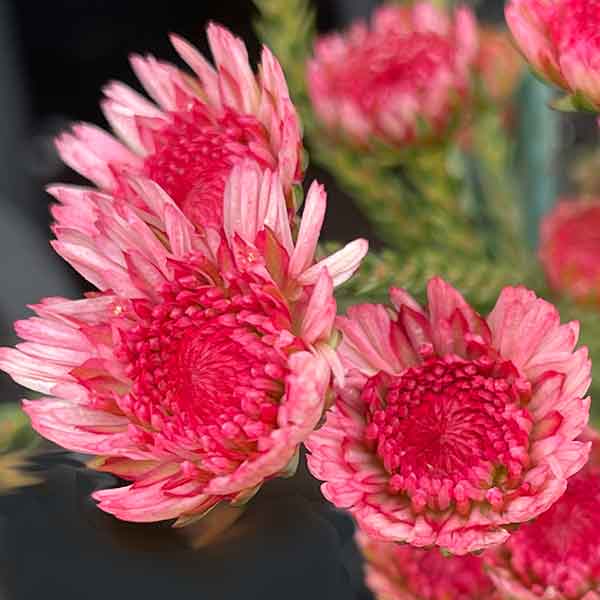
The flower colour does vary, from pink centres with white petals to different shaded of pink to red.
This is a naturally low growing plant and it is best grown at the front of the garden border. It is also excellent when grown in containers where the flowers can be made pride of place.
In the natural environment which includes areas around the Fitzgerald River National Park, through to Albany, many forms have been identified. It is found in low lying areas, so it will receive periods of moisture, hence the name ‘Swamp Daisy’ as well as ‘Albany Daisy’. You will also see Actinodium cunninghamii nana which is a lower growing form
How to grow Actinodium cunninghamii
For us, this is a plant that is best grown in containers in a sandy, free draining potting soil. It will grow in full sun, however in hotter climates part shade over summer months is recommended.
Fertiliser is generally not required although a little seaweed fertiliser each spring can be beneficial. Do not use high phosphate fertilisers.
Pruning
Prune immediately after flowering.
Propagation
Propagation can be achieved from seed, most varieties are grafted to improve performance.
Summary Information
- Botanical Name – Actinodium cunninghanii.
- Botanical Family – Myrtaceae
- Common Name – The Albany Daisy, Swamp Daisy
- Position – Full sun to a a little shade.
- Climate zone – Cool to warm Temperate. Not suited to sub tropical or tropical areas.
- Soil – Well drained to dry, best in a sandy soil with some moisture through summer.
- Height – To around .5 metres although taller and shorter varieties do exist.
- Spread – To around .5 metres.
- Growth Rate – Medium
- Flowers – Varying from a Pink and white through to Reds.
- Flowering Time – Spring, with spot flowering in winter.
- Foliage – Evergreen, mid to deep green.
- Frost tolerant – Light frosts only.
- Drought tolerant -Yes once established.