
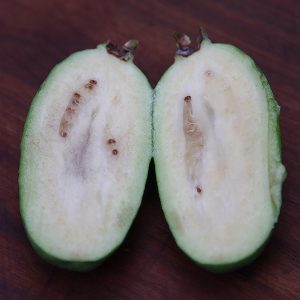
The Pineapple Guava
Feijoa trees (Acca sellowiana), also known as Pineapple Guavas, are hardy, attractive fruit trees valued for their sweet, aromatic fruit and ornamental nature. The flavour is unique — a mix of pineapple, guava and pear — with soft, jelly-like flesh that’s ideal for eating fresh or adding to desserts.
Although often mistaken for true guavas, Feijoas come from the cooler regions of South America. They thrive in temperate to subtropical parts of Australia and are especially popular in New Zealand gardens for their reliability and flavour.
How To Grow Feijoa Trees – Care and Growing conditions
Feijoas grow best in a sunny position with well-drained, humus-rich soil. They are frost-tolerant once established but can be damaged when young, so protect young trees from heavy frost and hot, drying winds.
Planting Steps:
- Prepare the soil by digging in compost, aged cow manure, and other organic matter.
- When planting, choose a location sheltered from strong afternoon sun.
- Water in well using a liquid seaweed fertiliser to reduce transplant shock.
- Mulch generously around the drip line using straw, lucerne, or composted leaves — but keep mulch 15 cm away from the trunk to avoid rot.
Feijoas can be trained as a single-trunk tree, a dense hedge, or even grown in containers, making them versatile for gardens of any size.
Seasonal Care and Maintenance
Once established, Feijoa trees require minimal care.
- Fertilising: Apply a balanced fruit tree fertiliser or high-nitrogen feed each winter. Follow with aged manure and refresh mulch layers in late winter to early spring.
- Watering: Deeply water young trees during dry spells to encourage strong, deep roots. Mature trees tolerate short dry periods.
- Mulching: Maintain a thick organic mulch to improve soil structure, encourage earthworms, and retain moisture.
Pruning Feijoa Trees
Feijoas respond well to pruning, and it’s key to better fruiting and shape control.
- When to prune: Late winter or early spring, or about four weeks after fruiting finishes.
- How to prune: Remove dead, diseased, or crossing branches to open up the canopy for light and air. Lightly trim remaining growth, leaving at least six leaf nodes per stem for strong fruiting.
- Hard pruning: If a Feijoa has become overgrown, cut it back to around 1–2 metres. The tree will reshoot vigorously.
- Suckers: Remove basal suckers as they appear.
Harvesting is best carried out when the fruit is ready to fall off the tree, this will give you the sweetest best tasting fruit.
Remember to remove all fallen fruit from the ground to prevent disease and insects.
Planting Suggestions and Landscaping Uses
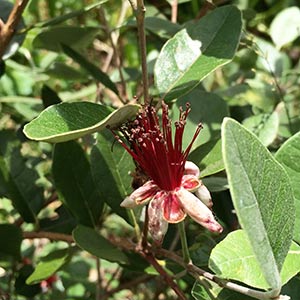
These are an attractive tree, nice foliage and flowers, they are also easy to prune so options are many.
Feijoa are used both as a fruiting tree and an ornamental tree, the fruit can be eaten when ripe, and the pink flowers are attractive.
- Grow Feijoa as a fruiting and flowering hedge.
- Try growing them as an espalier against a fence or a wall.
- Grow them in containers.
- Train them a single trunk tree.
- Allow multiple trunks to form.
In areas of strong winds and poor sandy soil you may wish to stake your Feijoa tree.
Harvesting Feijoa Fruit
Feijoa fruit is ripe when it falls naturally from the tree — this ensures the best flavour and sweetness. Gather fruit promptly to prevent insect damage and disease.
The flesh is best eaten fresh by splitting the fruit open and scooping it out with a spoon. Feijoas are delicious in muffins, cakes, jams, and even paired with ice cream. The edible flowers can be sprinkled over salads or used to flavour drinks for a subtle sweetness.
Common Problems
If your Feijoa tree isn’t setting fruit, check these common causes:
- Pollination: Some varieties need cross-pollination. Plant at least two trees or encourage a neighbour to do the same.
- Shade: Insufficient light reduces flowering and fruit set — ensure at least 6 hours of direct sun daily.
- Over-pruning: Heavy cuts can remove flowering wood and delay next season’s yield.
Feijoa Varieties for Australian Gardens
For reliable crops and great flavour, choose named cultivars rather than seedlings.
- ‘Apollo’ – Excellent commercial variety with sweet, aromatic fruit and upright growth.
- ‘Unique’ – Compact and self-fertile; perfect for small gardens or containers.
- ‘Mammoth’ – Very large fruit; self-fertile but produces more with cross-pollination.
- ‘Nazematze’ – Distinct pear-shaped fruit; strong performer with cross-pollination.
- ‘Gemini’ – Early fruiting, producing in mid-summer.
- ‘Opal Star’ – Late-fruiting cultivar with rich flavour through autumn.
- ‘Coolidge’ and ‘Superba’ – Older favourites still valued for consistent crops.
Landscaping and Design Ideas
Feijoas combine ornamental appeal with productivity. Their grey-green foliage and pink-white flowers suit both edible and decorative garden settings.
Try these creative options:
- Train as an espalier along a fence or wall.
- Plant several in a row as a flowering and fruiting hedge.
- Grow in large pots for patios and courtyards.
- Shape into small feature trees with a single or multi-trunk form.
In exposed sites with sandy soil or high winds, staking and extra compost at planting will improve establishment success.
Quick Feijoa Care Summary
| Growth Habit | Evergreen Shrub or Small Tree |
|---|
| Growth Habit | Evergreen Shrub or Small Tree |
|---|---|
| Height | 2–4 metres |
| Position | Full sun, sheltered from strong winds |
| Soil | Well-drained, enriched with compost |
| Watering | Regular until established |
| Feeding | Fruit tree fertiliser in winter |
| Harvest | Mid-summer to autumn when fruit drops naturally |
Feijoa trees offer both ornamental beauty and delicious fruit. With minimal care and a sunny spot, they’ll reward Australian gardeners with abundant harvests and year-round interest.
Where to Buy Feijoa Trees

470 Monbulk-Silvan Road Monbulk VIC 3793
"Guaranteed mail order flowering bulbs, perennials, roses, trees, landscaping plants, garden accessories and community fundraising Austra lia-wide."
www.gardenexpress.com.au

55 McDougal Rd Neerim South Victoria 3831 PH: (03) 56281507
Advanced ornamental trees and garden designs and concept plans. Direct to your property combined with specialist knowledge and outstanding service.
www.blericktreefarm.com.au
More Fruit Trees
What is Feijoa fizz?
This a simple fermented drink made from feijoa skins. For a 3 litre container
- Take the skins from around 15 to 20 feijoa
- Clean them but don’t wash them, so cut off any bits that don’t look good.
- You need a deep wide mouthed jar – A preserving jar is ideal
- Sterilise the jar and dry it
- Pack the skins into the jar a top with a 1/4 cup of sugar.
- Fill the jar with water. Around 1.5 – 2 litres, boiled and cooled.
- Use a smaller jar filled with water to weigh the skins down.
- Cover with a cloth and leave for three days in a cool dark position
- If the skins begin to float, push then under
- If the skins grow mould, start again with fresh skins
The water should look a little cloudy after 3 days
Strain the liquid add another 1/4 cup of sugar and dissolve it.
Pour the liquid into sterilised bottles with proper caps.
Chill and your ready to enjoy Feijoa fizz.