
Crab Apple Trees (Malus) are valued as beautiful spring-flowering ornamental trees and, with many varieties, for their small crab apples that are widely used in jams, jellies and traditional apple cider.
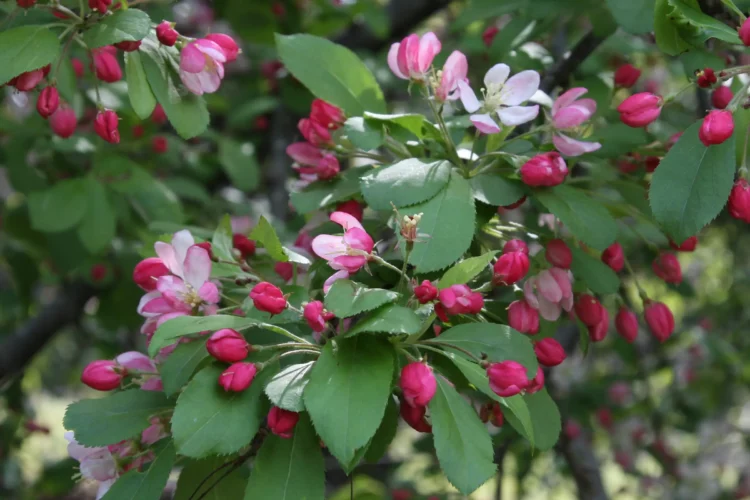
Both white and pink flowering varieties are available. They make an excellent small spreading shade tree, provide valuable spring colour and many varieties also develop attractive autumn foliage in shades of yellow, orange and red.
Crab apples are tough, adaptable trees that cope well with a wide range of growing conditions. Once established they require very little care and only light pruning to maintain shape.

Dwarf crab apple cultivars that reach around 3 metres are also available. These are grown mainly for their spectacular flowers rather than heavy fruit production and are well suited to smaller gardens.
Climate Zones
Crab Apple trees are best suited to the cool and temperate regions of Australia where they receive enough winter chill for reliable flowering and fruiting.
They perform best in:

- Australian Climate Zones: Cool Temperate, Temperate and many Arid inland areas with cold winters.
- They are less reliable in Tropical and Subtropical climates where winter chill is limited.
For gardeners familiar with the United States climate system, Crab Apples generally perform best in USDA Zones 4–8, with some cultivars also succeeding in Zone 9 where winters remain cool enough.
Best Crab Apple Varieties
Royal Raindrops is one of the outstanding modern cultivars, producing masses of rich pink flowers in spring followed by attractive purple foliage and excellent autumn colour.
Malus floribunda, or Showy Crab Apple, is one of the finest white flowering varieties. It typically reaches around 5–6 metres depending on growing conditions.
Malus hupehensis is regarded as one of the better pink flowering crab apples.
Malus × atrosanguinea, a New Zealand selection, is one of the best varieties for producing fruit, along with Malus ‘John Downie’, which can reach around 8 metres depending on the rootstock it is grown on.
Newer cultivars such as ‘Royal Raindrops’, with its striking pink flowers and purple foliage, and ‘Sugar Tyme’, whose pink buds open to masses of white flowers, are well worth looking for.
Crab Apple Tree Species
- Malus ioensis ‘Plena’ (Bechtel’s Flowering Crab Apple) is a favourite with fragrant double white flowers that age to soft pink.
- Malus ioensis ‘Rubra’ produces attractive pink to deep red flowers.
- Malus floribunda (Japanese Crab Apple) is one of the most popular varieties with masses of white spring flowers.
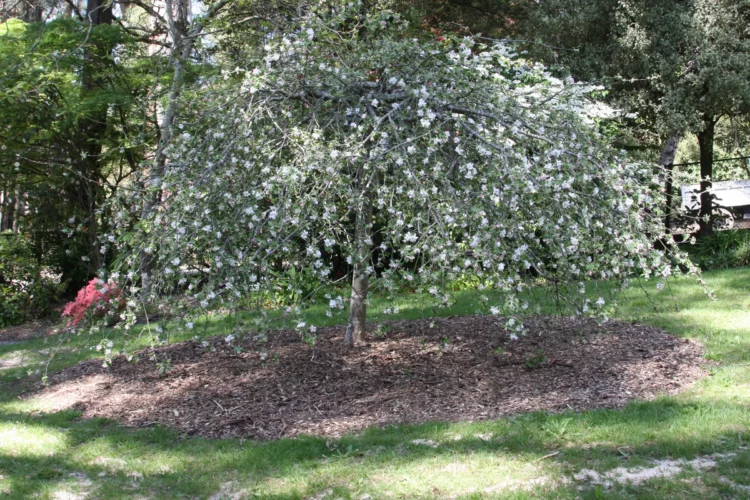
- Malus floribunda ‘Pendula’ is the graceful Weeping Japanese Crab Apple, usually grafted onto a standard trunk.
- Malus pumila pendula – Malus-Elise-Rathke is another weeping variety, top grafted.
- Malus spectabilis ‘Plena’ features large, attractive double flowers.
- Malus baccata (Mandshurian Siberian Crab Apple) is another excellent ornamental species.
- Malus trilobata is probably the best upright crab apple, with deeply lobed foliage, large white flowers and an attractive formal habit. Growing around 5–7 metres tall, it is an excellent landscaping tree and is particularly effective when planted along driveways or avenues.
- Malus tschonoskii is another upright-growing form valued for its elegant shape and colourful autumn foliage.
How to Grow Crab Apple Trees
Crab Apple trees are relatively easy to grow provided they receive full sun and good drainage.
Position
Choose a sunny position where the tree receives at least six hours of direct sunlight each day. More sun means heavier flowering, better fruit production and stronger autumn colour.
Soil
A well-drained soil is essential. Improve the soil before planting by incorporating plenty of well-rotted compost or aged organic matter.
Avoid digging deeply into heavy clay soils. Instead, improve the surface soil and consider planting slightly above ground level if drainage is poor.
Planting
- Dig a hole twice the width of the root ball.
- Position the tree so it sits at the same depth as it was growing in the nursery container.
- Backfill with the improved soil and firm gently.
- Water thoroughly after planting using a liquid seaweed fertiliser to encourage healthy root development.
- Apply mulch around the tree, keeping it clear of the trunk, to maintain a cool, moist root zone.
Watering

Water regularly during the first two summers while the tree becomes established. Once mature, Crab Apple trees are reasonably drought tolerant, although they perform best with occasional deep watering during extended dry periods.
Fertiliser
Feed in late winter or early spring with a balanced slow-release fertiliser formulated for flowering and fruiting trees. An annual top-dressing of compost also helps maintain healthy growth.
Pruning
Very little pruning is required. Remove dead, damaged or crossing branches during winter while the tree is dormant, and lightly shape if necessary. Excessive pruning reduces flowering.
Pests and Problems
Crab Apple trees are generally hardy and reliable. As with apples, they may occasionally be affected by aphids, scale insects or codling moth in some regions. Good garden hygiene and regular inspection usually keep problems under control.
You may also be interested in
Where To Buy Crab Apple Trees

Field grown tree nursery, providing a full planning & implementation service, over 90 species and 25 years experience. Specialising in Maples, Oaks, Ash, Pistachia, Dogwood, Birch, Pear, Honey locust, Plane Elm and many more!
www.treekeepers.com.au

55 McDougal Rd Neerim South Victoria 3831 PH: (03) 56281507
Advanced ornamental trees and garden designs and concept plans. Direct to your property combined with specialist knowledge and outstanding service.
www.blericktreefarm.com.au

Carey Gully, Adelaide Hills.
Family business selling a large range of deciduous trees in pots 1-4m high. Crepe myrtle specialist. Includes Ornamental pears & plums, Red maples, Japanese maples, Gingko, Cercis, Ash, Birch, Crab apples, Weeping cherries, Gleditsia, Liquidambar and more. Hedging plants, evergreen trees & fruit trees.
www.adelaidetreefarm.com.au