
The Butterfly Bush

Buddleja varieties, (Buddleia) commonly known as Butterfly Bush, is a diverse group of flowering shrubs grown for their ability to attract pollinators and provide long-lasting colour in the garden. With over 20 species and hundreds of named cultivars available, there is a Buddleja suited to almost every climate and garden size.
Native to regions ranging from the Himalayas through to Africa and parts of South America, Buddleja species vary in growth habit, cold tolerance, and drought resistance. Some are deciduous and better suited to cooler climates, while others are evergreen and thrive in warmer regions.
From tall, arching shrubs to compact dwarf varieties ideal for containers, Buddleja offers versatility along with distinctive flower spikes in shades of purple, red, white, pink, yellow, and blue.

Choosing the Right Buddleja
When selecting a Buddleja, consider:
- Climate tolerance (cold, drought, or humidity).
- Mature size and growth habit.
- Flowering season and colour.
- Whether you need a compact or full-sized shrub.
Dwarf forms such as the Buzz series are well suited to courtyards and smaller gardens, while larger species like B. davidii create a strong feature planting.
Size and Growth Habit
Buddleja varieties range widely in size:
- Dwarf varieties grow to around 1–1.5 metres, ideal for pots and small spaces.
- Medium shrubs reach 2–3 metres with a bushy habit.
- Larger species can grow into small trees up to 4–5 metres.
Some species, such as B. alternifolia and B. lindleyana, display an elegant weeping habit, making them useful as specimen plants.
Flowering Time
Flowering times vary depending on species:
- Summer flowering: Most popular varieties including B. davidii and its cultivars.
- Winter flowering: B. salviifolia provides fragrant blooms in cooler months.
- Extended flowering: Many modern cultivars are bred for longer blooming periods.
This variation allows you to select different species for year-round interest in the garden.
Buddleja varieties – Uses in the Garden and Landscape
Buddleja varieties are versatile shrubs that can be used in a range of garden styles, from informal cottage gardens through to structured landscape designs. Their fast growth, long flowering period, and ability to attract butterflies make them a valuable addition to many planting schemes.
- Feature shrub – Larger species such as B. davidii can be used as a focal point in garden beds, providing height and long-lasting summer colour.
- Small gardens and containers – Compact forms including the Buzz series are ideal for courtyards, patios, and pots where space is limited.
- Informal hedging and screening – Taller varieties can be planted as a loose hedge or informal screen, offering both privacy and seasonal interest.
- Dry and low-maintenance gardens – Drought-tolerant species such as B. crispa and B. glomerata perform well in low-water landscapes and exposed positions.
With a wide range of sizes, colours, and growth habits available, Buddleja can be incorporated into both modern and traditional garden designs with ease.
Popular Buddleja Varieties and Species
Below is a selection of commonly grown species, with links to more detailed information where available.
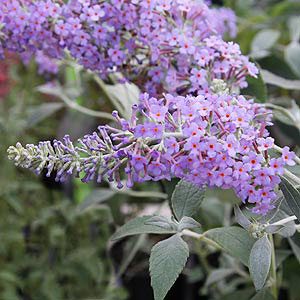
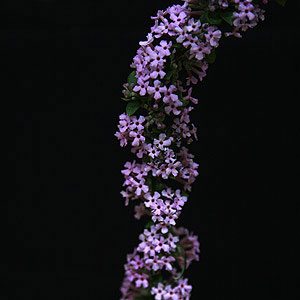
- B. albiflora – An Asian species with graceful form and pale flowers.
- B. alternifolia – A cold-tolerant species with a distinctive weeping habit and arching branches.
- B. Buzz – A compact series, ideal for small gardens, patios, and containers.
- B. caryopteridifolia – A lesser-known Asian species with attractive foliage.
- B. colvilei – Noted for its large, open flowers and good cold tolerance.
- B. crispa – A drought-tolerant species with textured foliage and soft-toned flowers.
- B. davidii – The most widely grown species, with many cultivars available in a range of colours and sizes.
- B. fallowiana – A deciduous species, often grown for its soft foliage; includes white forms such as var. alba.
- B. forrestii – A deciduous species suited to cooler climates.
- B. globosa – One of the earliest cultivated species, known for its distinctive spherical orange flowers.
- B. glomerata – A drought-tolerant African species with yellow flowers and silvery foliage.
- B. lindleyana – A graceful, weeping shrub with fragrant purple flowers.
- B. limitanea – A naturally compact species with pale violet to blue flowers.
- B. loricata – A hardy African shrub with cream, fragrant blooms.
- B. macrostachya – Can grow into a small tree; dwarf selections such as ‘Fanispan’ are available.
- B. myriantha – A small shrub with violet-blue flowers and soft grey-green foliage.
- B. nivea – Known as the woolly butterfly bush, often grown for its foliage.
- B. officinalis – Used in traditional Chinese medicine as well as for ornamental purposes.
- B. salviifolia – Also called Sage Bush or Winter Buddleja, with fragrant pink flowers in winter.
- B. sterniana – A species with pale lavender flowers and silvery foliage.
- B. weyeriana – Hybrid forms (B. davidii × B. globosa) with unique yellow tones.
Buddleja varieties are widely available through specialist nurseries, with many offering both classic species and modern cultivars suited to Australian conditions.
Buddleja varieties are available for sale from the following nurseries

www.planterspatch.com.au

Large variety of Epimediums, Woodland plants and Herbaceous perennials
Mail order or nursery. We do not send to Tasmania or WA
www.cloverhillrareplants.com
Buddleja and Buddleia Explained – Different Spelling however same plant
The genus name Buddleja was introduced by Carl Linnaeus in 1753, likely in honor of the English clergyman and botanist Adam Buddle. Both Buddleja and Buddleia refer to the same group of flowering shrubs (butterfly bushes), but Buddleja is the original and formally accepted spelling. The variation arises from early typographic conventions, when the letters “i” and “j” were often used interchangeably (e.g., “Iesus” for “Jesus” and “Iuliet” for “Juliet”).