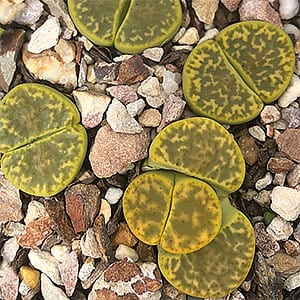
Lithops lesliei is one of the most widely grown and adaptable living stones, making it an excellent choice for both beginners and experienced collectors. Native to southern Africa, this species is especially valued for its reliability in cultivation, wide range of colours, and consistent flowering.

It is often recommended as a starter Lithops, but its many beautiful forms ensure it remains interesting even for advanced growers.
Description & Characteristics
Lithops lesliei forms compact, paired leaves that closely resemble small stones, an adaptation that allows it to blend seamlessly into its rocky native habitat.
Key features:
- Smooth to lightly patterned leaf surfaces
- Colours ranging from grey and brown to pinkish and reddish tones
- Clear or lightly mottled windows on the top surface
- Flowers typically bright yellow, appearing from late summer to autumn
Compared to some species, Lithops lesliei is fairly forgiving, tolerating minor care mistakes better than many of its relatives.
How to Grow Lithops lesliei
Lithops lesliei thrives under the same general conditions as most living stones but is particularly well suited to container culture.
Light
- Requires bright light for at least 5–6 hours per day
- Some direct sun is beneficial
- Avoid strong afternoon sun in very hot climates
Soil
- Must be grown in a very free-draining mix
- Use a cactus or succulent mix with added grit, pumice, or coarse sand
- A mineral-rich soil helps maintain compact growth and good colour
Watering
- Water sparingly during active growth (spring and autumn)
- Keep almost completely dry during summer dormancy and winter
- Always allow the soil to dry fully between waterings
Fertiliser
- Minimal feeding required
- If repotted annually, fertiliser is usually unnecessary
- At most, apply a very light feed once per year
Flowering
Lithops lesliei is a reliable bloomer when grown correctly.
- Flowers emerge from the central fissure between the leaves
- Blooms are usually bright yellow, occasionally pale yellow
- Flowering typically occurs from late summer through autumn
The flowers often appear surprisingly large compared to the plant body.
Propagation
Lithops lesliei can be propagated by:
- Seed – the most common method, producing variable offspring
- Natural division – mature plants may form small clumps over time
Seed-grown plants are especially rewarding, as colour and pattern variation can be significant.
Recommended Varieties & Forms of Lithops lesliei
Lithops lesliei is known for its diversity, with many attractive forms worth featuring.
Popular and collectible forms include:
- L. lesliei var. lesliei
The classic form, typically grey to brown with subtle window markings. - L. lesliei ‘Rubrobrunnea’
Highly sought after for its rich reddish-brown colouring and strong contrast. - L. lesliei ‘Albinica’ / ‘Albiflora’
Pale-bodied forms with lighter windows; very striking in collections. - L. lesliei ‘Storm’s Albinigold’
Known for its lighter body tones and excellent flowering. - L. lesliei ssp. burchellii
Often shows more pronounced patterning and slightly different body shape.
Colour intensity can vary depending on light levels, soil composition, and growing conditions, making each plant subtly unique.
Common Problems & Growing Tips
- Overwatering is the most common issue
- Soft or translucent leaves usually indicate excess moisture
- Stretching or pale colour suggests insufficient light
- Always prioritise drainage and airflow
Lithops lesliei is more tolerant than many species, but it still rewards careful, minimal intervention.
Why Grow Lithops lesliei
- One of the best Lithops for beginners
- Reliable flowering and strong growth
- Wide range of colours and named forms
- Excellent performance in pots and indoor settings
- A cornerstone species for any Lithops collection