
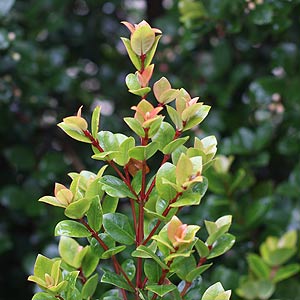
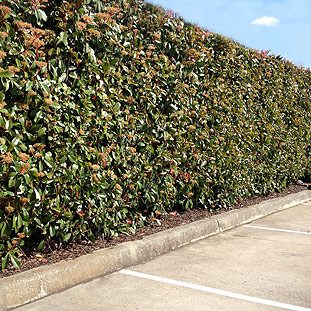
As a hedging plant, the Lilly Pilly is one of the most reliable native choices for creating quick, effective privacy screens. Most forms combine fast growth, naturally dense foliage and good drought tolerance once established, making them ideal for low-maintenance boundary hedges and garden screening.
Lilly Pillies (Syzygium, Waterhousea and Acmena species) clip beautifully, so you can prune confidently without fear of damaging the plant, and they respond well even to hard renovation pruning. Many cultivars also feature flushes of colourful new growth and bird-attracting berries, adding ornamental value as well as function in the garden.
- They are fast growing, you can establish a good screen in a few years.
- Foliage is naturally dense, which means you can block out neighbours and reduce noise.
- Once established they are reasonably drought tolerant. So little to no watering after 2 years.
- They are very easy to prune. You do it yourself with no worries about damaging the plant. They will grow back.
Ongoing Care for Lilly Pilly Hedges
General Care
Lilly Pillies perform best in a sunny to lightly shaded position with well-drained soil and regular moisture during the first couple of years. Once their root systems are established, they become relatively tough and cope with periods of dry weather with minimal additional watering.
Watering
For newly planted hedges, water deeply and consistently for the first 1–2 years, allowing the soil to dry slightly between waterings but never to the point of severe stress. After establishment, most varieties will only need supplementary water during extended dry spells or very hot weather, especially in lighter sandy soils
Soil Amendments & Fertilizer
Prepare the planting area with compost or well-rotted organic matter to improve soil structure and moisture retention, especially in poor or sandy ground. Use a quality native plant fertiliser in spring, always watering well before and after application to prevent root burn and encourage even nutrient uptake.
Pruning & Deadheading
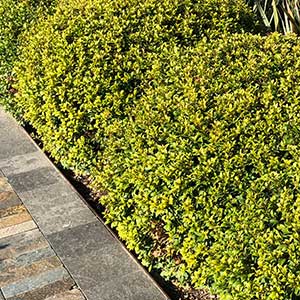
Lilly Pilly hedges are very forgiving and can be trimmed as lightly or as hard as needed to maintain size and shape. A general rule is to give them a main prune once a year in late winter or early spring, just before new growth starts.
As with all hedging plants keeping the hedge slightly narrower at the top allows light can reach the lower foliage and prevent bare patches.
You can use electric or petrol hedge trimmer. or you can use garden shears. It is best to prune with a slight narrowing toward the top of the hedge. The top also needs to be pruned evenly and a string line will assist with this.
If berries are an issue around paths or driveways, a light trim immediately after flowering will reduce fruit set while still keeping the hedge dense and tidy.
It is always advisable to remember to prune the back of the hedge as well, especially if it is against a neighbours fence. This reduces the risk of neighbours needing to prune overhanging foliage, and perhaps indadvertedly damaging the hedge structure.
Overwintering / Cold Protection
Most commonly grown Lilly Pilly species are evergreen and tolerate light frosts once established, particularly robust cultivars such as Waterhousea floribunda and many Syzygium selections.
In colder or exposed sites, young plants benefit from some protection from strong winter winds and heavy frost until they have developed a stronger framework.
Seasonal Care Guide
Spring:
- Feed with a native fertiliser to support new growth.
- Carry out main structural pruning if needed.
- Check for psyllids or other pests as fresh foliage emerges.
Summer:
- Water during hot, dry periods, especially for new hedges.
- Lightly trim to maintain a neat outline and manage berry production.
Autumn:
- Remove any damaged or straggly growth.
- Top up mulch to conserve soil moisture and suppress weeds.
Winter:
- Minimal watering is required once plants are established.
- Inspect for any wind damage and lightly tidy if necessary, keeping major cuts for late winter.
Design Ideas
- Garden styles suited to Lilly Pilly: Excellent in contemporary suburban gardens, native and coastal schemes, and as a structural backbone in traditional mixed borders where evergreen screening is needed.
- Companion plants: Combine with other hardy natives such as Lomandra, Dianella, Grevillea or Westringia, or mix with grasses and flowering perennials to soften the hedge line.
- Colour pairings: The glossy green foliage and coloured new growth pair well with silver or grey-leaved plants, deep burgundy foliage, and bright flowering shrubs.
- Placement ideas: Use as a formal clipped hedge along driveways, as an informal screen along fences, or as feature standards in large containers flanking entrances or patios.
Varieties / Cultivars
Lilly Pilly is a common name used for a group of related plants across the Syzygium, Waterhousea and Acmena genera, with numerous species and named cultivars suited to different hedge sizes and styles.
One very popular variety is Lilly Pilly – ‘Backyard Bliss’ Others Include:
| Cultivar Name / Species | Mature Size (H × W) | Flower / Fruit Colour | Key Differences | Best Garden Use |
| Waterhousea floribunda ‘Whisper’(Weeping Lilly Pilly) | Approx. 8 × 5 m | Creamy-white flowers, small green berries | Graceful weeping habit, dense foliage to ground level, relatively low berry drop | Tall screening hedge, feature tree along boundaries |
| Syzygium australe ‘Bush Christmas’ | Small to medium tree/hedge (often kept 2–4 m) | White flowers, red berries | Compact habit, attractive red new growth, good for clipped hedges | Medium formal or informal hedges, courtyard screening |
| Syzygium australe ‘Aussie Southern’ | Medium to tall hedge (around 4–6 m if unpruned) | Creamy flowers, red berries | Strong grower, glossy foliage, tolerates coastal sites | Boundary screening, tall privacy hedges |
| Syzygium luehmannii ‘Royal Flame’ | 4–6 m (pruned lower if required) | White flowers, pink to red berries | Striking fiery red new growth, sweet-tasting fruit, ornamental foliage | Decorative hedge or small feature tree, edible garden hedging |
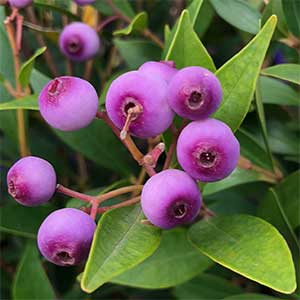
| Acmena smithii (incl. dwarf forms) | 2–6 m depending on cultivar | White flowers, purple berries | Naturally psyllid-resistant, smaller leaves on many forms, good for pots | Container hedging, narrow or low hedges, coastal gardens |
9 Lilly Pilly Hedging Facts
- Spacing – This will depend on variety, however 1 metre is a good indicator for most hedges.
- Growth rate – Medium to Fast depending on soil and climate
- Pruning – One of the great things is that you can prune Lilly Pilly hedges as hard as you want to. Generally it is best to prune once a year, in late winter spring just before new growth commences. However you can prune them right back to the ground and they will reshoot.
- Leaf Size – Some varieties have smaller leaves than others and look better after pruning.
- Root system – Lilly Pilly plants are regarded as having non invasive roots
- Psyllids – Acmena smithii varieties are Psyllid resistant.
- Fruits – Most are edible, some are sweeter than others with S. luehmannii being regarded as the sweetest, so a fruiting hedge.
- Foliage – All have glossy foliage, most have new foliage flushed with red to bronze
- Growing in containers – Acmena smithii is regarded as the best variety for containers.
Planting Distance
This will depend on variety and if you are after an informal screen, or a more formal hedge.
As a guide :
- For a screening plant, try spacings of 2 metres to 2.5 metres apart. You can go to 3 metres if needed.
- For a more formal hedge, space them at around .7 of a metre apart and choose a small leafed variety



Where To Buy

55 McDougal Rd Neerim South Victoria 3831 PH: (03) 56281507
Advanced ornamental trees and garden designs and concept plans. Direct to your property combined with specialist knowledge and outstanding service.
www.blericktreefarm.com.au