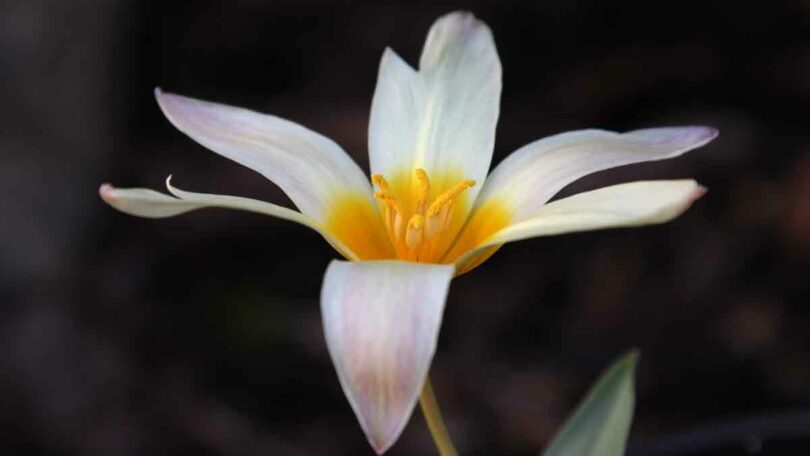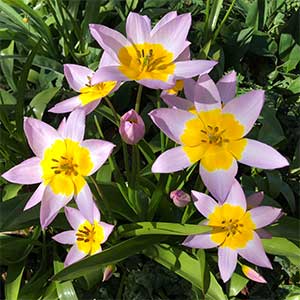

If you are looking for some of the easiest tulips to grow, then Species Tulips are the ones to try. So, what are species tulips? They are the wild species of Tulipa, and closely related forms, rather than the large modern hybrid tulips commonly grown for bedding and cut flowers.
Species tulips are generally smaller growing than modern hybrids, but they are no less colourful and, in our opinion, more elegant. Many are also easier to grow and more likely to return year after year when planted in the right conditions.
You do not usually have to dig them up every year, and many will gradually naturalise and multiply in the garden.
We were first introduced to Species Tulips (Tulipa) by Shirley Tonkin and we now have more of these in the garden than the modern cultivars.
So in our opinion, more elegant and definitely easier to grow, as well as hardier than many of their florist-shop relatives.
In the Australian climate as well as many areas of Southern Europe and USDA hardiness zones 3 through 8 they can be excellent garden plants.
A hot summer is no problem for most species because the bulbs are dormant anyway, and as long as the soil is well drained, you are pretty much on the way to successful growth.
The main thing to remember is that different species have slightly different preferences, so it pays to choose the right species for your garden.
What are Species Tulips?
Species tulips are the smaller, wild-type tulips found naturally across parts of Europe, North Africa, the Middle East and Central Asia. They are the tulips that occur in nature rather than the large, highly bred cultivars commonly grown for bedding and cut flowers.
They tend to have smaller flowers and shorter stems, but this is part of their charm. Many have beautifully marked foliage, star-shaped flowers, unusual colouring and a more natural appearance than modern hybrid tulips.
One of the big advantages is that species tulips are often perennial and can naturalise, meaning they can remain in the ground and gradually increase in number when conditions suit them.
They are particularly useful in rock gardens, gravel gardens, sunny borders and pots, and some species are happy to spread through less formal areas of the garden.

Popular Species Tulip Varieties
Here are some of the stars we grow (and the ones you’ll spot in good bulb catalogues):
- Tulipa aucheriana – Charming star-shaped mauve-pink flowers about 7–8 cm across on low stems. Super elegant and one of the easiest.
- Tulipa hageri (or Hageri Group) – Warm coppery-red or brick-red blooms, often multi-flowered. Reminds us of old Mediterranean tiles.
- Tulipa kaufmanniana – The famous waterlily tulips. Early bloomers that open flat in the sun like waterlilies, with beautiful mottled foliage.
- Tulipa kolpakowskiana – Graceful buttercup-yellow flowers with tapered petals on short stems. A real charmer.
- Tulipa marjolettii – Creamy-yellow petals edged in soft rose-pink. Has a lovely relaxed, old-world feel.
- Tulipa mauritiana – Late-flowering beauty from the French Alps with primrose-yellow blooms often flamed or marked with red.
- Tulipa saxatilis – Lilac-pink flowers (the ‘Lilac Wonder’ selection is popular) that love a hot, well-drained spot.
- Tulipa sylvestris – Fragrant bright yellow flowers with a green stripe on the outside – one of the most natural-looking and scented.
- Tulipa turkestanica – Delicate white star-shaped flowers (up to a dozen per stem) with a fresh fragrance.
- Tulipa whittallii (Whittallii Group of T. orphanidea) – Rich orange-red tones with a bronze base – very striking.
Why Species Tulips Beat Modern Hybrids
These are the wild tulips, or tulips very closely related to wild species, from areas including Central Asia, Turkey, the Middle East and parts of Europe. They are quite different from the large modern hybrid tulips grown for mass displays and cut flowers.
Because they are closer to their wild forms, many species tulips are tougher, more perennial, and happier to naturalise and spread gently in the garden without special treatment.
Modern hybrid tulips often look spectacular for one season then fizzle out unless conditions are right or the bulbs are lifted and replanted. Species tulips? Just plant them and, once established, let them do their thing.
Of course, there are exceptions. Some modern tulips, including certain Kaufmanniana types, can also flower reliably for several years. But if your aim is a tulip that behaves more like a permanent garden bulb, species tulips are well worth considering.
So most hybrids often look spectacular for one season then fizzle out unless you dig them up and baby them. Species tulips? Just plant them and let them do their thing.
How to Grow and Care for Species Tulips
The great thing about species tulips is that they are generally uncomplicated plants. Give them the conditions they prefer and they need surprisingly little attention.
In the garden
Plant in a sunny spot with well-drained, humus-rich soil. They love good drainage, particularly through the summer dormant period, and a little well-rotted compost worked into the soil at planting time is beneficial.
A gravel garden, rock garden or sunny border is ideal for many species tulips.
Not every species has exactly the same requirements, however. Tulipa sylvestris, for example, is happy in part shade and moisture-retentive soil, so it is worth checking the requirements of the particular species you are growing.
In pots or containers
Species tulips are excellent container plants and are particularly useful where you want to appreciate their smaller flowers up close.
- Use a good-quality, free-draining potting mix and make sure the pot has plenty of drainage holes. Same sunny position rules apply.
- Choose pots at least 30 cm deep.
- Plant bulbs pointy-end up, 10–12 cm deep in a free-draining mix.
- Water well after planting, then keep just moist over winter.
- Once shoots appear, move to the sunniest spot you have.
- In warmer states (QLD/NSW north coast), give bulbs 4–6 weeks in the fridge before planting to mimic cold winters.
- They perform brilliantly on balconies and courtyards
Planting tips
- Depth: Around 10–15 cm, or roughly two to three times the height of the bulb.
- Time: Autumn. In much of Australia this is generally April to May, once the soil has cooled.
- Spacing: Around 10–15 cm apart for a natural drift look.
- Position: Full sun is best for most species, although some tolerate or prefer part shade.
- Drainage: Good drainage is important, particularly for species that need a dry summer rest.
Feeding
A light application of a balanced bulb fertiliser or liquid seaweed fertiliser during active growth works well. Keep it light – they’re not heavy feeders.
Avoid overfeeding with high-nitrogen fertilisers, as the aim is healthy bulbs and flowers rather than masses of soft leafy growth.
We do top dress ours with a little aged cow manure every 2 – 3 years.
After flowering
Let the foliage die back naturally (this feeds the bulb for next year). Once it’s yellow and crispy, you can snip it off. No need to dig them up.
Species tulips are often best left undisturbed, where they can gradually multiply.
Aftercare & Propagation
Once the foliage yellows, reduce and eventually stop watering during the summer dormant period if you are growing a species that prefers dry summer conditions.
This dry summer rest is one of the reasons species tulips can work so well in Australian gardens, provided the soil drains freely.
Offsets (small bulbs) can be gently separated when you divide overcrowded clumps and replanted. Keep in mind that small offsets can take several years to reach flowering size, depending on the species and their growing conditions.
Some species also spread by stolons (underground runners), making lovely natural drifts. Tulipa sylvestris is a good example.
Weed around the clumps to prevent root competition and overshadowing.
Dividing Species Tulips
There is no need to divide species tulips simply because a certain number of years has passed. If a clump becomes overcrowded or flowering starts to decline, lift and divide it during the dormant season or in autumn, depending on the species and your climate.
Separate the offsets carefully and replant them at the correct depth.
They really are set-and-forget plants once established – just the kind of low-maintenance spring colour every gardener dreams of.
Design Ideas for Species Tulips Gardens
- Use species tulps in rock gardens, gravel beds, or the front of sunny borders where drainage is sharp.
- They look magical naturalised in drifts under deciduous trees or mixed with early daffodils, muscari, and low native grasses.
- In pots, cluster different varieties on a sunny patio for a long season of colour from early to late spring.
- Because they’re smaller and more delicate, they suit cottage-style or Mediterranean-inspired gardens perfectly
Where To Buy Species Tulips
Species tulips are not always as widely available as the familiar large-flowered hybrid varieties, but specialist bulb nurseries and good bulb catalogues are worth checking.
Look for bulbs sold under their botanical names, such as Tulipa turkestanica, Tulipa sylvestris, Tulipa saxatilis, Tulipa kaufmanniana and Tulipa kolpakowskiana.
Choose firm, healthy bulbs and plant them as soon as practical after purchase. For less common species, availability can be seasonal, so it is worth looking early.

'Sylvan Vale' 375 Olinda Creek Rd, Kalorama, VIC.3766
Including a large range of Rare and unusual bulbs, corms and perennials
www.tonkinsbulbs.com.au

365 Lighthouse Rd Wynyard. TAS 7325
PH 03 6442 2012
email to: [email protected]
www.vdqbulbs.com.au

2 Jacksons Hill Rd, Menzies Creek VIC 3159
Hundreds of different varieties of daffodils as well as other beautiful spring & autumn flowering bulbs for home gardeners. Free colour catalogues available. Tulips, Daffodils,Alliums, Freesias, Iris and many other bulbs.
www.daffodilbulbs.com.au