
Type of Lilies an Overview

Liliums, commonly known as true lilies, are stunning perennial bulbs prized for their elegant blooms and scent. Native to temperate regions of the Northern Hemisphere, these flowers are found in the wild across Asia, North America, and Europe. With over 100 species, the greatest diversity occurs in Asia—particularly in China, Japan, and the Himalayas—home to more than two-thirds of all known species.
- Asian Lilies
- North American Lilies
- European Lilies
- Main Lilium Divisions and Hybrids
- Ideal Growing Conditions and Climate
- Cold-Hardy Liliums
- Heat-Tolerant Liliums
- Soil Preparation and Planting Tips
- Pet Safety: Toxicity of Liliums
- Lilium Plant Profile and Growing Hints
- Liliums – Divisions in Detail
- Where To Buy Liliums
Regional Highlights: Lilium Species
Asian Lilies
Asia’s native Liliums are among the most spectacular and widely cultivated.
Notable species include:
- Tiger Lily (Lilium lancifolium) – Bold orange petals peppered with black spots.
- Goldband Lily (Lilium auratum) – Large white blooms with golden and crimson stripes.
- Regal Lily (Lilium regale) – Graceful white trumpets with pink-yellow throats.
- Coral Lily (Lilium pumilum) – Nodding scarlet-red flowers on slender stems.
- Showy Lily (Lilium speciosum) – Fragrant white-to-pink blooms with deep spotting.
North American Lilies
Native North American species bring vibrant colour and strong architectural form.
Examples include:
- Canada Lily (Lilium canadense) – Elegant yellow-to-orange bells.
- Swamp Lily (Lilium superbum) – Tall spikes with large Turk’s cap flowers.
- Wood Lily (Lilium philadelphicum) – Bright upright orange-red cups.
- Panther Lily (Lilium pardalinum) – Orange-red recurved petals.
- Washington Lily (Lilium washingtonianum) – Sweetly fragrant white-to-pink blooms.
European Lilies
Europe’s native lilies often feature classic “Turk’s cap” blooms and fragrant trumpets.
Common species include:
- Martagon Lily (Lilium martagon) – Purple-pink recurved flowers.
- Madonna Lily (Lilium candidum) – Iconic pure white blooms with fragrance.
- Fire Lily (Lilium bulbiferum) – Vibrant orange upright flowers.
- Pyrenean Lily (Lilium pyrenaicum) – Golden blooms with red spotting.
- Pomponium Lily (Lilium pomponium) – Compact red, recurved petals.
Main Lilium Divisions and Hybrids
Most lilies seen in gardens today are hybrids developed for their enhanced colour, fragrance, and adaptability. The Royal Horticultural Society (RHS) recognises nine major divisions:
- Asiatic Hybrids (Division I) – Early flowerig with vivid colour range and minimal fragrance.
- Martagon Hybrids (Division II) – Small, downward-facing flowers; ideal for shaded, cooler areas.
- American Hybrids (Division IV) – Derived from native North American species; hardy and lightly speckled.
- Longiflorum Hybrids (Division V) – The famous Easter Lily; large, white, and highly fragrant.
- Trumpet & Aurelian Hybrids (Division VI) – Tall, trumpet-shaped blooms with rich scent.
- Oriental Hybrids (Division VII) – Iconic for their massive, ruffled, strongly perfumed blooms.
- Interdivisional Hybrids (Division VIII) – Crosses like LA (Longiflorum × Asiatic) or OA (Oriental × Asiatic)—combining vigor with upward-facing flowers.
- Orienpet (OT) Hybrids (Division VIII) – Between Oriental and Trumpet lilies; robust, tall, and intensely fragrant.
- Species Lilies (Division IX) – True wild lilies in their natural form.
Ideal Growing Conditions and Climate
Lilies prefer sun to partial shade and well-drained, fertile soil. They thrive when their roots are cool and moist but never waterlogged.
For best results:
- Improve clay soils with grit or sand.
- Maintain a neutral to slightly acidic pH.
- Mulch with organic matter to retain moisture and regulate temperature.
Cold-Hardy Liliums
These tolerate frosty winters:
- Siberian Lily (L. pensylvanicum) – Exceptionally hardy and compact.
- L. distichum – Survives sub-arctic winters.
- Martagon Lily (L. martagon) – Reliable in woodland or alpine gardens.
- Asiatic Hybrids – Generally the hardiest for home gardens.
Heat-Tolerant Liliums
These perform well in warm to hot climates like Australia:
- Asiatic Hybrids – Sun-loving, low-maintenance performers.
- Orienpet (OT) Hybrids – Heat-tolerant giants with lasting fragrance.
Soil Preparation and Planting Tips
Good drainage is essential—lilium bulbs rot easily in soggy ground.
Follow these key planting steps:
- Depth: Plant bulbs 8–20 cm deep depending on size.
- Position: Point the growing tip upward.
- Mulch: Apply organic mulch to cool roots and retain moisture.
- After flowering: Allow foliage to die down naturally to replenish nutrients.
Lilies can be propagated through seed, dividing established clumps, or bulb scaling for more plants.
Pet Safety: Toxicity of Liliums
All true lilies (Lilium species) are highly toxic to cats, even in trace amounts—pollen, petals, or water from the vase can cause kidney failure. Dogs can also experience milder symptoms, but should still be kept away.
Always confirm whether a plant is a true lily—many others (like daylilies or peace lilies) belong to different genera and vary in toxicity.
Lilium Plant Profile and Growing Hints
Liliums come in a range of forms Asiatic Hybridss, Oriental Liliums, Perfumed Trumpet Liliums, Lilium Longifolium x Asiatic (LA cross), OrientalLilium x Trumpet, Asiatic species and Species Lilium.
Oriental types have large flowers and are fragrant. Martagon Lilies with their nodding flowers are most attractive. A huge range of flower colors from white through to deep red.
Many liliums are fragrant and flowers can be spotted, or have a brush stroke appearance. Liliums mostly grow from bulbs and are deciduous.
Liliums – Divisions in Detail

Asiatic Hybrids
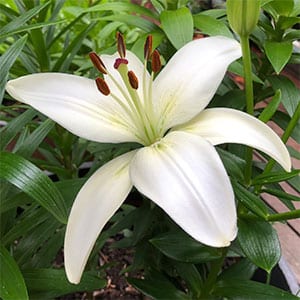
Asiatic Hybrids have a huge color range from white through to deep red, are easy to grow and are the earliest to flower.
The flowers of Asiatic Hybrid Lilies can be pendant, upward facing or downward facing and are in general Asiatic Hybrids are not fragrant.
The most popular asiatic lilies seem to be the yellow and orange varieties, new varieties have spots, speckles and brushmarks.
Martagon Lilies and Martagon Hybrids
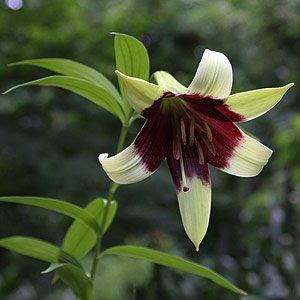
Martagon Lilies are sometimes referred to as ‘Turks Caps’. Downward facing flowers with lots of flowers growing on tall stems.

Martagon Liliies prefer a shaded position and like to be well mulched, leave undisturbed for best results.
Only two species in this group, however many Martagon Hybrids.
• Lilium martagon var. martagon – from Portugal to Mongolia
• Lilium martagon var. pilosiusculum Russia, Kazakhstan, Xinjiang, Mongolia
Candidum Hybrid Lilies
Candidum Hybrids flower in early summer, generally white fragrant flowers also referred to as ‘madonna lilies’. Plant these only10cm deep. Really a beautiful lily.

Longiflorum
Long trumpet shaped flowers, used a lot in floristry, Longiflorum are a little fussy to grow. White is the common form however yellow forms are now available.
Commonly known as the Easter lily, originates from the Ryukyu Islands, an arc of islands stretching from Taiwan to the southern tip of Japan, including Okinawa.
L.longifolium was introduced to Europe in the early 19th century highly valued for its striking white, trumpet-shaped flowers.
Trumpet Lily
Growing up to 2.5m Trumpet Lilies are giants, a wide range of colors from white through to purple.

New shorter growing types of Trumpet Lilies are available, but why not look for the tall ones.
Trumpet Lilies, such as species like Lilium regale, are giants.
Large, trumpet-shaped, and often fragrant flowers in a wide range of colors from white to purple.
Native to regions such as western Sichuan in China, Lilium regale is a key species in this group.
Oriental Hybrids
riental Hybrids (Lilium spp.) are prized for their intense fragrance and large, colorful flowers in shades from pure white to deep purple.

Popular species and varieties include Lilium auratum, Lilium speciosum, and the famous ‘Stargazer’ hybrid—a cross between L. auratum and L. speciosum.
These lilies prefer semi-shade with humus-rich, well-drained soil to keep roots cool.
Orienpets and other hybrids
Orienpets are a cross between Oriental Lilies and Trumpet Lilies. Other crosses between divisions are plentiful. Orienpets are fairly tough and will cope with colder conditions.
American Hybrids
American hybrids are hybrids of liliums native to North America. Interesting ballon like flowers these lilies like a shaded position with humus rich soil and a cool root run




Where To Buy Liliums

365 Lighthouse Rd Wynyard. TAS 7325
PH 03 6442 2012
email to: [email protected]
www.vdqbulbs.com.au

'Sylvan Vale' 375 Olinda Creek Rd, Kalorama, VIC.3766
Including a large range of Rare and unusual bulbs, corms and perennials
www.tonkinsbulbs.com.au

412 James Lane, Fern Hill VIC. 3458 - Phone 0419002651
Large range of Rare plants, Climbers, Bulbs, Perennials Fruit Trees, Ornamental Trees and Shrubs. Available both Retail and by Mail Order
www.whitehousenursery.com.au

357 Monbulk Road SILVAN VIC 3795
Guaranteed "garden worthy" bulbs, plants and perennials. Visit the website to browse our large range of daffodils or request the latest free catalogue.
www.tesselaar.net.au

470 Monbulk-Silvan Road Monbulk VIC 3793
"Guaranteed mail order flowering bulbs, perennials, roses, trees, landscaping plants, garden accessories and community fundraising Austra lia-wide."
www.gardenexpress.com.au

PO Box 7040 Leura NSW 2780
Rare woodland plants, Trilliums Epimediums, Arisaemas, plus much more.www.lynnsrareplants.com.au