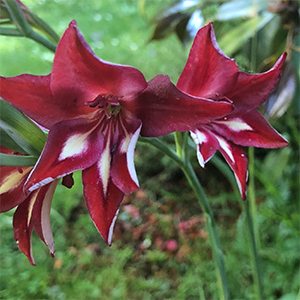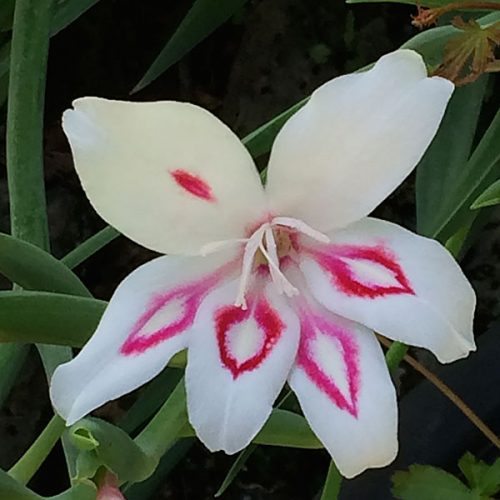
Gladiolus liliaceus, commonly known as the Large Brown Afrikaner, is one of the most curious and charming of the South African Gladiolus species.

Flowers that change Color.
The flowers are large, open and star-shaped with slightly twisted petal tips, giving them a delicate, almost wind-swept appearance. During the day the blooms appear in warm earthy tones—browny-orange, tan, dull pinkish red, cream or yellow—often with subtle markings or streaks.
And they do change color, evening approaches the flowers perform their remarkable transformation, shifting to soft mauve or purple tones. At the same time it releases a rich, sweet clove-like fragrance, an adaptation that attracts night-flying moths which pollinate the blooms.
Flower spikes carry several blossoms and appear from late winter into spring, creating a surprisingly showy display for such a slender plant. The foliage is narrow, grassy and upright, forming neat fans of green leaves that complement the elegant flowers without overwhelming them.
Growing from corms, Gladiolus liliaceus forms a tidy clump reaching about 35–45 cm (14–18 inches) in height and around 30 cm wide. Native to the Cape regions of South Africa, it is a winter-growing species that prefers well-drained soil and a sunny position. Like many South African bulbs it enjoys regular moisture during the growing season but should be kept dry through its summer dormancy.
How To Grow Gladiolus liliaceus – Basic Care
One established this is an easy care plant. It does require a well drained soil, with at least good morning sun.
It is a Gladioli with a strong growth habit, and although the flowers are amazing in colour, it is smaller than modern cultivars, so rarely does this plant require staking.
Position
For best flower colour, plant in full sun, to a little afternoon shade in hotter climate zones.
Soil
Prepare a humus rich well drained soil that will retain moisture.
Fertiliser
In good soil you will need very little e4xtra fertiliser. A top dressing with blood and bone each year in early spring should be enough. In containers use a slow release fertiliser in spring and a liquid fertiliser every 3 weeks in spring.
Where to grow
Plant in the garden near the front of the border for a strong splash of colour in spring.
You can also this spring flowering bulb in containers, bring it to the forefront when it flowers for impact.
Ongoing care
By the time summer gets into full swing it will be dying back, it is summer dormant and therefore drought tolerant. Simply let the foliage die back and then do a quick tidy up. Mulch lightly adding a little compost if you have it, and this lovely plant will bounce back next spring.
Every 3 years dig and dived the corms. Do this in winter or earlier in late summer. Digging and dividing will encourage more vigorous growth and at the same time you should replenish the soil with good well rotted compost and some aged cow manure.
Propagation
Propagation is by division of bulbs or corms during dormancy. Dig and divide after th foliage has died back. Ensure that each corm has a gowth point and a base plate. replant as soon as possible.
More Gladioli Species