
Have ever seen Adventitious roots? Have you noticed strange little roots growing along the stem or trunk of your succulent? Perhaps your Crassula (Jade Plant), Aeonium or Agave attenuata has suddenly developed tiny pink, white or reddish roots above the soil. Are they normal? Is your plant trying to tell you something? And most importantly, should you remove them?
Before reaching for the scissors, take a look at one of nature’s most impressive examples of these unusual roots: the magnificent Curtain Fig.
If any tree deserves the title of king of adventitious roots, it has to be the fig tree! Some fig species produce enormous aerial roots that descend from their branches, reach the ground and gradually thicken into woody, supporting pillars. In the case of the Curtain Fig, these roots can form spectacular, curtain-like structures around the tree. What begins as a tiny root growing from a branch can eventually become part of an extraordinary network supporting a massive tree.

Of course, the little roots appearing along your succulent’s stem are unlikely to grow into anything quite so dramatic! But they belong to the same broad category of roots.
Adventitious roots are roots that develop from a plant’s stems, leaves or other non-root tissues rather than from the original embryonic root, known as the radicle. In succulents, they often appear as fine aerial roots along stems and branches, sometimes becoming more noticeable as the plant matures.
But why do these roots appear? Are they a sign that your plant is thirsty, stressed or unhappy in its pot? Can you safely cut them off, or might they help you propagate a new plant?
Let’s explore why plants develop adventitious roots, which common garden plants produce them, and what you should do when you spot them growing where you least expect them.
Adventitious roots on Garden Plants
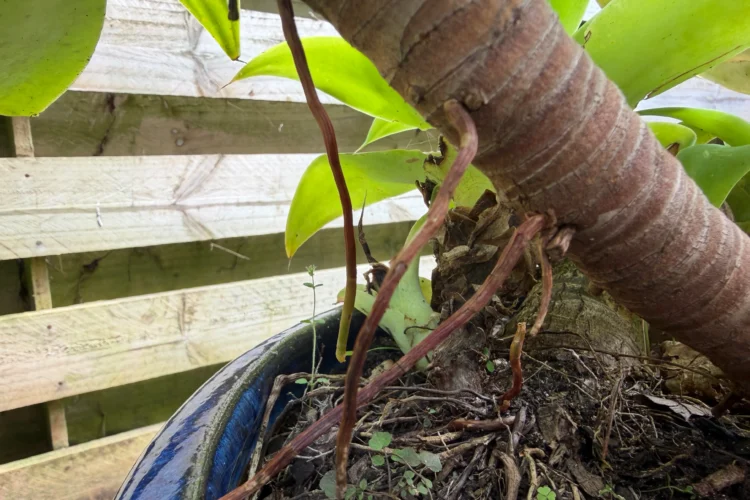
Have you noticed strange little roots growing along the stem or trunk of your succulent? Perhaps your Crassula (Jade Plant), Aeonium or Agave attenuata has suddenly developed tiny pink, white or reddish roots above the soil, leaving you wondering what they are, why they’re growing there, and whether you should remove them.
Don’t panic — these are usually adventitious roots, and they’re often a perfectly natural part of your plant’s growth.
Adventitious roots are roots that develop from a plant’s stems, leaves or other parts rather than from its original root system. In many succulents, they appear as fine aerial roots along stems and branches, sometimes becoming more noticeable as the plant matures.
But why do they appear? Are they a sign that your plant is thirsty, stressed or unhappy in its pot? Can you safely cut them off, or can they help you grow a new plant?
Let’s explore why plants develop adventitious roots, which common garden plants produce them, and what you should do when you spot them growing where you least expect them.
What Are Adventitious Roots?
Adventitious roots are extra roots that grow from a plant’s stems, leaves or other parts rather than from its original root system. They are perfectly natural and are especially common in succulents, including Crassula, Aeonium, Sedum, Kalanchoe and Echeveria.
In succulents, these roots often appear as small, pinkish, white or reddish strands growing along stems or branches. They can help the plant absorb moisture, attach itself to the soil and prepare to grow new roots if a stem breaks off or touches the ground.
What Causes Adventitious roots
- Humidity: Moist air may encourage root growth.
- Water stress: The plant may be responding to difficulty absorbing enough water through its existing roots.
- Limited space: An overcrowded pot or restricted root system may contribute to their development.
- Natural growth: The plant may be preparing to anchor itself if a stem reaches the soil.
- Low light: Some succulents stretch when light is insufficient, and aerial roots may develop along the elongated stems.
Their appearance does not automatically mean something is wrong. Often, they are simply part of the plant’s natural growth and survival strategy.
What should you do?
* Check the soil: Make sure it isn’t staying too wet or becoming excessively dry.
* Check the main roots: If the plant is overcrowded, consider repotting it into fresh, well-draining succulent soil.
* Leave them alone: These roots are usually harmless and can be left as they are.
* Trim them if you prefer: You can carefully remove them with clean scissors.
* Grow a new plant: If the stem has these roots, you can take a cutting and plant it in suitable soil.
Which Other Plants Grow Adventitious Roots?
Adventitious roots are found throughout the plant kingdom, not just in succulents. Tomatoes can develop roots along buried stems, corn produces supporting roots near its base, and climbing plants such as ivy use them to attach themselves to surfaces.
Some plants, including figs, develop large aerial roots that eventually reach the ground and become supporting pillars. These roots can help support enormous branches and can create dramatic, curtain-like structures.
The important thing to remember: Adventitious roots are a natural adaptation that helps plants survive, spread, climb and reproduce. In your succulents, they are usually nothing to worry about and can even be useful when propagating new plants.
Examples of Plants That Grow Adventitious Roots
Adventitious roots are common in many garden plants. They are particularly noticeable in succulents, where they often appear as small roots growing along stems, branches or trunks. Depending on the plant, these roots can help with moisture uptake, anchoring, support and propagation.
Succulents
Crassula — Jade plants and other Crassula species often develop small aerial roots along their stems and branches. These are especially noticeable on older stems or where branches are hanging or touching the soil.
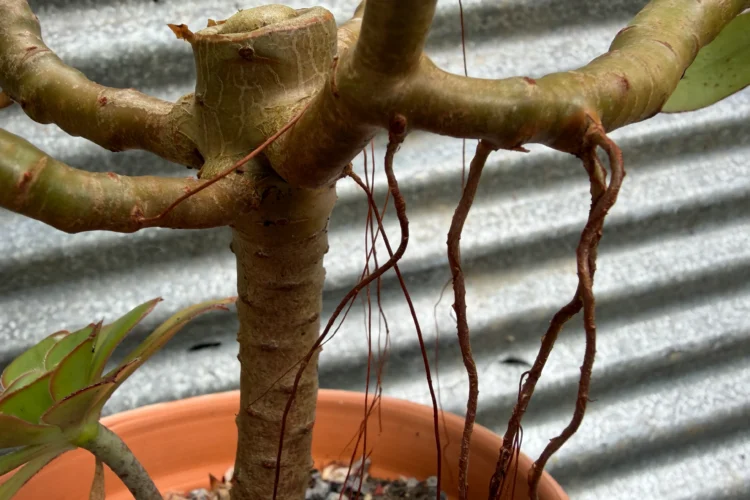
Aeonium — Many Aeoniums develop reddish or brown aerial roots along their stems. These are common on elongated branches and can help the plant establish contact with the soil.
Sedum — Trailing varieties, such as Burro’s Tail, readily develop roots along their stems. When these stems touch the soil, the roots can help the plant spread and establish new growth.
Kalanchoe — Some species develop adventitious roots at stem nodes, while others produce plantlets that can form roots and grow into new plants.
Echeveria — Elongated stems may produce aerial roots, particularly when the plant grows leggy or its lower leaves drop. These roots can help a cutting establish itself when planted.
Graptopetalum and Graptoveria — These rosette-forming succulents can develop roots along exposed stems and from detached rosettes, making them relatively easy to propagate.
Senecio — Trailing succulents, including String of Pearls and String of Bananas, can form roots at stem nodes where they contact suitable growing conditions.
Haworthia and Haworthiopsis — These plants develop fleshy roots from the base of the stem. Although these roots are usually hidden beneath the soil, they are adventitious roots because they do not develop from the original embryonic radicle.
Epiphytic cacti — Christmas Cactus, Easter Cactus and Rhipsalis can produce aerial roots along their stems. These help the plants attach to bark or other surfaces in their natural habitats.
Agaves and Other Architectural Succulents
Agave attenuata (Foxtail Agave) — This agave can develop adventitious roots along its thick, exposed trunk. As the stem grows taller and older, roots may emerge from its surface and help the plant establish contact with soil or other suitable growing conditions. Agave attenuata, roots emerging along the exposed trunk are a useful example of adventitious root development, but the presence of these roots alone does not necessarily indicate water stress or a need to repot.
Agave americana (Century Plant) — Like other agaves, it develops a substantial root system from the base of the stem. Adventitious roots may also emerge from offsets or from stem tissue under suitable conditions.
Agave desmettiana — This popular garden agave produces offsets that can develop their own roots, allowing new plants to establish independently.
Yucca — Many yuccas can produce adventitious roots from stems or underground stems, and some species can be propagated from stem sections.
Aloe — Some aloes develop roots along exposed stems, especially when older stems become elongated or lie against the ground. Offsets also produce their own roots.
Portulacaria afra (Elephant Bush) — Its fleshy stems readily produce roots when cuttings are placed in suitable growing conditions. Branches that touch the soil may also establish roots.
Other Common Garden Plants
Adventitious roots are not limited to succulents. Many familiar garden plants use them to climb, spread or develop stronger root systems.
- Tomatoes — Roots can form along buried stems, helping the plant establish additional points of water and nutrient uptake.
- Basil and mint — Stems can develop roots at nodes when they are placed in water or kept in contact with moist growing media.
- Ivy — Adventitious roots help climbing stems attach to walls, tree trunks and other surfaces.
- Pothos and Monstera — These popular indoor plants produce aerial roots from stem nodes. The roots can attach to supports and, when they reach suitable growing media, develop into soil-anchoring roots.
- Spider Plant — Young plantlets can develop roots as they mature, helping them establish when they touch soil.
- Strawberries — Runners produce new plantlets that develop adventitious roots when they contact the ground.
- Corn (Maize) — Brace roots emerge from lower stem nodes and help support the plant against wind and lodging.
- Figs (Ficus species) — Some figs produce aerial roots that descend from branches or trunks. When they reach the ground, they can thicken and become supporting roots. The Curtain Fig is a striking example.
Why Are Adventitious Roots Useful?
Depending on the plant, these roots can:
- Absorb water and nutrients when they reach suitable soil or another moist growing surface.
- Provide support by anchoring stems or acting as prop roots.
- Help plants climb by attaching to walls, bark or other surfaces.
- Assist propagation by allowing cuttings, offsets or plantlets to establish new root systems.
- Improve survival when stems become damaged, exposed or separated from the original root system.
Top Tip
Remember: Adventitious roots are not necessarily a sign of a problem. In succulents such as Crassula, Aeonium and Agave attenuata, they can be a normal part of growth. However, if they appear alongside wilting, yellowing or soft, mushy tissue, it is worth checking the plant’s growing conditions and existing roots.
Summing Things Up
Adventitious roots are a natural part of how many plants grow. They don’t automatically mean something is wrong. However, if your plant is also wilting, turning yellow or becoming mushy, check its watering and root health.


